


Benefits Of AI In Product Development Explained
AI Across the Product Development Lifecycle.
The benefits of AI in product development are evident in how businesses now build, test, and launch products faster than ever before. Product development used to follow a predictable, often painfully slow rhythm: research for months, design for months more, build a prototype, test it, find out it didn’t quite work, and start the loop again. By the time a product hit the market, the opportunity that inspired it had often changed shape entirely.
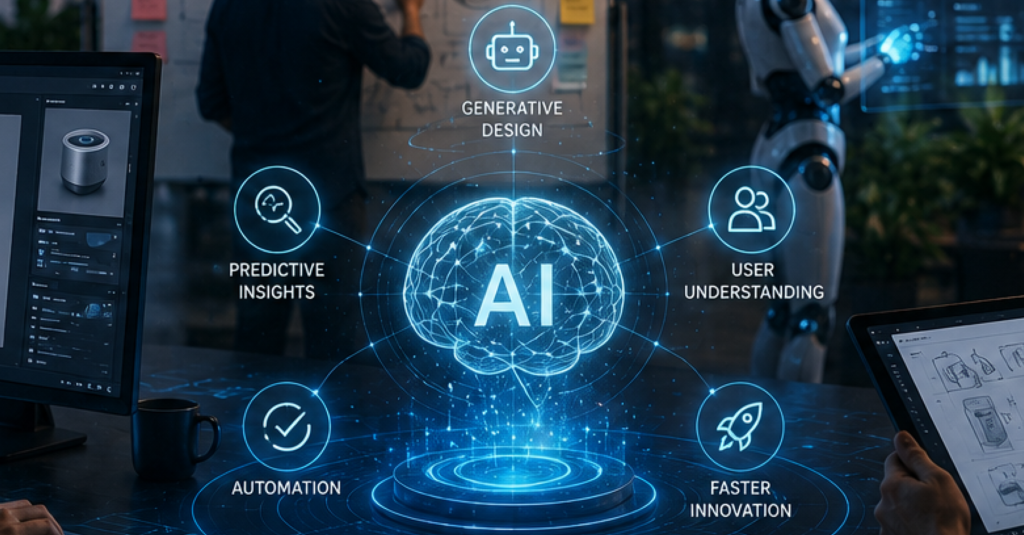
Artificial intelligence has broken that rhythm, in a good way. The benefits of AI in product development lifecycle are visible from the first spark of an idea to the moment a product ships and beyond. AI is now embedded in nearly every stage of development, helping businesses innovate faster while reducing risk and manual effort.
At AI-IoT Geeks, we’ve built AI-powered products across healthcare, fintech, education, legal, and home services, so this isn’t theory for us. It’s what we do for clients every time. If you’re a founder, product manager, or business leader wondering whether AI is worth the investment for your next product, here’s a clear, practical look at the benefits, and the trade-offs, backed by what we’ve actually seen work.
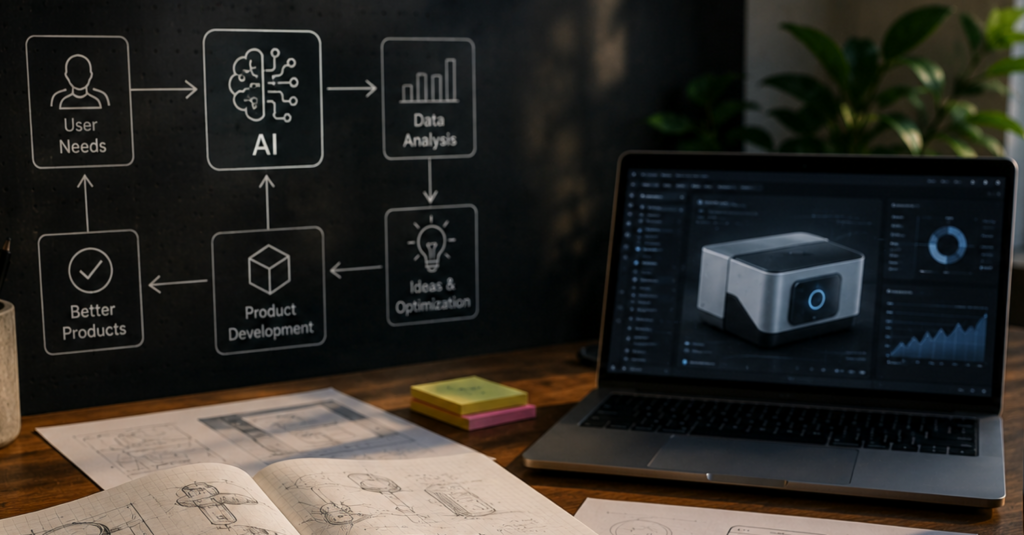
What Does AI in Product Development Actually Mean?
Understanding AI in Product Development.
AI in product development refers to using machine learning, generative AI, predictive analytics, and automation tools across the stages of building a product: research, ideation, design, prototyping, testing, launch, and iteration. Instead of relying purely on manual research and intuition, teams use AI to process data, generate options, simulate outcomes, and flag risks in a fraction of the time it used to take. The benefits of AI in new product development process become evident as AI supports every phase, enabling faster innovation, improved accuracy, and more informed decision making.
This isn’t a future trend. It’s already standard practice at companies ranging from early-stage startups to global enterprises, and it’s the same approach our team at AI-IoT Geeks uses when we take clients from concept to launch through our AI & Machine Learning Development service. The gap between teams using AI well and teams that aren’t is widening fast.
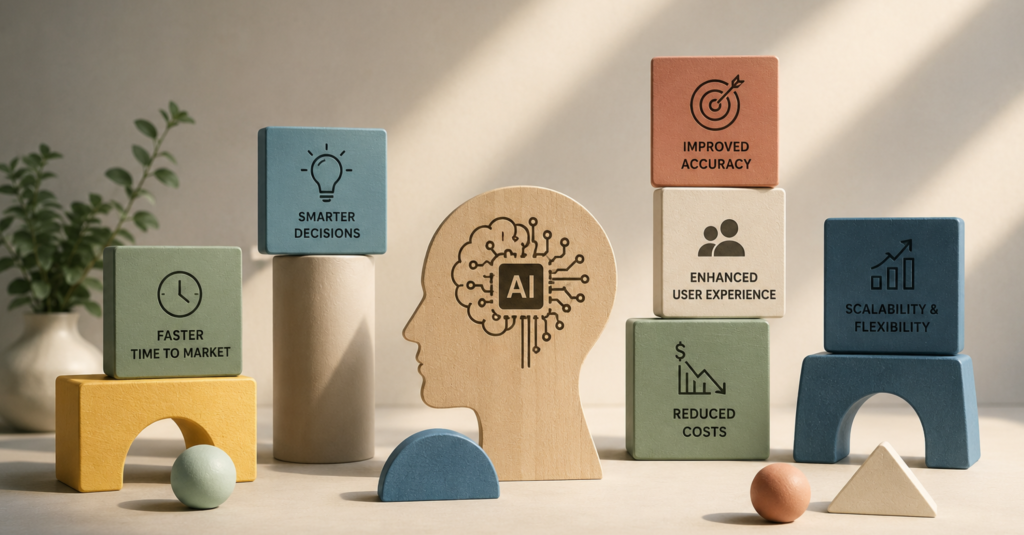
What Are The Top Benefits Of AI In Product Development?
Key Benefits Across the Product Development Lifecycle.
1. Faster Time-To-Market
Speed is probably the single biggest reason companies adopt AI in product development. AI tools compress research, ideation, and prototyping timelines by automating tasks that used to take weeks of a team’s time: sifting through customer feedback, generating design variations, running simulations instead of building physical prototypes. Teams that used to spend months validating a concept can now do it in days, which means products reach customers while the opportunity is still fresh.
This is a big part of how we help startups go from idea to launch-ready MVP in 6 to 8 weeks through our MVP development service. Our Room Services build, a multilingual, on-demand booking platform, is a good example of how quickly a well-scoped, AI-assisted development process can move from concept to a live product.
2. Smarter, Data-Driven Decision-Making
Every product decision, what to build, for whom, at what price, is only as good as the information behind it. AI models can process massive volumes of market data, customer reviews, social sentiment, and usage patterns to surface insights a human team would take weeks to find manually. Instead of guessing what customers want, product teams can see it in the data and make decisions with real evidence behind them.
We built Datalect, an AI-powered reporting and intelligence tool for Aseef IT Holding Company, specifically to turn scattered business data into real-time insights leadership teams could act on.It’s a direct example of our AI & Machine Learning Development work applied to decision-making, not just automation.
3. Higher Product Quality
AI-powered testing and simulation tools can run thousands of scenarios against a design before a single physical unit is built. This means design flaws, usability issues, and performance gaps get caught early, when they’re cheap to fix, rather than after launch, when they’re expensive and damaging to a brand. In software products specifically, AI-driven QA can test far more edge cases than manual testing ever could, catching bugs before customers do.
Quality and structure mattered enormously in our work on the Claimtime legal case management platform, where secure, accurate, well-tested workflows weren’t optional, they were the entire point.Our UI/UX product design process bakes in this kind of rigorous, data-informed testing from day one, the same structured evaluation we walk through in our UX audit guide on the blog.
4. Reduced Development Costs
Every hour saved on manual research, every design flaw caught before manufacturing, every automated QA cycle translates directly into cost savings. AI also helps optimize material usage and resource allocation in physical product development, and reduces the labor cost of repetitive tasks like documentation, compliance checks, and data entry, freeing your team to spend their time on higher-value work.
Clients working with us have seen manual workflows reduced through AI-driven automation, a number we track closely because it’s core to how we prove ROI. Our Odoo ERP implementation service is where we most often deliver this kind of cost efficiency for manufacturing, retail, and services businesses. If you’re weighing whether to bring this in-house or bring in outside expertise, our blog post on working with an Odoo consultant walks through that decision in more detail.
5. Deeper Personalization
AI makes it possible to understand not just your market as a whole, but individual customer segments and preferences within it. That insight can shape everything from feature prioritization to in-product recommendations, resulting in products that feel tailor-made rather than generic, which is a real driver of customer loyalty and retention.
The ASL Platform, a centralized operations management system we developed, was built around this exact principle, giving different user roles a tailored view of the data and workflows relevant to them. It’s the kind of personalization we build into our mobile app development projects as standard practice, not an afterthought, something we go deeper on in our post about mobile-first banking experiences.
6. Access To Better, More Creative Ideas
Generative AI tools are genuinely useful creative partners during ideation. They can generate dozens of concept variations, mockups, or feature ideas based on market data in the time it takes a team to finish one brainstorming session. This doesn’t replace human creativity, it gives teams more raw material to react to, refine, and build on, which tends to produce stronger final concepts.
At AI-IoT Geeks, our design and product teams use AI-assisted ideation as a starting point, not a finish line, on nearly every website development and product engagement we take on. We regularly write about how this plays out in practice on our blog, including our roundup of what makes strong responsive web design worth a browse if you want more detail on our process.
7. Automated, Consistent Workflows
Documentation, compliance monitoring, status reporting, task assignment, the unglamorous but necessary parts of product development, can largely run on autopilot with AI.
That reduces human error, keeps teams aligned automatically, and frees up product managers and engineers to focus on strategic and creative work instead of admin.
8. Continuous Improvement After Launch
AI doesn’t stop being useful once a product ships. Post-launch, AI systems can monitor real-world usage, flag anomalies, and surface emerging customer needs in real time, turning launch from a finish line into the start of a continuous improvement loop. This is a major shift from the old model, where product teams often had to wait for the next big release cycle to act on feedback.
Our Online Learning Platform build for Dhahran Ahliyya Schools has evolved well past its initial launch, with ongoing updates shaped directly by usage data and user feedback, the same continuous-improvement approach we bring to every digital marketing strategies and product engagement.
9. Better Risk Management
Predictive AI models can flag potential technical, financial, or market risks earlier in the process, before a company has committed a significant budget to a direction that isn’t going to work. This kind of early warning system is one of AI’s most underrated benefits: it’s not just about building faster, it’s about building the right thing.
Risk management is baked into our Discovery & Assessment and Strategy & Planning phases before a single line of code gets written, a process we walk every client through on their first free strategy call. It’s how we help clients avoid costly rebuilds later.
10. Scalable Product Development With AI
As product lines grow or demand fluctuates, AI systems can scale analysis, testing, and automation accordingly, without requiring a proportional increase in headcount. This is especially valuable for startups and growing companies that need enterprise-level capabilities without an enterprise-level budget.
11. AI For Sustainable Product Development
AI is also becoming a meaningful sustainability lever in physical product development. Predictive models can flag the likely environmental footprint of a design choice before manufacturing begins, and AI-optimized designs can meaningfully cut the raw material and energy used per unit. Industry research on AI-enhanced industrial automation has pointed to double-digit reductions in both materials used and finished product weight, which flows directly into lower shipping and manufacturing emissions over a product’s life.
For teams under pressure to hit sustainability targets alongside launch deadlines, this is turning into a genuine competitive differentiator, not just a compliance checkbox.
Sustainability trade-offs come up regularly in our Discovery & Assessment phase for manufacturing and operations-heavy clients, particularly through our Odoo ERP Implementation work, where resource and material planning is already central to the system we’re building.
How AI-IoT Geeks Uses AI Across the Product Development Lifecycle?
AI Across Every Stage of Product Development.
At AI-IoT Geeks, we believe AI creates the greatest business impact when it is integrated throughout the entire product development lifecycle rather than applied to isolated tasks. Our team specializes in AI integration in product development, combining machine learning, generative AI, predictive analytics, and intelligent automation to help businesses make data-driven decisions from initial research to post-launch optimization. This end-to-end approach enables faster development, reduced costs, improved product quality, and solutions that continuously evolve based on real user feedback.
Stage | How AI-IoT Geeks Uses AI in Product Development |
Research | Analyzes market data, customer feedback, and trends to identify real opportunities |
Ideation | Generates concept variations, mockups, and feature ideas based on data, not guesswork |
Design & Prototyping | Speeds up CAD and UI/UX iteration; simulates performance before physical builds |
Testing & QA | Runs automated, large-scale testing to catch flaws early and reduce manual QA hours |
Launch | Validates market fit and pricing using predictive models |
Post-Launch | Monitors usage data in real time and flags opportunities for the next iteration |
Sustainability & Compliance | Flags material, energy, and regulatory impact before manufacturing decisions are locked in |
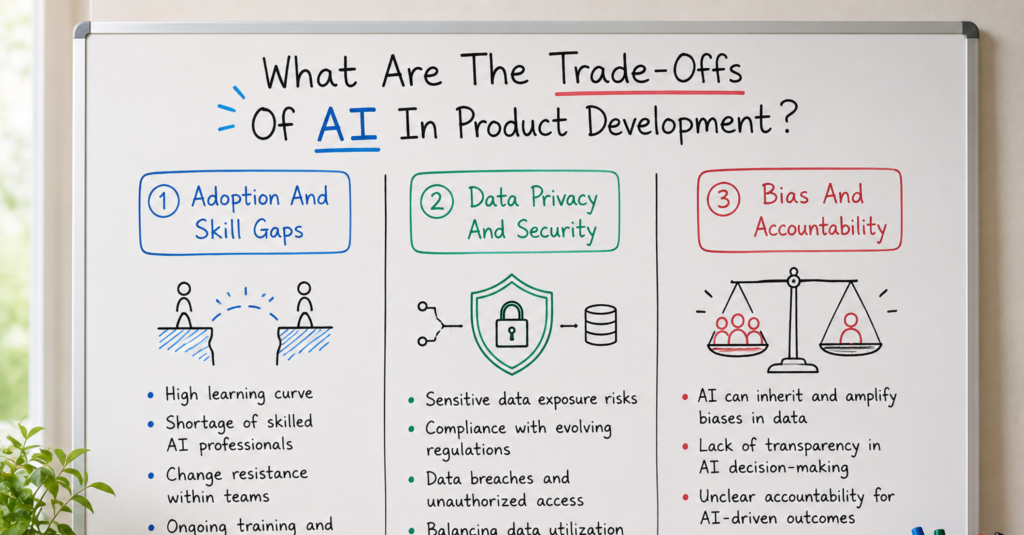
What Are The Trade-Offs Of AI In Product Development?
Responsible AI Adoption Requires Strong Governance.
AI isn’t a plug-and-play upgrade, and any honest look at the topic has to say so. The teams that get the most value from AI in product development are usually the ones who go in with eyes open about where it can go wrong.
1.Adoption And Skill Gaps
Getting a team to actually trust and use AI tools well takes real ramp-up time. Prompting, interpreting model output, and knowing when to override a recommendation are skills, not defaults. Teams that skip training tend to underuse the tools or misapply them.
2.Data Privacy And Security
AI systems that touch customer data, proprietary designs, or unreleased product plans raise real governance questions. Where is that data stored, who can access the model outputs, and does the toolchain meet the compliance standards your industry requires? This matters even more in regulated spaces like healthcare and fintech.
3.Bias And Accountability
AI models can inherit and amplify bias in training data or historical usage patterns, which can quietly skew a product’s design or feature prioritization toward the wrong audience. Someone on the team needs to own the question of what happens when an AI recommendation turns out to be wrong or unfair, before that becomes a live problem in a shipped product.
None of this is a reason to avoid AI in product development. It’s a reason to build governance into the process from day one instead of bolting it on after something goes wrong.
We treat this as part of the job, not an afterthought. Our Discovery & Assessment phase includes a straightforward audit of where AI genuinely adds value on a given project versus where a manual or human-reviewed process is the safer call, especially for clients in healthcare, fintech, and legal, where the cost of getting it wrong is high.
What Is The Future Of AI In Product Development?
1.The Next Wave of AI Driven Innovation.
The future of AI in product development is being shaped by technologies that go beyond automation. Emerging innovations such as agentic AI, low code platforms, and predictive simulations are expanding the benefits of AI in new product development, enabling businesses to bring ideas to market faster while improving product quality and reducing development costs.
2.Agentic AI Will Automate Complete Workflows
Instead of responding to a single prompt, agentic AI can perform multi step tasks such as conducting market research, generating product requirements, creating design concepts, and identifying risks with minimal human intervention.
3.Low Code And No Code Platforms Will Accelerate Development
AI powered platforms enable product managers, designers, and business teams to build prototypes, automate workflows, and validate ideas without extensive coding, reducing dependence on engineering resources.
4.Predictive Simulations Will Improve Product Quality
AI can create digital models, simulate real world scenarios, and identify design or performance issues before physical development begins, helping teams reduce costs and shorten development cycles.
5.Continuous AI Optimization Will Become Standard
AI will monitor user behavior, product performance, and market trends after launch, providing real time recommendations for updates, feature improvements, and future releases.
6.Human Expertise Will Remain Essential
AI can automate analysis and repetitive tasks, but experienced product teams are still needed to define strategy, validate AI generated insights, ensure regulatory compliance, and make critical business decisions.
At AI-IoT Geeks, we’re already incorporating agentic AI workflows into client engagements through our AI & Machine Learning Development services. By combining intelligent automation, predictive analytics, and scalable cloud infrastructure, we help businesses build AI powered products that continue to evolve long after launch.
Conclusion
The benefits of AI in product development go far beyond automating repetitive tasks. AI enables businesses to accelerate research, improve decision making, enhance product quality, reduce development costs, and continuously optimize products after launch. By combining data driven insights with intelligent automation, organizations can develop products that better meet customer needs while responding more quickly to changing market demands.
As AI technologies continue to evolve, businesses that adopt them strategically will be better positioned to innovate, scale efficiently, and maintain a competitive advantage. Success, however, depends on balancing AI capabilities with human expertise, strong governance, and a clear product strategy.
At AI-IoT Geeks, we help businesses unlock the full benefits of AI in product development through end to end AI solutions tailored to their goals. From concept validation and MVP development to deployment and continuous optimization, our team builds AI powered products that deliver measurable business value and long term growth.
If you’re ready to build an AI powered product or explore how AI can accelerate your next project, contact our team to schedule a consultation and discuss your requirements.
Build innovative AI powered products faster with AI-IoT Geeks expert team.
Have any questions in mind
Frequently Asked Questions?
1. What are the benefits of AI in product development?
The benefits of AI in product development include faster product launches, smarter decision making, improved product quality, lower development costs, enhanced personalization, and continuous optimization. AI helps businesses streamline workflows, reduce manual effort, and deliver products that better meet customer needs.
2. How does AI improve the product development lifecycle?
The benefits of AI in product development lifecycle are evident across every stage, from market research and ideation to testing, launch, and post launch optimization. AI enables teams to make data driven decisions, automate repetitive tasks, identify potential risks early, and continuously improve products based on real user insights.
3. Which industries benefit the most from AI in product development?
Industries including healthcare, fintech, manufacturing, retail, education, logistics, legal, and SaaS benefit significantly from AI powered product development. AI helps these businesses improve operational efficiency, reduce costs, accelerate innovation, and deliver better customer experiences.
4. Can AI reduce product development costs?
Yes. AI lowers development costs by automating repetitive tasks, identifying design flaws early, optimizing resource allocation, and reducing the need for multiple prototype iterations. This allows organizations to improve productivity while maximizing return on investment.
5. Why should businesses choose AI-IoT Geeks for AI product development?
AI-IoT Geeks combines industry expertise, AI engineering, and product strategy to build scalable AI powered solutions tailored to business goals. We focus on practical implementation, secure development, continuous optimization, and measurable business outcomes to ensure long term success.
6. How do I get started with AI product development?
The best way to start is by identifying a clear business objective and evaluating where AI can deliver the greatest impact. At AI-IoT Geeks, we begin with a discovery and strategy session to assess your requirements, recommend the right AI technologies, and create a roadmap for successful product development. If you’re ready to start, you can contact our team to discuss your project and explore the best AI solution for your business.