


AI Product Development Process: From Research To Product Launch
Explore the key stages, tools, and benefits of AI product development.
Building a product used to mean months of guesswork: research that took weeks, prototypes built on assumptions, and a launch date decided more by hope than data. That is changing fast.
AI has moved from a “nice to have” experiment into the backbone of how modern teams design, build, test, and ship products. It is not about replacing product managers, designers, or engineers. It is about giving them faster feedback loops, sharper insights, and fewer dead ends. Teams that build this into their workflow are shipping products in weeks that used to take quarters, with far more confidence that those products will actually work in the market. This shift is transforming the AI product development process, enabling businesses to move from idea validation to product launch with greater speed and confidence.
This blog explains AI in the product development process and breaks down the AI product development process from research to launch. You will learn the key stages, tools, benefits, and challenges involved, whether you are building your first MVP or modernizing an existing product.
About this guide: This process reflects how AI-IoT Geeks approaches AI powered product development for clients across healthcare, fintech, retail, and the public sector. Every stage below is drawn from work we have actually delivered, not a theoretical framework.

What Is AI Product Development?
Learn how AI supports every stage of product development.
AI product development refers to the practice of using artificial intelligence, including machine learning models, generative AI, predictive analytics, and intelligent automation, across the stages of building a product, from the first spark of an idea to post launch iteration.
It shows up in two distinct ways:
AI As A Tool In The Process
Using AI to speed up research, generate design variations, write and test code, or analyze user feedback, regardless of what the product itself does.
AI As A Feature Of The Product
Building AI capabilities like recommendation engines, chatbots, forecasting, or personalization directly into what you are shipping to customers.
Most modern product teams use both at once: AI accelerates how the product gets built, and AI capabilities often end up inside the product itself.
Our AI and machine learning team builds both kinds of AI into client engagements: workflow acceleration during development, and production grade AI features such as churn prediction and recommendation engines once the product ships. That dual experience is what shapes the process below.

Why Is AI Reshaping Product Development?
See how AI speeds up research, prototyping, and product delivery.
A few years ago, using AI in product development mostly meant running some data through a spreadsheet model. Today it means language models that can synthesize thousands of customer reviews in minutes, generative design tools that produce dozens of prototype variations from a single brief, and AI agents that write, test, and refine code with minimal human intervention.
The shift matters because the constraints that used to slow teams down, including limited research bandwidth, slow prototyping cycles, and manual QA, are no longer fixed costs. Teams that adopt AI driven product development workflows consistently report shorter development cycles, fewer late stage surprises, and products that are more closely aligned with what users actually want, simply because they can test more ideas against real data before committing engineering time.
AI-IoT Geeks has seen this shift firsthand. Clients who once needed six to eight weeks just to validate an MVP concept now move through research and prototyping in a fraction of that time, because AI assisted research and generative prototyping compress work that used to be entirely manual.
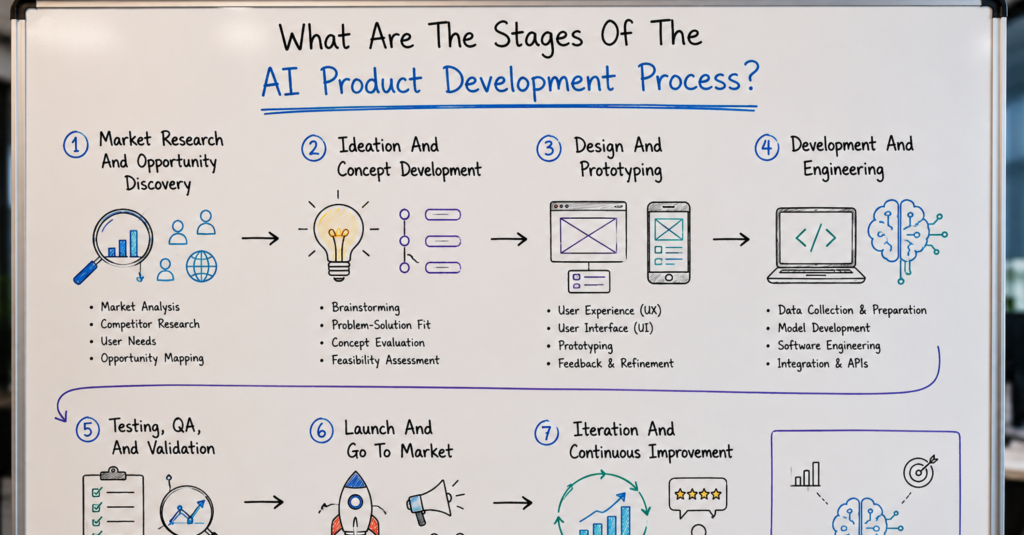
What Are The Stages Of The AI Product Development Process?
Key Stages Of The AI Product Development Process.
The following AI product development lifecycle stages explain process steps show how artificial intelligence supports every phase of a typical product development lifecycle, from market research and ideation to design, development, testing, launch, and continuous improvement.
1. Market Research And Opportunity Discovery
Every product starts with a question: does anyone actually need this? AI tools now do the heavy lifting here. Natural language processing models can scan social media conversations, app store reviews, support tickets, and competitor content to surface patterns a human researcher might take weeks to find manually. This stage demonstrates one of the most valuable uses of AI in product development, enabling teams to identify market opportunities, uncover customer pain points, and validate ideas using real data rather than assumptions.
Instead of running a handful of surveys and hoping they are representative, teams use AI to:
- Cluster thousands of pieces of customer feedback into themes.
- Track sentiment shifts around competitor products in near real time.
- Flag emerging pain points before they show up in formal research.
- Model demand for a proposed feature using historical and market data.
The output is not a final answer. It is a much stronger starting hypothesis, built on data instead of intuition.
On engagements across retail and financial services, our team pairs AI driven sentiment analysis with direct customer interviews. AI surfaces the patterns quickly, but our researchers still validate them with real conversations before a single feature gets prioritized. That combination of automation and human judgment is central to how we work.
2. Ideation And Concept Development
Once you know the problem worth solving, AI helps widen the net of possible solutions. Generative AI tools can produce dozens of concept directions, feature combinations, or positioning angles from a single prompt, giving product and design teams more raw material to react to and refine.
This phase typically includes:
- Brainstorming feature sets and product concepts with generative AI as a creative partner.
- Generating early mockups or wireframes to visualize ideas quickly.
- Scoring concepts against feasibility, cost, and market fit criteria.
- Running lightweight concept tests with AI simulated or real user panels.
The goal is volume and speed: get more ideas on the table faster, so the strongest ones rise to the top sooner. A structured AI product development process helps teams evaluate these ideas before committing development resources.
Our product strategists use generative AI to widen the funnel early, then apply the same feasibility and ROI scoring criteria we have refined across client projects to narrow it back down. Speed only helps if it leads to better decisions, not just more options.
3. Design And Prototyping
AI assisted design tools have transformed this stage from a slow, linear process into an iterative one. Designers can generate multiple UI variations, test layouts against usability heuristics, and get AI assisted feedback on accessibility and user flow before a single line of production code is written.
Key applications include:
- AI enhanced UI/UX tools that suggest layout, color, and interaction improvements.
- Generative design systems that produce prototype variations for A/B comparison.
- Predictive usability testing that flags likely friction points using behavioral models.
- Rapid mockup to prototype conversion, reducing design to development handoff time.
This stage of the AI product development process reduces design risks and speeds up collaboration between designers and developers. This is where our UI/UX design team does its deepest work. We use predictive UX modeling and heatmap analysis on every engagement, not as an add on service, but as the default way we validate design decisions before development starts. It is a core part of our design process, built on years of client deliveries. If you’re evaluating an existing product rather than starting fresh, our UX audit guide walks through how we assess usability before recommending changes.
4. Development And Engineering
This is where AI has arguably made the biggest visible impact. AI coding assistants now handle a meaningful share of boilerplate code, suggest architecture patterns, catch bugs before code review, and even generate test cases automatically.
In practice, teams use AI to:
- Accelerate code generation for repetitive or well defined components.
- Automate code review and flag security or performance issues early.
- Generate unit and integration tests alongside new features.
- Assist with documentation, so engineering knowledge does not stay locked in one person’s head.
This does not eliminate the need for skilled engineers. Within the AI product development process, AI-assisted engineering improves development speed while maintaining software quality. If anything, it raises the bar, since teams can now tackle more ambitious builds in the same timeframe. It does mean fewer hours spent on repetitive scaffolding and more time spent on architecture and logic that actually differentiates the product.
Our engineering teams use AI coding tools daily across website and mobile app builds, but every AI generated component still goes through the same senior level code review standard we have applied since before these tools existed. Experience is what tells you when to trust the output and when to rewrite it.
5. Testing, QA, And Validation
Manual QA does not scale well against modern release cycles. AI driven testing tools can run thousands of test permutations, simulate diverse user behaviors, and catch edge cases that a human tester would likely miss simply due to time constraints.
This stage typically covers:
- Automated regression and functional testing at scale.
- AI generated test cases based on usage patterns and past defects.
- Predictive quality scoring before a build goes to staging.
- Performance and load testing simulations under varied conditions.
The result is a product that has been stress tested against far more scenarios than a manual QA cycle could realistically cover, before it ever reaches a real user. Testing is one of the most important stages of the AI product development process, ensuring products meet quality and performance expectations before release.
We have integrated AI driven testing into our QA process across multiple industries, including healthcare products with strict compliance requirements. AI expands test coverage, but our QA leads still own final sign off, especially where data privacy and regulatory accuracy are non negotiable. For a broader look at how testing fits into avoiding costly failures, see our guide to risk management in software development.
6. Launch And Go To Market
AI’s role does not stop at the build. During launch, AI tools help fine tune pricing, personalize onboarding flows, and predict how different customer segments will respond to a rollout, informing everything from messaging to feature flagging strategies.
Common applications include:
- Predictive analytics for pricing and market fit validation.
- AI driven audience targeting for launch campaigns.
- Personalized onboarding sequences based on user behavior signals.
- Real time monitoring dashboards that flag adoption issues early.
An effective AI product development process continues through launch by using AI insights to improve adoption and customer engagement. This can include solutions such as AI chatbot app development to support personalized customer interactions and automated assistance. Because our team also runs digital marketing and AI powered audience targeting, we treat launch as a continuation of product development, not a handoff to a separate team. That connected approach shortens the gap between shipped and adopted.
7. Iteration And Continuous Improvement
Product development does not end at launch. Arguably, this is where AI delivers the most compounding value. Once real usage data starts flowing in, AI models can detect anomalies, surface emerging feature requests, and highlight which parts of the product are underperforming, long before those issues show up as churn.
Ongoing activities include:
- Monitoring real time usage and engagement metrics
- Detecting anomalies or drop off points in the user journey
- Prioritizing the product roadmap based on data backed impact scoring
- Continuously retraining any AI features embedded in the product itself
This creates a feedback loop where each release is measurably better informed than the last. Continuous learning is what makes the AI product development process more effective with every product release.
Post launch support is not an afterthought in how we work. We have ongoing engagements where we retrain client-facing AI models on a regular cadence and use the resulting data to reprioritize the roadmap every quarter. Long term product health depends on that discipline.

What Are The Key Benefits Of An AI Driven Product Development Process?
Key Benefits Of AI Driven Product Development.
The benefits of AI in new product development process extend across the entire product lifecycle. From faster research and smarter design decisions to automated testing and continuous optimization, AI helps teams deliver higher quality products with greater efficiency. Organizations following a structured AI product development process consistently achieve faster delivery and better product outcomes.
1.Faster Time To Market
Automating research synthesis, prototyping, and testing removes the slowest bottlenecks in a traditional development cycle.
2.Better Product Market Fit
Decisions are grounded in real data patterns rather than assumptions, reducing the risk of building something nobody wants. Our product strategists validate AI generated insights with user research and business objectives, ensuring every feature addresses real customer needs.
3.Lower Development costs
Fewer manual, repetitive tasks mean engineering and design time gets spent on higher value work.
4.Higher Quality At Launch
AI driven testing catches more edge cases than manual QA alone, reducing costly post launch fixes.
5.Continuous, Data Backed Iteration
Products keep improving based on real usage signals instead of periodic guesswork. AI-IoT Geeks provides ongoing monitoring, model optimization, and product enhancements, helping clients continuously improve performance as user needs and business requirements evolve.
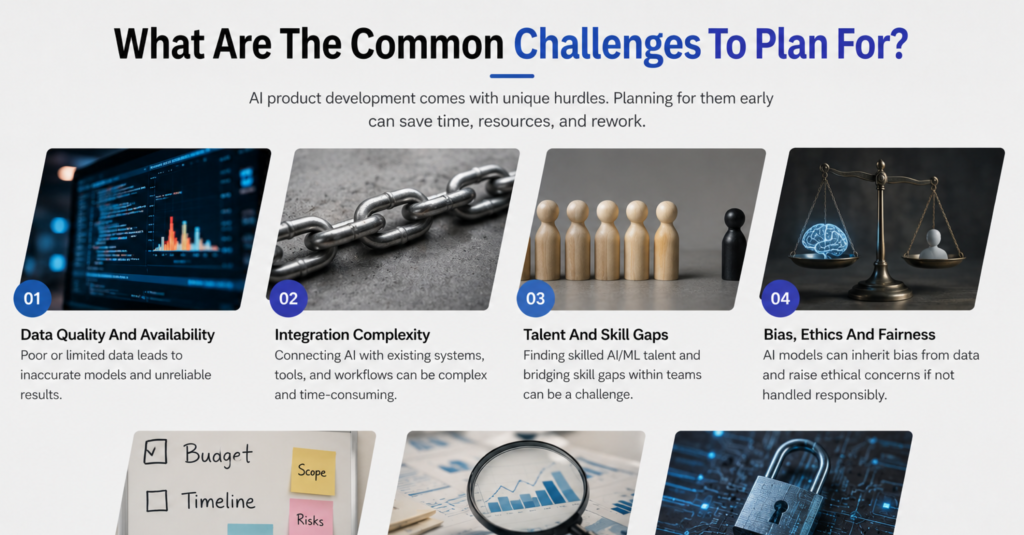
What Are The Common Challenges To Plan For?
Key Challenges To Consider Before Adopting AI.
AI product development is not a plug and play upgrade. Teams typically run into a few recurring obstacles:
1.Data Quality And Readiness
AI tools are only as good as the data feeding them. Messy, incomplete, or siloed data undermines every downstream benefit. Inconsistent data formats, duplicate records, and outdated information can reduce model accuracy and lead to unreliable outcomes. Establishing strong data governance and cleaning existing datasets should be one of the first steps before implementing AI.
2.Talent And Skill Gaps
Teams need people who understand both the product domain and how to responsibly apply AI tools within it. Many organizations also need to upskill existing employees so they can effectively work with AI systems and interpret AI generated insights. Cross functional collaboration between product, engineering, and business teams is essential for successful adoption.
3.Tool Sprawl
It is easy to end up with a patchwork of disconnected AI point solutions instead of an integrated workflow. Using too many standalone tools often creates data silos, inconsistent outputs, and additional maintenance costs. Choosing scalable platforms that integrate with existing systems helps avoid unnecessary complexity as AI adoption grows.
4.Governance And Compliance
Especially in regulated industries like healthcare or finance, AI use needs clear guardrails around data privacy and bias. Organizations should establish policies for data security, model transparency, and human oversight to reduce compliance risks. Regular monitoring and audits also help ensure AI systems continue to meet regulatory and ethical standards.
5.Change Resistance
Introducing AI into established workflows often requires as much change management as it does technology implementation. Employees may hesitate to trust AI recommendations or worry about changes to their roles. Clear communication, practical training, and involving teams early in the adoption process can significantly improve acceptance.
None of these are reasons to avoid AI driven development. They are simply the reason a clear strategy and the right implementation partner matter more than the tools themselves.
Data readiness is the single biggest blocker we see in first conversations with new clients. Before we recommend any AI tooling, our team runs a data and infrastructure assessment, because we have learned from experience that skipping this step is the most common reason AI initiatives stall.

Which Tools Are Commonly Used Across The AI Product Development Process?
Common AI Tools Used In Product Development.
Choosing the best AI solutions for product development process depends on your business goals, existing technology stack, data maturity, and product complexity. While the right stack varies by organization, most AI driven product teams draw from a similar toolkit.
1.Research And Insights
Google Cloud Natural Language, Brandwatch, Sprinklr, Talkwalker.
2.Design
Figma AI, Uizard, Galileo AI, Adobe Firefly.
3.Development
GitHub Copilot, Cursor, Amazon Q Developer, Tabnine.
4.Data Infrastructure
Pinecone, Weaviate, ChromaDB, LangChain.
5.Testing
Testim, Applitools, Mabl, Diffblue Cover.
6.Analytics
Microsoft Power BI, Tableau AI, Google Looker, Mixpanel.
The tools matter less than how well they are integrated into a single, coherent workflow, which is usually where in-house teams without dedicated AI/ML expertise start to struggle.
Our AI and machine learning team selects the stack based on the client’s existing infrastructure and data maturity, not a fixed vendor list, which is why our recommendations differ significantly from one engagement to the next, see our roundup of top AI product development companies in the USA.
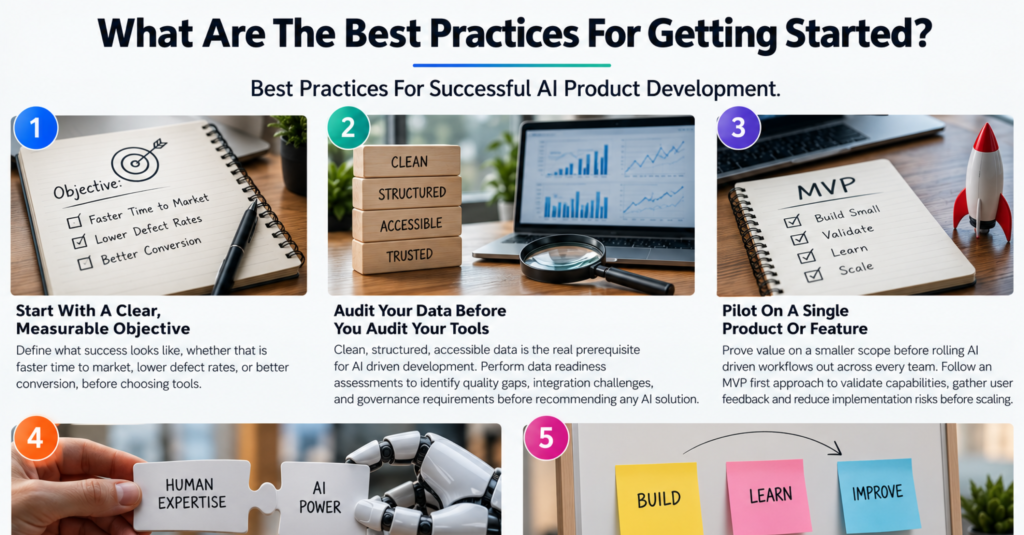
What Are AI Product Development Process Best Practices?
Best Practices For Successful AI Product Development.
1.Start With A Clear, Measurable Objective
A successful AI product development process begins with defining what success looks like, whether that is faster time to market, lower defect rates, or better conversion, before choosing tools.
2.Audit Your Data Before You Audit Your Tools
Clean, structured, accessible data is the real prerequisite for AI driven development. Our AI and data engineering specialists perform data readiness assessments to identify quality gaps, integration challenges, and governance requirements before recommending any AI solution.
3.Pilot On A Single Product Or Feature
An AI product development process should prove value on a smaller scope before AI driven workflows are rolled out across every team. AI-IoT Geeks follows an MVP first approach, allowing businesses to validate AI capabilities, gather user feedback, and reduce implementation risks before scaling.
4.Keep Humans In The Loop
A successful AI product development process accelerates decisions with AI, but it should not replace the judgment of experienced product owners, designers, and engineers.
5.Build For Iteration, Not Perfection
The biggest advantage of AI driven development is how fast you can learn and adjust. Design your process to take advantage of that. Design your AI product development process to support continuous improvement instead of aiming for perfection from the start.
How Did AI-IoT Geeks Build The Datalect AI Reporting Platform?
A Real World AI Product Development Case Study.
Goal
Build an AI powered reporting platform that transforms fragmented business data into real time insights, enabling leadership teams to make faster, data driven decisions.
Challenges
Business data was spread across multiple systems, making reporting slow, inconsistent, and heavily dependent on manual processes. Decision makers lacked a centralized view of operational performance and key business metrics.
Objectives
- Centralize data from multiple business systems.
- Automate reporting through AI powered analytics.
- Deliver real time dashboards for faster decision making.
- Build a scalable platform that supports future business growth.
Solution
Following a structured AI product development process, our team began with discovery and data assessment to identify reporting gaps and business requirements. We then designed and developed Datalect with AI powered analytics, automated reporting workflows, and interactive dashboards that transformed complex data into actionable insights.
Results
- Reduced manual reporting effort through automation.
- Faster access to real time business insights.
- Improved decision making with centralized dashboards.
- Built a scalable AI powered reporting platform.
Conclusion
The AI product development process is not a single tool or a one time upgrade. It is a shift in how research, design, engineering, and go to market work together. A well-defined AI product development process helps businesses innovate faster while reducing development risks and improving long-term product performance.Teams that treat AI as an integrated part of the entire lifecycle, rather than a bolt on feature, are the ones seeing real reductions in time to market and real improvements in product quality.
If you are exploring how to bring AI into your product development process, whether that is AI enhanced UI/UX design, custom machine learning models, or full stack web and mobile development built with AI at the core, AI-IoT Geeks can help you build a roadmap that fits your product, your data, and your team.
Book a free strategy call to talk through where AI can have the biggest impact on your next product.
Start building smarter products with AI-IoT Geeks through a free strategy consultation.
Have any questions in mind
Frequently Asked Questions?
1. How is AI used in product development?
AI in the product development process helps businesses analyze customer feedback, generate product ideas, create prototypes, assist developers with coding, automate testing, personalize user experiences, and monitor product performance after launch.
2. Which industries benefit most from AI product development?
The AI product development process benefits industries such as healthcare, finance, retail, manufacturing, SaaS, logistics, and the public sector by improving efficiency, decision making, and customer experiences.
3. What are the biggest benefits of AI product development?
A well-implemented AI product development process helps businesses accelerate product development, improve product market fit, reduce repetitive work, enhance product quality, and continuously optimize products using real user data.
4. What challenges should businesses consider before adopting AI?
Common challenges in the AI product development process include poor data quality, skill shortages, disconnected AI tools, compliance requirements, and organizational resistance to change. Addressing these early improves project success.
5. Which AI tools are commonly used in product development?
Popular tools used throughout the AI product development process include Figma AI and Uizard for design, GitHub Copilot and Cursor for development, Pinecone and LangChain for AI infrastructure, Testim for testing, and Microsoft Power BI for analytics.
6. What should I prepare before starting an AI product development project?
Before beginning the AI product development process,start with clear business goals, high quality data, defined success metrics, stakeholder alignment, and a roadmap for validating ideas through an MVP before scaling.
7. Why choose AI-IoT Geeks for AI product development?
AI-IoT Geeks delivers a structured AI product development process by combining combines AI strategy, product design, machine learning, software engineering, and post launch optimization to build scalable AI solutions tailored to each client’s business goals, existing infrastructure, and long term growth