


How To Hire An Odoo Developer : A Practical Guide
Learn how to choose the right Odoo expert to build a scalable, efficient ERP solution.
Your business runs on processes (purchasing, inventory, sales, accounting, HR) and at some point, a spreadsheet just does not cut it anymore. Odoo, the world’s most widely used open-source ERP platform, promises to unify all of that under one roof. But here’s the catch: getting Odoo to work for your business, not against it, almost always requires a skilled developer who can customize, configure, and extend it to fit your exact workflows.That’s why thousands of businesses every year search for how to hire Odoo developer and get overwhelmed by the vast number of options, varying price ranges, and conflicting advice.
At AI-IoT Geeks, we help businesses implement, customize, and optimize ERP solutions that support growth and operational efficiency. Through our experience delivering software development, business automation, and ERP implementation services, we’ve seen how the success of an Odoo project often depends on the quality of development expertise behind it. Understanding what makes a skilled Odoo developer is essential for building a scalable and reliable ERP system.
This guide cuts through the noise. Whether you’re a startup implementing Odoo for the first time or an enterprise looking to migrate from an older version, you’ll learn exactly what to look for, where to find the right talent, what it should cost, and how to avoid the most common hiring mistakes.

What Does An Odoo Developer Actually Do?
Understanding the responsibilities behind successful Odoo projects.
Before you post a job or reach out to an agency, it helps to understand what you’re actually hiring for. An Odoo developer’s responsibilities typically fall into these categories:
Custom Module Development
Building new features that don’t exist in standard Odoo, such as industry-specific workflows, unique pricing rules, or custom reporting dashboards.
Odoo Customization
Modifying existing Odoo modules (Sales, Purchase, Inventory, Accounting, HR, etc.) to match your business logic without breaking core functionality.
Third-Party Integration
Connecting Odoo with external systems like payment gateways, e-commerce platforms (Shopify, WooCommerce), shipping providers, or custom APIs.
Odoo Migration
Upgrading your Odoo instance from an older version (e.g., v14 or v15) to Odoo 17, preserving your data and custom code in the process. This is essentially a form of legacy modernization, our blog covers the different approaches to legacy system modernization if you want to understand the trade-offs before committing to a migration path.
Implementation And Configuration
Setting up Odoo from scratch, configuring apps, importing master data, and deploying to a production environment.
Performance Optimization
Identifying bottlenecks, optimizing database queries, and improving system speed for large data sets.
Odoo eCommerce Development
Building or customizing Odoo’s built-in website builder and eCommerce module.
A senior developer may handle all of the above. A specialist might focus on just one area, such as accounting module customization or eCommerce integration. Knowing what you need is the first step.
At AI-IoT Geeks, we understand that every Odoo project has unique technical and operational requirements. Whether the focus is implementation, customization, migration, or integration, having the right expertise ensures the platform is configured to deliver maximum business value while remaining scalable and maintainable as requirements evolve.

What Are The Key Skills To Look For When You Hire Odoo Developer?
Essential technical and business skills to evaluate carefully.
Not all developers who claim Odoo expertise are equal, especially when businesses want to hire best Odoo developer talent for critical ERP projects. Here’s a practical checklist of technical and functional skills to evaluate:
At AI-IoT Geeks, our team delivers Odoo ERP implementation, custom module development, third-party integrations, and business process automation solutions for organizations across multiple industries. Working on ERP deployments alongside software development, AI solutions, and digital transformation projects has given us practical experience in evaluating the technical and functional skills required for successful Odoo development.
1. Technical Skills
Python Proficiency
Odoo’s backend is built entirely in Python. Strong Python skills are non-negotiable.
XML/QWeb Templating
Used for reports, views, and Odoo’s frontend rendering.
JavaScript/OWL Framework
Odoo 16+ uses OWL (Odoo Web Library) for frontend components. Essential for UI customizations.
PostgreSQL
Odoo runs on Postgres, the developer should be comfortable writing efficient queries and understanding the ORM.
Git Version Control
A professional developer will always manage code in version control.
Linux/Ubuntu Server Administration
Most Odoo deployments run on Linux. Comfort with the command line matters.
Odoo ORM And Framework knowledge
Understanding of models, views, security rules, workflows, and wizards in Odoo’s architecture.
2. Functional And Domain Knowledge
- Familiarity with the Odoo modules relevant to your business (e.g., Manufacturing, Accounting, Payroll, Point of Sale).
- Understanding of standard ERP concepts including chart of accounts, BOM, stock valuation methods, etc.
- Experience with Odoo Community vs. Enterprise editions and their differences.
As an ERP implementation and technology solutions provider, we work with businesses that require Odoo to support operations such as inventory management, accounting, procurement, customer management, and workflow automation. This experience highlights the importance of selecting developers who understand both Odoo’s technical framework and the operational processes the platform is designed to manage.
3. Soft Skills
- Clear communication (especially important for remote hires).
- Ability to translate business requirements into technical specifications.
- A track record of on-time delivery.

How Important Are Odoo Developer Certifications?
Key factors that influence overall hiring investment.
The cost of hiring an Odoo developer depends on several factors, including their experience level, geographic location, technical expertise, and the engagement model you choose. Developers with advanced Odoo customization, integration, and ERP implementation experience typically command higher rates than junior or mid-level professionals.
When you hire an Odoo developer, you have several engagement models to choose from. Each comes with trade-offs. As a provider of Odoo implementation, customization, integration, and support services, AI-IoT Geeks understands that the choice of hiring model can significantly impact project costs, resource allocation, and long-term ERP success.
Other factors that influence the overall cost include:
- Project complexity and scope
- Number of custom modules required
- Third-party integrations
- Migration requirements
- Ongoing maintenance and support needs
- Whether you hire a freelancer, dedicated developer, or agency
While it may be tempting to focus solely on cost, the lowest-priced option is not always the most cost-effective.Businesses that hire most experienced Odoo developer professionals like AI-IoT Geeks, often benefit because experienced Odoo developers deliver higher-quality code, complete tasks more efficiently, minimize technical debt, and reduce the likelihood of costly issues later.

Which Hiring Model Is Right For You?
Compare hiring options based on business needs.
When you hire an Odoo developer, you have several engagement models to choose from. Each comes with trade-offs.
1. Full-Time In-House Developer
Best for: Large enterprises with ongoing, complex Odoo needs.
You hire a developer as a permanent employee. They’re fully dedicated to your project, deeply familiar with your systems, and available for day-to-day support. The downside is cost (salary, benefits, HR overhead) and the difficulty of finding strong Odoo talent in your local market.
2. Dedicated Remote Developer (Offshore/Nearshore)
Best for: Growing businesses that need full-time support without the cost of a local hire.
You hire a developer through an agency or directly, and they work exclusively on your projects but remotely. Countries like India, Ukraine, and Eastern Europe have deep Odoo talent pools. A senior developer can cost significantly less than a local equivalent, while maintaining high quality if you vet carefully, this is where our IT resource outsourcing model fits well.
3. Project-Based / Fixed-Price Contract
Best for: Well-defined, scoped projects (e.g., “Build a custom purchase approval module” or “Migrate us from Odoo 14 to 17”).
You agree on a scope, timeline, and price upfront. Good for predictable budgets. The risk is scope creep, so make sure requirements are documented thoroughly before signing.
4. Hourly/Time And Material
Best for: Ongoing maintenance, bug fixes, and smaller enhancements.
You pay for hours worked. Flexible, but requires trust and regular communication to avoid runaway costs. Always ask for weekly time reports.
5. Odoo Development Agency
Best for: Complex implementations requiring a full team (developer, functional consultant, project manager, QA).
Agencies bring a bench of talent and often maintain Odoo partnerships. You get structured processes, SLAs, and accountability. It typically costs more than individual freelancers but delivers more reliability on large projects.

How Much Does It Cost To Hire Odoo Developer?
Key factors that influence overall hiring investment.
The cost of hiring an Odoo developer depends on several factors, including their experience level, geographic location, technical expertise, and the engagement model you choose. Developers with advanced Odoo customization, integration, and ERP implementation experience typically command higher rates than junior or mid-level professionals.
When you hire an Odoo developer, you have several engagement models to choose from. Each comes with trade-offs. As a provider of Odoo implementation, customization, integration, and support services, AI-IoT Geeks understands that the choice of hiring model can significantly impact project costs, resource allocation, and long-term ERP success.
Other factors that influence the overall cost include:
- Project complexity and scope
- Number of custom modules required
- Third-party integrations
- Migration requirements
- Ongoing maintenance and support needs
- Whether you hire a freelancer, dedicated developer, or agency
While it may be tempting to focus solely on cost, the lowest-priced option is not always the most cost-effective.Businesses that hire most experienced Odoo developer professionals like AI-IoT Geeks, often benefit because experienced Odoo developers deliver higher-quality code, complete tasks more efficiently, minimize technical debt, and reduce the likelihood of costly issues later.
What Red Flags Should You Watch Out For?
Avoid costly hiring mistakes and project setbacks.
Hiring the wrong Odoo developer can cost you far more than the developer’s fee. Think data loss, broken workflows, and re-implementation costs. Many of these risks mirror the broader challenges we cover in our post on risk management in software development, where the same principles of identifying, assessing, and mitigating risk apply just as directly to ERP hiring decisions.
AI-IoT Geeks provides Odoo implementation, customization, migration, integration, and support services for businesses across industries. Through our experience working on ERP projects, we’ve identified several warning signs that often lead to project delays, upgrade issues, increased maintenance costs, and avoidable implementation challenges.
Watch out for these warning signs:
1. No Version-Controlled Code
If a developer delivers work without Git history, that’s unprofessional and risky.
2. Unable To Explain Their Approach
A skilled developer should be able to clearly explain why they chose a particular approach (e.g., overriding a method vs. creating a new model).
3. Customizing Core Odoo Files
This is a major red flag. Proper customization happens through inheritance and extension, never by editing Odoo’s core source files. Core modifications break every time you update.
4. No Staging/Testing Environment
Any professional developer should test on a staging server before deploying to production.
5. Vague Timelines And No Milestones
If you can’t get a clear project plan, that’s a sign of poor project management.
6. No References Or Portfolio
An experienced developer should have client references and sample work they can share.
7. Promising Everything
Be wary of developers who say “yes” to every requirement without clarifying complexity. Odoo has real limitations, and a good developer will push back when something doesn’t make sense.

What Are The Steps To Hire Odoo Developer?
A proven process for finding the right talent.
Every successful Odoo project starts with clear requirements and realistic expectations. At AI-IoT Geeks, our implementation approach begins with requirement gathering, workflow analysis, and technical planning to ensure development efforts align with business goals from day one.
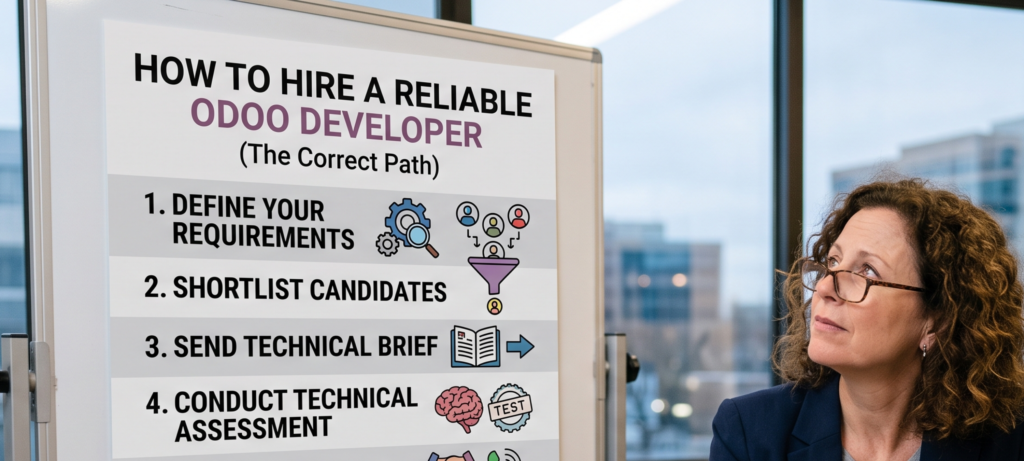
Step 1: Define Your Requirements
Document your business processes, the modules you need, and any specific integrations. The clearer your brief, the more accurate the quotes you’ll receive.
Step 2: Shortlist Candidates
Use the sources above to identify 5 to 10 candidates. Look at portfolios, certifications, and client reviews.
Step 3: Send Technical Brief
Share your requirements document and ask each candidate for a proposed approach, timeline, and cost estimate. How they respond tells you a lot about their professionalism and understanding.
Step 4: Conduct Technical Assessment
For critical projects, give shortlisted candidates a small paid test task, for example, building a simple custom module or explaining how they’d approach your integration. This is far more revealing than an interview alone.
Step 5: Check References
Actually call or email previous clients. Ask: “Did they deliver on time? Were there unexpected costs? Would you hire them again?”
Step 6: Start With Small Engagement
For new relationships, begin with a clearly scoped, smaller piece of work before committing to a large project. This builds trust and lets both sides evaluate the working relationship.
Step 7: Establish Communication Norms
Set expectations for update frequency, communication tools (Slack, email, project management software), code repository access, and milestone reviews before work begins.
Conclusion
Building a reliable partnership for long- term Odoo success.
Hiring the right Odoo developer is about finding someone who understands both the technical side of Odoo and the business processes it supports. By clearly defining your requirements, evaluating skills and experience, choosing the right hiring model, and following a structured selection process, you can reduce risks and ensure a successful implementation. Taking the time to vet candidates carefully, watch for red flags, and establish clear communication expectations will help you build a reliable partnership that delivers long-term value from your Odoo investment. Whether you choose to hire Odoo developer in USA, hire remote Odoo developers, or work with a dedicated offshore team.
As organizations continue to modernize their operations through ERP technology, working with experienced Odoo specialists can help reduce implementation risks and improve long-term outcomes. At AI-IoT Geeks, we recognize that successful ERP projects depend on careful planning, the right technical expertise, and a commitment to building solutions that support business growth over time. Ready to start your Odoo project? Book a free strategy call with our team
Need to hire Odoo developer experts? Contact AI-IoT Geeks
Have any questions in mind
Frequently Asked Questions?
1. Why do businesses hire Odoo developers?
Businesses hire Odoo developers to customize workflows, integrate third-party tools, improve system performance, and ensure successful ERP implementation.
2. What skills should an Odoo developer have?
An Odoo developer should have expertise in Python, PostgreSQL, XML, JavaScript, Odoo ORM, ERP processes, and system integrations.
3. How do I evaluate an Odoo developer before hiring?
Review their technical skills, Odoo certifications, portfolio, client references, industry experience, and ability to understand business requirements.
4. Are Odoo certifications important when hiring a developer?
Certifications can validate expertise, but practical experience, successful projects, and community contributions are equally important indicators of capability.
5. What questions should I ask before I hire Odoo developer talent?
Ask about previous Odoo projects, certifications, customization experience, integration capabilities, development approach, and post-launch support.
6. What are the biggest mistakes to avoid when hiring an Odoo developer?
Common mistakes include choosing solely based on cost, skipping technical assessments, ignoring references, and hiring developers without Odoo-specific experience.
7. How can the right Odoo developer improve ERP success?
An experienced Odoo developer can streamline implementation, reduce customization risks, improve performance, and ensure the platform aligns with business goals, which is why many businesses prefer to hire most experienced Odoo developer professionals. Companies such as AI-IoT Geeks combine Odoo implementation expertise, custom development capabilities, and integration experience to help businesses maximize ERP performance, scalability, and long-term operational efficiency.