


Generative AI In Software Development
Generative AI is no longer a future concept. It is actively reshaping how software teams design, code, test, and ship products and the organizations that recognize this shift early are pulling ahead of those still waiting to see how it plays out.
The use of generative AI in software development has moved from experimentation to measurable impact, driving faster delivery cycles, improved code quality, and reduced operational costs across industries.
Over the past years, the impact of generative AI in software development has moved the conversation from speculation to measurable business outcomes. Development cycles that once stretched across months are now completing in weeks. Test coverage that required dedicated QA engineers to maintain manually is now generated and updated automatically.
Documentation that was perpetually out of date is now produced in real time as code evolves. These are not theoretical possibilities. They are outcomes our team at AI-IoT Geeks has helped clients achieve across healthcare, fintech, retail, and enterprise SaaS environments.
What makes generative AI in software development different from every previous wave of developer tooling is its scope. Earlier productivity tools made individual tasks faster. Generative AI restructures the entire development lifecycle. It contributes to requirements gathering before a line of code is written, assists through every stage of the build, accelerates testing and review, and continues adding value through deployment and post-launch maintenance. No previous technology has touched every phase of software delivery simultaneously.
At AI-IoT Geeks, our engineers, architects, and DevOps specialists work with generative AI not as an experimental side project but as a core part of how we build and deliver software for clients. That direct, ongoing experience is what informs this guide. We are not summarizing research from a distance. We are sharing what we have tested, validated, and refined inside real projects with real delivery constraints.
This guide breaks down what generative AI in software development means for your development lifecycle, the measurable gains on the table, the tools leading teams are using right now, and exactly how to implement it the right way without the common mistakes that turn promising AI adoption into an expensive distraction.
What Is Generative AI In Software Development?
The Rise of Generative AI in Software Development.
Generative AI, commonly referred to as GenAI, describes a class of AI systems that can produce new content including code, text, images, and designs by learning patterns from large datasets. In the context of software development, these systems are trained on vast libraries of source code, technical documentation, architecture patterns, and user requirements.Generative AI in software development enables development teams to generate code, automate testing, create documentation, and streamline software delivery using advanced AI models trained on large-scale programming data.
Unlike traditional AI that predicts outcomes from existing data, generative AI creates entirely new outputs. It can write an entire function from a plain English prompt, generate a full test suite for a new feature, or explain a legacy codebase that no one on the current team has ever touched.
The models powering these capabilities include Large Language Models, Generative Adversarial Networks, and Variational Autoencoders. Tools like GitHub Copilot, Amazon CodeWhisperer, and Cursor have turned these models into everyday developer companions.
At AI-IoT Geeks, we have worked with development teams across healthcare, fintech, retail, and SaaS to integrate generative AI into their software workflows through our AI & Machine Learning Development practice. What we consistently observe is that this technology is not simply making developers faster. It is changing the nature of the work itself. Engineers who once spent the bulk of their day writing repetitive boilerplate code are now spending that time on architecture decisions, product thinking, and solving genuinely hard problems.
What makes the current moment particularly significant is the pace of improvement. When our team first began evaluating AI coding tools for client projects, the outputs required substantial correction before they were production-ready. Today, the same tools produce context-aware, project-specific code that integrates cleanly into complex existing codebases with far less intervention. The gap between what AI can do and what a senior developer can do is narrowing at a pace that demands attention.
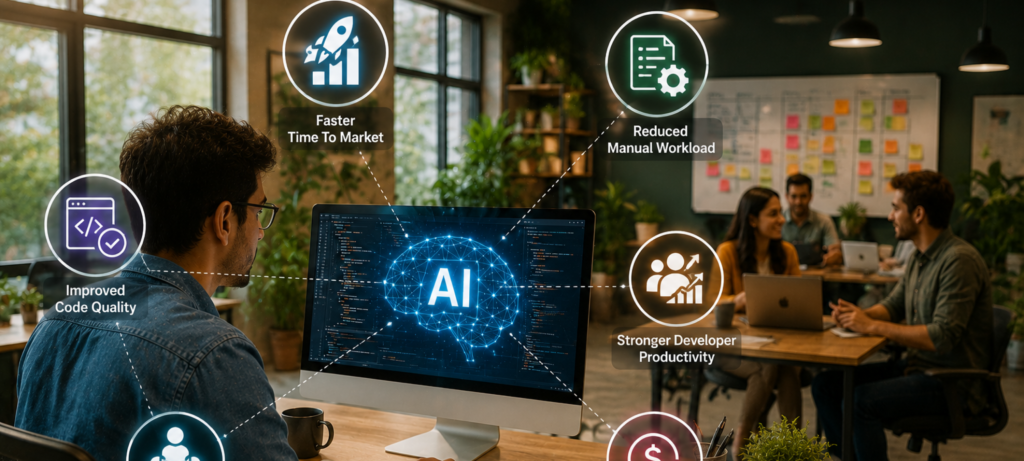
What Are The Key Benefits Of Generative AI For Development Teams?
Advantages of Generative AI in Software Development.
The business case for integrating generative AI into software development is no longer theoretical. Early adopters are reporting measurable improvements across speed, quality, and cost. The benefits of generative AI in software development extend beyond productivity, helping organizations accelerate delivery, improve software quality, reduce operational costs, and strengthen collaboration across development teams. Here are the core benefits driving adoption.
1.Faster Time To Market
AI assisted code generation compresses development cycles significantly. Work that previously consumed entire working days, such as writing boilerplate code, creating data models, and scaffolding API endpoints, can now be completed in a fraction of the time. At AI-IoT Geeks,our development team integrates generative AI in software development into coding, testing, and documentation workflows to help accelerate software delivery and streamline project execution. Teams that have adopted GenAI across their workflows report launching products and MVPs in weeks rather than months.
2.Improved Code Quality
Generative AI tools detect common errors, suggest cleaner solutions, and follow best practices automatically. This makes code easier to read, easier to maintain, and less likely to break in production. Technical debt accumulates at a slower rate when AI flags problems at the point of writing rather than discovering them much later.
3.Reduced Manual Workload
Documentation, test case generation, code reviews, and deployment scripts are among the most time consuming but least creatively rewarding tasks in software engineering. By delegating these to AI, development teams are freed to focus on high value work that drives genuine innovation and business impact, the same principle behind our RPA Development & Process Automation service, applied at the engineering level rather than the business-operations level.
4.Stronger Developer Productivity
Teams using AI assistants consistently report meaningful productivity improvements. Organizations that go further and embed AI across the full development lifecycle rather than just the coding phase see significantly higher returns than those treating it as a standalone tool. Our team applies generative AI throughout the software development lifecycle, enabling developers to focus more on architecture, innovation, and solving complex business challenges.
5.Onboarding And Knowledge Transfer
New team members can ask AI tools to explain complex codebases, describe architecture decisions, or generate readable summaries of unfamiliar modules. This dramatically reduces the time it takes for engineers to become productive and reduces dependence on tribal knowledge that often lives only in the minds of long-serving team members.
6.Lower Development Costs
By automating repetitive tasks and reducing defect rates, generative AI lowers the total cost of software delivery. The more a team embeds AI across planning, coding, testing, and maintenance, the more that cost efficiency compounds over time. As generative AI in software development becomes part of everyday engineering, businesses can reduce delivery costs while improving software quality, development efficiency, and long-term scalability. For growing businesses and startups especially, this means being able to build more with leaner teams without compromising on quality or reliability.
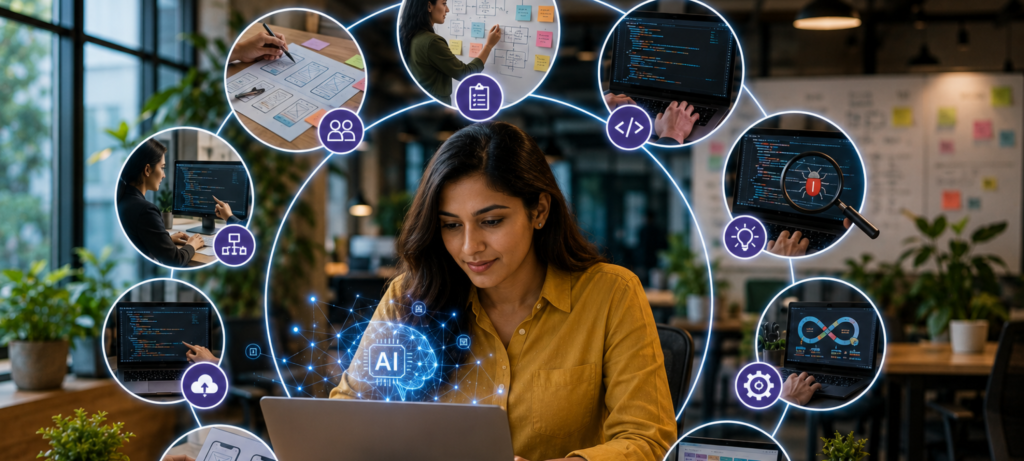
What Are The Top Use Cases Of Generative AI Across The SDLC?
Generative AI Applications Throughout the Software Development Lifecycle.
Generative AI software development use cases span every stage of the software development lifecycle, from the first stakeholder conversation to post-launch maintenance. Here is where it makes the most meaningful difference
1.Requirements And Planning
GenAI interprets business requirements and transforms them into user stories, acceptance criteria, and UML(unified modeling language) diagrams. This dramatically accelerates the pre-development phase and reduces misalignment between stakeholders and engineers before a single line of code is written.
2.Code Generation And Autocompletion
Tools like GitHub Copilot and Amazon CodeWhisperer predict and complete code in real time. One of the biggest advantages of generative AI In software development is intelligent code generation and autocompletion, enabling developers to produce high-quality code more efficiently. Developers can describe a function in plain language and receive working, context-aware code instantly. This covers everything from basic utility functions to full API endpoints with error handling included.
3.Debugging And Error Detection
Large language models can scan code as it is being written and flag logical errors, security vulnerabilities, performance bottlenecks, and syntax issues before the code ever reaches a build pipeline. Finding bugs at the point of creation costs a fraction of what it costs to fix them after deployment, a principle we cover in more depth in Risk Management In Software Development.
4.Automated Testing
AI generates unit tests, integration tests, and edge case scenarios automatically and updates them as the codebase evolves. Teams report dramatically improved test coverage without any additional manual effort. AI understands how different parts of a project connect and generates tests that cover both common scenarios and rare situations that human testers are likely to overlook. At AI-IoT Geeks, our developers combine AI-generated testing with established quality assurance practices to improve software reliability while reducing manual testing effort.
5.Documentation Generation
Generative AI writes inline comments, function level documentation, README files, and full API guides by analyzing the codebase directly. Documentation stays current because AI generates it automatically whenever code changes, ending the long-standing problem of documentation that is out of date from the moment it is published.
6.Code Refactoring And Optimization
AI identifies outdated patterns, inefficient algorithms, and readability issues in existing codebases and suggests modern, cleaner alternatives. This is especially valuable for legacy modernization projects where the cost of manual review is high and the risk of human error is significant. This is especially valuable for legacy modernization projects where the cost of manual review is high and the risk of human error is significant, we break this down further in legacy modernization challenges and legacy system modernization strategies.
7.UI And UX Prototyping
Generative AI can produce UI mockups, generate component variants, and suggest layout adjustments based on user behavior data. By analyzing user preferences and interaction patterns, AI can dynamically produce interface elements tailored to individual users, giving design and development teams faster feedback loops during the product definition phase. Our ui/ux product design team uses these same principles, explored further in enterprise application UX. These capabilities are also valuable when designing conversational products, including AI chatbot app development, where interface design and user interaction play a critical role.
8.DevOps And CI/CD Automation
AI writes deployment scripts, optimizes continuous integration and delivery pipelines, generates infrastructure as code templates, and helps Site Reliability Engineers identify operational bottlenecks before they affect production systems. We integrate AI-driven automation into DevOps workflows to streamline deployments, improve operational efficiency, and support faster release cycles.
9.Code Review Assistance
Generative AI reviews pull requests by checking coding standards, style consistency, security vulnerabilities, potential regressions, and architectural compliance. It accelerates feedback, improves code quality, reduces manual review effort, and helps development teams maintain consistent, reliable, and maintainable code across large and complex software projects.

Need A Generative AI Development Partner?
Accelerate software delivery with custom generative AI solutions designed for your business goals.
What Are The Popular Generative AI Tools For Developers?
Leading Generative AI Tools for Modern Development Teams.
The market for AI-powered developer tools has matured rapidly. At AI-IoT Geeks, our software engineers regularly evaluate and implement AI-powered development tools as part of custom software, AI application, and enterprise modernization projects. The ecosystem supporting generative AI in software development continues to expand with new developer tools and platforms, giving engineering teams more options to accelerate coding, testing, and software delivery. This hands-on experience helps us understand how different platforms perform across real-world development environments and business use cases.
Here is an overview of the most widely adopted platforms in use today.
1.GitHub Copilot
GitHub Copilot is the most widely used AI coding assistant and excels at real time code generation and autocompletion across a wide range of programming languages and integrated development environments. At AI-IoT Geeks, our developers use AI-powered coding assistants such as GitHub Copilot to accelerate development workflows, reduce repetitive coding tasks, and improve productivity across software projects while maintaining established code quality standards
2.Amazon CodeWhisperer
Amazon CodeWhisperer offers code suggestions alongside built-in security scanning, making it a strong choice for teams working heavily within AWS infrastructure or operating in security-sensitive environments.
3.Cursor
Cursor is an AI-native code editor that understands the full context of a project, not just the file being edited. It is particularly well suited to engineers who want deep, project-level AI understanding rather than line-by-line suggestions.
4.Tabnine
Tabnine focuses on privacy-first code completion and supports on-premise or private cloud deployments, making it a strong fit for enterprises with strict data governance requirements.
5.Devin By Cognition
Devin by Cognition represents the next generation of AI development tools, functioning as an autonomous software engineer capable of planning and executing multi-step development tasks from a single natural language brief.
6.ChatGPT And Claude
ChatGpt and Claude serve as general-purpose reasoning and code assistance tools, well suited for architecture planning, explaining complex concepts, drafting prompts, and working through problems that require open-ended thinking.
7.Replit Ghostwriter
Replit Ghostwriter is built into Replit’s browser-based coding environment and is ideal for rapid prototyping and collaborative coding sessions that do not require a local development setup.
Most high-performing teams use a combination of these tools rather than relying on a single solution, pairing an IDE-level assistant for daily coding with a general-purpose large language model for architecture discussions and specialized tools for testing or security analysis.

What Are The Best Practices For Using Generative AI In Software Development?
Best Practices for Generative AI Adoption in Software Development.
Understanding how to use generative AI in software development is not simply a matter of choosing the right tool. Successfully implementing generative AI in software development requires more than choosing the right tool. It also requires clear processes, governance, and collaboration across development teams. The teams extracting the most value treat AI integration as a deliberate, structured process. Here are the practices that consistently distinguish successful implementations from costly experiments.
1.Embed AI Across The Entire SDLC Rather Than Just Coding
The most common mistake organizations make is limiting AI to code completion. Leading adopters take a fundamentally different approach, rearchitecting their entire software development lifecycle around generative AI and embedding it deeply into every stage from requirements gathering through post-deployment monitoring. When AI contributes to writing user stories, generating test cases, reviewing code, and creating deployment documentation, the cumulative gains multiply across every phase of delivery rather than appearing only at one point in the process.
2.Define Clear Goals And Metrics Before You Start
AI adoption without measurement is guesswork. Before rolling out any generative AI tooling, establish the baseline metrics you intend to improve. These might include defect rates, deployment frequency, time to merge, documentation coverage, or onboarding duration. Track these consistently from day one. This discipline is what transforms AI from an experimental cost center into a quantifiable return on investment.
3.Treat AI Output As A First Draft Rather Than A Final Product
AI-generated code is a powerful starting point, not a finished deliverable. Every suggestion must be reviewed, tested, and validated by a developer before it enters a production codebase. Senior engineers should define non-negotiable code standards and configure AI tools to align with them. Hallucinations, meaning outputs that sound plausible but contain errors, are a real risk particularly on complex logic or security-sensitive code paths.
4.Invest In Prompt Engineering As A Core Engineering Skill
The quality of AI output is directly proportional to the quality of the prompt. Research into how developers use generative AI consistently highlights the difficulty of communicating precise objectives to an AI model. Teams that teach developers how to write clear, well-scoped prompts with appropriate context and constraints see dramatically better results than those who treat prompting as intuitive. Prompt engineering is now a legitimate professional skill that warrants deliberate investment. Through our AI development projects, AI-IoT Geeks has observed that well-structured prompts can significantly improve output accuracy, code quality, and overall development efficiency.
5.Implement A Robust Security Review Process For AI-Generated Code
AI tools can introduce security vulnerabilities as readily as they prevent them. A structured review process for AI-generated code is essential, particularly around authentication flows, data handling, database queries, and API design. Static analysis tools should run alongside AI suggestions, and security scanning should be a mandatory step in every continuous integration and delivery pipeline. AI-IoT Geeks follows security-first AI development practices, helping businesses integrate generative AI while maintaining compliance, code quality, and data protection standards.
6.Build A Centralised AI-Powered Knowledge System
Generative AI can serve as an intelligent search layer across internal codebases, past architectural decisions, and project documentation. When team members can query this knowledge using natural language, onboarding accelerates, silos dissolve, and teams stop solving the same problems repeatedly. AI acting as a virtual mentor surfaces relevant context proactively based on what a developer is currently working on, improving decision making across all roles and experience levels, a pattern similar to what we centralized in the ASL platform case study.
7.Redirect Saved Time Intentionally
Research consistently shows that organizations see only modest returns when saved developer time is not intentionally reallocated to higher-value work. When AI frees up meaningful portions of the working week, leadership must decide explicitly what those hours should produce, whether that means shipping more features, reducing technical debt, improving test coverage, or accelerating innovation. Without this intentional redirection, productivity gains dissolve into unfocused activity.
8.Choose Extensible And Integrated Toolchains
Siloed AI point solutions create fragmented experiences that are difficult to govern and impossible to scale. The highest-performing teams build or adopt platforms where AI is integrated seamlessly across code editors, testing frameworks, CI/CD pipelines, project management tools, and documentation systems. A platform-based approach creates a consistent experience, centralizes governance, and makes AI benefits visible across the entire team rather than being confined to individual power users.
9.Use Data To Continuously Improve Your AI Workflow
Every stage of the software development lifecycle generates data that can sharpen your AI-assisted processes. Collect and analyze code quality scores, test coverage rates, deployment success rates, and user feedback. Use generative AI to surface patterns that human reviewers might miss. Feeding these insights back into your development process creates a compounding loop where AI workflows improve continuously rather than plateauing after initial adoption.
10.Foster A Culture Of Responsible AI Use
Establish clear organizational policies on which data can be shared with external AI tools, how AI outputs should be attributed, and what constitutes acceptable use in production contexts. Teams that build trust and clarity around AI governance are far better positioned to scale adoption safely and avoid the reputational, legal, and security risks that come with unchecked AI use in software systems. Our Managed IT Services team helps organizations put this governance in place and keep it running long after initial rollout.

What Challenges Should Organizations Watch Out For?
Key Challenges and Risks of Generative AI Adoption.
Generative AI in software development is genuinely transformative, but organizations must also understand the risks of generative AI in software development. Acknowledging these friction points allows teams to prepare for them rather than be caught off guard.
Prompt Complexity And Iteration Time
Getting the right output from an AI model sometimes demands multiple rounds of refinement. Poorly scoped prompts produce generic or unusable results, and the time spent iterating can offset some of the productivity gains, particularly for developers who are still building fluency with prompting techniques.
AI Hallucinations And Incorrect Code
Large language models can generate code that appears correct but contains logical flaws, uses deprecated methods, or quietly introduces security vulnerabilities. Without rigorous review, these errors can reach production.
The non-deterministic nature of these models means the same prompt can yield meaningfully different outputs across separate sessions.
At AI-IoT Geeks, we mitigate this risk through human oversight, automated testing, and structured code review processes that validate AI-generated outputs before deployment.
Intellectual Property And Licensing Concerns
AI models trained on publicly available code repositories may produce output that closely resembles licensed open-source code. Organizations operating in regulated industries or those with strict IP requirements need clear legal guidance on how AI-generated code is handled, reviewed, and attributed before deploying it at scale.
Over-Reliance And Skill Atrophy
There is a legitimate concern that developers, particularly those early in their careers, may become excessively dependent on AI suggestions and gradually lose the ability to reason through complex problems independently.
Thoughtful onboarding practices and continued exposure to first-principles engineering are essential counterweights to this risk. At AI-IoT Geeks , we encourage a human-in-the-loop approach where AI supports developers while preserving critical problem-solving and decision-making skills.
Low Adoption And Cultural Resistance
Despite the quality of available tooling, developer adoption of AI assistants remains inconsistent across organizations. Research shows that the majority of software firms have deployed generative AI tools, yet individual developer adoption is frequently low. Change management, structured training, and visible executive sponsorship matter as much as the technology itself.
What Is The Future Of Generative AI In Software Engineering?
The Rise of Agentic AI and Autonomous Development.
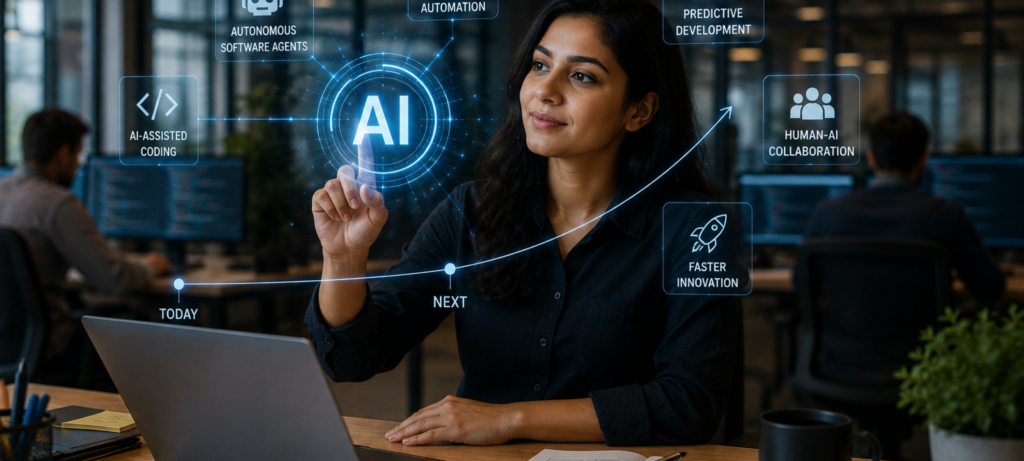
The current wave of AI-assisted development, where humans drive and AI assists, is only the beginning. The next evolution is agentic AI, which refers to autonomous systems capable of planning, executing, and iterating on complex multi-step development tasks with minimal human intervention.
Gartner predicts that generative AI will take on entirely new roles in software engineering and operations within the next few years. Early versions of this future are already visible in tools that can autonomously research requirements, plan implementation approaches, write and test code, and refactor based on feedback from a single natural language brief.
Research suggests that a substantial and growing portion of new production code is now AI-generated. As models improve and agentic frameworks mature, that share will grow considerably. The organizations building AI-native development cultures today, with the right processes, governance structures, and team skills in place, will hold a meaningful competitive advantage as this transition accelerates.
The future of software engineering will be defined by human creativity enhanced by intelligent automation. The developers who thrive will be those who combine deep technical expertise with the ability to collaborate effectively with AI systems, directing them with precision and evaluating their outputs with rigor. As an AI development company, AI-IoT Geeks helps organizations prepare for this shift by implementing AI-powered software solutions, establishing governance frameworks, and supporting teams in adopting emerging AI technologies responsibly.
Conclusion
Generative AI in software development is not a trend to observe from a safe distance. Generative AI In Software Development is transforming how organizations design, build, test, and maintain modern software systems. It is a capability to build today. From accelerating code generation and automating testing to redesigning documentation workflows and enabling smarter CI/CD pipelines, GenAI touches every stage of how software is conceived, built, and maintained.
The teams seeing the highest returns are those embedding AI across their entire process, measuring outcomes rigorously, and continuously refining their approach based on real data. The technology is ready. The question is whether your organization is ready to use it well.
At AI-IoT Geeks, we build AI-powered software systems, from custom machine learning pipelines and intelligent mobile applications to full-stack platforms with AI-assisted development baked into the process from day one. If you are exploring how to integrate generative AI into your own software development lifecycle, we are ready to help you do it right.
Transform your business with generative AI in software development. Speak with our experts today.
Have any questions in mind
Frequently Asked Questions?
1. How is generative AI different from traditional AI?
Traditional AI analyzes data and predicts outcomes, while generative AI creates new outputs like code, functions, or documentation based on learned patterns.
2. Why is generative AI in software development becoming popular?
Because it helps speed up development, reduce manual work, improve code quality, and automate repetitive tasks across the entire SDLC.
3. Which tools use generative AI for coding?
Popular tools include GitHub Copilot, Amazon CodeWhisperer, Cursor, ChatGPT, and Tabnine.
4. How does generative AI improve the software development lifecycle (SDLC)?
It supports every stage including requirements, coding, testing, debugging, deployment, and documentation, making the entire process faster and more efficient.
5. What are the main benefits of generative AI for development teams?
Key benefits include faster time to market, improved code quality, reduced manual workload, better developer productivity, and lower development costs.
6. What is the future of generative AI in software engineering?
The future lies in agentic AI systems that can independently plan, build, test, and optimize software with minimal human intervention, transforming how engineering teams operate.
7. Why should businesses work with AI-IoT Geeks for generative AI implementation?
AI-IoT Geeks helps organizations design and implement AI-powered development workflows, integrate generative AI into the full SDLC, and establish governance frameworks that ensure safe, scalable, and high-impact adoption. Their expertise enables businesses to accelerate delivery, improve software quality, and maximize ROI from AI-driven development.