


Enterprise Application UX: From Frustration To Results
Smarter UX Design For Faster Workflows, Better Adoption, And Higher Productivity.
Most enterprise application UX challenges come from cluttered dashboards, confusing navigation, multi-step processes that should take two clicks ,these aren’t just minor inconveniences. They cost businesses millions of dollars every year in lost productivity, expensive errors, and underused tools that no one actually wants to open in the morning.
But here’s what’s changing: the bar for enterprise UX has never been higher, and the companies that treat it as a strategic investment not an afterthought are pulling ahead. At AI-IoT Geeks, our team of UX strategists, product designers, and engineers has worked across healthcare, SaaS, fintech, and public sector systems, helping organizations redesign complex enterprise platforms into intuitive, high-performing products.

What Is Enterprise Application UX ?
Understanding Enterprise Application UX.
Enterprise UX refers to the practice of designing software that employees use to do their jobs. Strong enterprise application UX design helps organizations simplify workflows, improve usability, and reduce operational friction across complex systems. We’re not talking about Instagram or TikTok. We’re talking about CRM systems, ERP platforms, HR portals, supply chain dashboards, SaaS tools, healthcare record systems, and every other piece of critical business software that powers organizations day to day.
The key difference between enterprise UX and consumer UX comes down to purpose. Consumer UX is about engagement ,getting users to stay longer, scroll more, come back tomorrow. Enterprise UX is about productivity. A user spending three hours on an expense reporting tool isn’t a success metric. It’s a failure signal.
From our experience working with enterprise clients across the USA, Saudi Arabia, and the UAE, we’ve consistently seen that productivity-driven UX directly impacts business KPIs, from operational efficiency to employee satisfaction.

What Are The 7 Core Principles Of Effective Enterprise Application UX?
The Foundational UX Principles That Improve Enterprise Software Usability And Performance.
✓
Role-Based Design: One Platform, Many Users
Enterprise software rarely serves a single type of person.
At AI-IoT Geeks, we implement role-based UX architectures using modular design systems that allow interfaces to dynamically adapt without increasing system complexity, ensuring scalability for growing organizations.
✓
Progressive Disclosure: Making Complexity Manageable
Enterprise applications must accommodate dense, data-heavy tasks.
Our UX audits often reveal that information overload is one of the biggest adoption barriers. By applying progressive disclosure strategies, we’ve helped clients significantly improve usability without sacrificing functionality.
✓
Cognitive Load Reduction
Enterprise users often work under pressure.
We apply data-backed UX methodologies such as heatmap analysis, interaction tracking, and usability testing to identify friction points and reduce cognitive load in high-stakes enterprise environments.
✓
Usability For Power Users And Beginners Alike
Enterprise software must serve both beginners and experts.
Our design approach balances guided onboarding experiences with advanced user capabilities like bulk actions and automation, ensuring long-term usability across skill levels.
✓
Accessibility And Compliance
In enterprise contexts, accessibility isn’t optional.
AI-IoT Geeks integrates WCAG compliance and industry-specific regulations (HIPAA, GDPR, SOC 2) into the design process from day one,reducing legal risks and ensuring inclusive user experiences.
✓
Continuous User Research
Good enterprise UX doesn’t come from assumptions.
We maintain continuous feedback loops through usability testing, analytics, and real-user insights, allowing enterprise systems to evolve based on actual usage patterns rather than assumptions.
✓
Consistency Across A Complex System
Enterprise platforms grow over time.
Our design systems are built as scalable, reusable component libraries, ensuring consistency across modules, teams, and future product expansions.
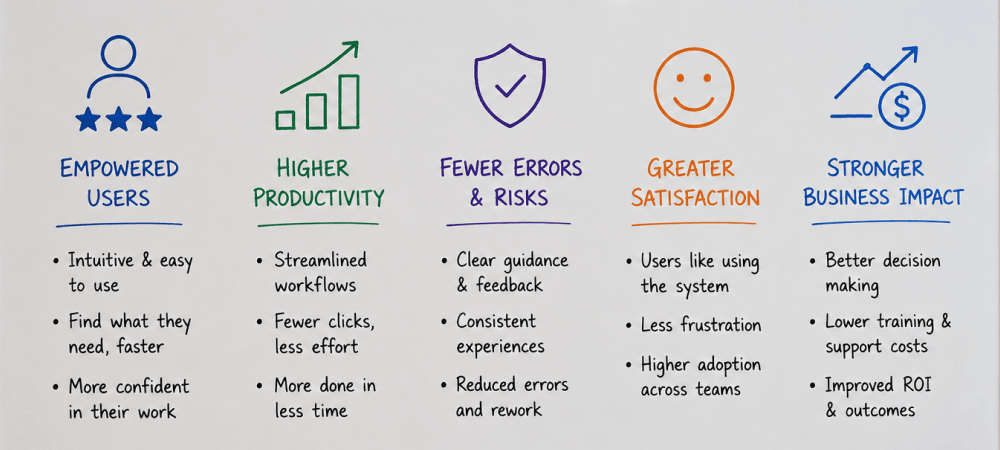
What Great Enterprise UX Delivers?
Business Outcomes Driven By Effective Enterprise UX Design.
When enterprise UX is done well, it creates a measurable impact across the business.From our experience at AI-IoT Geeks working with enterprise clients across industries, we’ve seen clear improvements in efficiency, adoption, and overall performance through the implementation of the best enterprise application UX strategies.
Key outcomes include:
✓
Higher Productivity
Simplified workflows reduce time spent on repetitive tasks.
✓
Lower Training Costs
Intuitive systems are easier to learn and require less support.
✓
Fewer Errors
Clear interfaces and smart defaults help prevent costly mistakes.
✓
Better User Adoption
Employees are more likely to use tools that are easy and efficient.
✓
Improved Decision-Making
Well-designed dashboards make data easier to understand and act on.
✓
Stronger ROI
Better usability ensures organizations get real value from their software investments.
These outcomes are exactly what we aim for in every engagement. Explore our Case Studies to see how we’ve helped enterprise clients achieve these results across industries.

What Are The Real Cost Of Bad Enterprise Application UX?
Poor Enterprise UX Creates Productivity Loss, Higher Costs, And Operational Friction.
The impact of poor enterprise UX goes far beyond frustration. Even small inefficiencies in workflows, navigation, or interface design can compound over time, leading to significant productivity loss across teams and departments.
The data makes this impossible to ignore. According to Nielsen Norman Group, “the estimated productivity gains from redesigning an intranet to improve usability are 8 times bigger than the costs for a company with 1,000 employees, 20 times bigger for a company with 10,000 employees, and 50 times bigger for a company with 100,000 employees.” For enterprise organizations running on poorly designed systems, this isn’t a minor gap , it’s a compounding operational cost that grows with every new employee who struggles with the same broken workflows.
From our experience , even minor UX improvements such as restructuring dashboards or simplifying user flows have led to noticeable gains in efficiency and reduced operational friction within a short period.
Research and industry insights consistently show that organizations investing in better digital experiences benefit from improved adoption, lower support costs, and stronger overall performance.
These outcomes align closely with what we observe across client engagements. UX is not just design, it is a critical driver of business performance.
If your enterprise platform is showing signs of poor adoption or workflow friction, our UI/UX Product Design team can help identify and fix the root cause before it becomes a bigger operational liability.

What Are The Challenges Enterprise UX Designers Face?
Common Enterprise UX Challenges That Impact Usability, Adoption, And Scalability.
Understanding the principles is one thing. Navigating real-world constraints is another. Having worked with legacy modernization and SaaS transformation projects, we’ve seen firsthand how technical debt, stakeholder alignment, and compliance constraints can shape UX decisions. Our approach focuses on incremental improvements that deliver value without disrupting core operations.
Key challenges include:
✓
Legacy Systems
Many enterprises rely on outdated platforms with years of technical debt, making UX improvements complex and risky.
✓
Multiple Stakeholders
Conflicting priorities from business, IT, compliance, and end users can slow decision-making and dilute UX quality.
✓
Data Complexity
Enterprise applications must handle large volumes of data, making it difficult to balance clarity with functionality.
✓
User Adoption Resistance
Employees may resist change, even when the new system is objectively better.
✓
Cross-Platform Consistency
Ensuring a seamless experience across desktop, mobile, and different environments adds design complexity.
✓
Scalability Challenges
Systems must evolve with business growth without breaking usability or consistency.
For organizations dealing with legacy modernization specifically, our Odoo ERP Implementation service is one example of how we help businesses transition from outdated platforms to modern, scalable systems without sacrificing usability.

How Is AI Reshaping Enterprise Application UX?
AI-Driven Enterprise UX Is Creating Smarter, More Adaptive User Experiences.
The most significant shift in enterprise application design today is the integration of AI. At AI-IoT Geeks, we incorporate AI and ML capabilities such as predictive UX, intelligent automation, and NLP-based interfaces to enhance decision-making and improve overall efficiency. These technologies allow systems to adapt to user behavior and provide more relevant, context-aware experiences.
AI co-pilots embedded directly into workflows are becoming standard in modern enterprise applications. Our approach focuses on explainable AI, ensuring users understand how the system works, maintain control over decisions, and build trust in AI-driven interactions.
Our AI & Machine Learning Development service works hand-in-hand with our UX practice to bring intelligent, adaptive experiences to enterprise platforms ,combining technical depth with design thinking for outcomes that go beyond surface-level improvements.
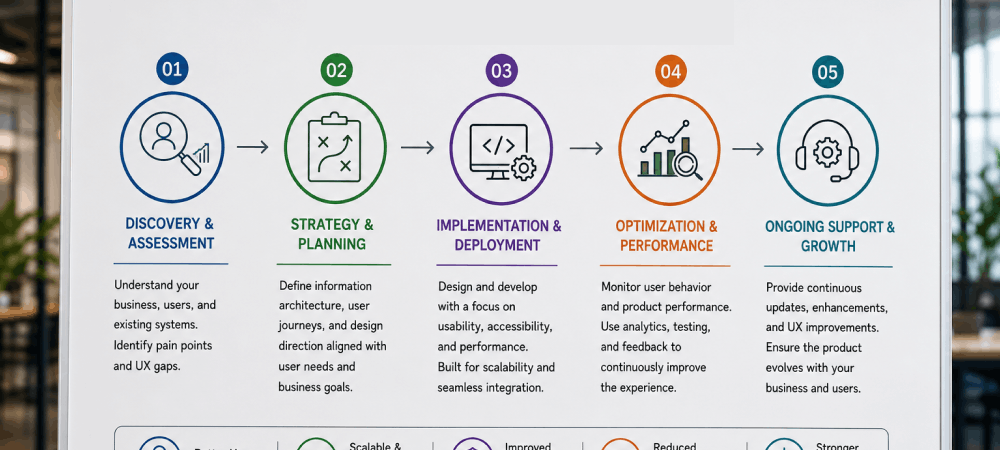
How AI-IoT Geeks Approaches Enterprise Application UX?
A Research-Driven Enterprise UX Process Focused On Usability, Scalability, And Business Growth.
At AI-IoT Geeks, we follow a structured and research driven approach to design enterprise applications that are user friendly, scalable, and aligned with business goals.
Our multidisciplinary team combines UX research, product strategy, and engineering expertise to deliver enterprise solutions that are not only functional but scalable and future ready.
Our process runs through five phases:
✓
Discovery & Assessment
We start by understanding your business, users, and existing systems. This includes analyzing workflows, identifying pain points, and evaluating current UX gaps to define clear objectives.
✓
Strategy & Planning
Based on insights, we define information architecture, user journeys, and design direction. This phase ensures that the product structure aligns with both user needs and business goals.
✓
Implementation & Deployment
We design and develop the solution with a focus on usability, accessibility, and performance. Every component is built to support scalability and seamless integration with your existing systems.
✓
Optimization & Performance
After launch, we monitor how users interact with the product. Using analytics, testing, and feedback, we identify areas for improvement and refine the experience continuously.
✓
Ongoing Support & Growth
Enterprise products evolve over time. We provide continuous updates, enhancements, and UX improvements to ensure the system adapts to changing business needs and user expectations.
Conclusion
Enterprise application UX has moved from a “nice to have” to a business critical capability. As systems grow more complex, the need for intuitive and efficient design becomes even more important.
Organizations that invest in the best enterprise application UX improve how their teams work, make decisions, and deliver results. Better UX leads to higher productivity, stronger adoption, and greater value from technology investments.
With experience across global industries, AI-IoT Geeks helps organizations transform complex systems into intuitive, high performing digital products that drive real business outcomes.
If you’re building or modernizing an enterprise application, we’d be glad to help you achieve better results through UX.
Ready to improve enterprise UX? Contact AI-IoT Geeks for smarter, efficient, user-focused enterprise solutions.
Book a Free Strategy Call at aiiotgeeks.com
Have any questions in mind
Frequently Asked Questions?
Why is enterprise UX important for businesses?
Enterprise UX improves how employees interact with software, leading to better productivity, fewer errors, and more efficient workflows across the organization.
What are the key principles of effective enterprise application UX?
Key principles of effective enterprise application UX design include role-based design, progressive disclosure, reducing cognitive load, usability for different user levels, accessibility, continuous research, and system consistency.
What challenges do companies face in enterprise UX design?
Common challenges include legacy systems, multiple stakeholders, complex data handling, user resistance, cross-platform consistency, and scalability issues.
How can AI-IoT Geeks help improve enterprise application UX?
AI-IoT Geeks uses a structured approach including research, strategy, design, and continuous optimization to build scalable and user-friendly enterprise applications.
What results can businesses expect from improving enterprise UX?
Businesses can expect higher productivity, better user adoption, reduced training costs, improved decision-making, and stronger ROI from their software systems.