


The Reality Of Legacy Modernization Challenges
Breaking Down the Reality of Legacy System Challenges.
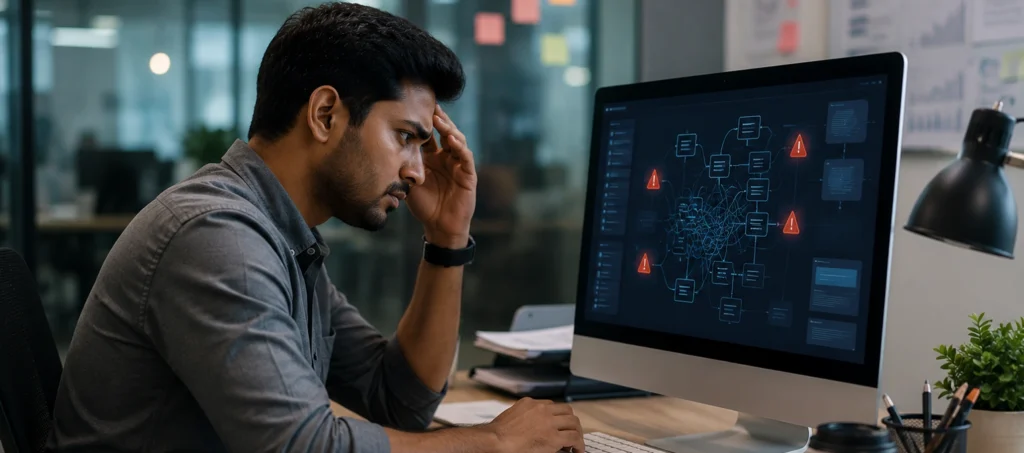
Legacy systems don’t break down all at once. They slow you down bit by bit , a new feature takes too long, an integration doesn’t work, a security update can’t be applied. And before you know it, your team isn’t thinking about growth anymore. They’re just trying to keep the lights on. Based on what we’ve seen at AI-IoT across multiple modernization projects, this gradual slowdown is one of the earliest and most consistent warning signs. At that point, legacy modernization isn’t a future goal. It’s an urgent need. At that point, legacy modernization isn’t a future goal. It’s an urgent need.
But here’s the problem: many organizations jump into modernization without fully understanding what they’re getting into and end up spending more money, taking more time, and still running on the same old systems. The common are real, but they’re also predictable. If you know what to expect, you can prepare for it.
This guide covers nine of the most common and most damaging legacy modernization challenges, why they happen, and what you can actually do about them.
What Is Legacy Modernization?
Understanding Legacy Modernization and Its Real-World Impact.
Legacy modernization refers to the process of updating, refactoring, migrating, or replacing outdated software systems so they can meet current business demands and integrate with modern technology. It spans a wide spectrum , from wrapping old systems in APIs to enable new integrations, all the way to full platform re-architecture on cloud-native infrastructure.
When it works, legacy modernization cuts maintenance costs, improves security, accelerates feature delivery, and unlocks capabilities the old system simply couldn’t support. When it doesn’t work, it burns time, budget, and organizational goodwill in ways that can set a technology strategy back by years. The difference between success and failure usually comes down to how well the team understood and prepared for the challenges ahead.
At AI-IoT Geeks, we’ve seen in real projects that modernization works best when teams first spend time understanding the existing system properly , especially through system discovery, dependency mapping, and basic architecture review before starting any redevelopment work.

What Are The 9 Legacy Modernization Challenges You Need To Prepare For?
Exploring Real Issues, Root Causes, and Practical Solutions.
1. Years Of Technical Debt Piling Up
Every old system carries some level of technical debt , shortcuts taken, quick fixes applied, outdated code never cleaned up. That’s normal. The problem is when this builds up over ten or twenty years without being addressed.
At that point, the system becomes so complex that no one fully understands how everything connects. Engineers become hesitant to make changes because even a small modification in one area can unexpectedly impact another part of the system. Over time, the codebase turns into a complex network that is difficult to navigate or safely modify.
At AI-IoT Geeks, our team has observed that unmanaged technical debt is often the earliest and most critical blocker in modernization projects. It slows down development and increases system risk significantly.
What You Can Do:
Before touching anything, map out the codebase. Use tools that can visually show you how different parts of the system connect. Break the work into smaller pieces instead of trying to fix everything at once. AI-powered tools can help speed up this analysis significantly , what would take a team weeks to map manually can be done in a fraction of the time.
2. A Monolithic System Where Everything Is Connected To Everything
Many legacy systems were built as one big application , one block of code where every part touches every other part. In the early days, this was fine. It was simple to build and manage.
But as the system grew and changed over the years, all those connections became a trap. Now, if you want to update one feature, you risk breaking five others. If you want to scale one part of the system, you have to scale all of it.
This kind of architecture makes modernization feel like defusing a bomb. You pull one wire and you’re not sure what happens next.
What You Can Do:
Don’t try to fix the whole monolith at once. Instead, pick one small, self-contained piece of the system and move it out first. Build it as a separate service, test it thoroughly, and once it works, move on to the next piece. Go slow, go steady, and map your dependencies carefully before every step.
3. Data Migration That's More Complicated Than It Looks
Moving data from an old system to a new one sounds straightforward. It rarely is.From what we’ve seen at AI-IoT, unclear data structures and hidden dependencies are often the root cause of migration failures, not the tools being used.
Legacy databases are often messy. Fields have been repurposed over the years. Naming conventions changed mid-project and never got cleaned up. Business logic got buried inside database triggers instead of the application itself. Some tables haven’t been looked at in years, but they’re still being used , just nobody knows exactly how.
The real danger is that data migration mistakes don’t show up right away. They appear weeks later as wrong numbers in reports, failed transactions, or confused customers. And by then, they’re hard to trace back to the source.
What You Can Do:
Before you migrate anything, document what your data actually means. Build a clear reference that explains every important table and field. Run the old and new systems side by side and compare their outputs before you fully switch over. Clean your data before migration , moving inconsistent data to a new system just moves the problem. And automate the migration process wherever you can to reduce human error.
4. Little Or No Documentation Of The System
One of the most frustrating issues in legacy system modernization challenges is the absence of updated documentation. The system was built years ago, the team has changed multiple times, and nobody wrote things down properly along the way.
What documentation does exist is often outdated, incomplete, or describes the original design rather than what the system actually does today after years of patches and changes.
Without documentation, your modernization team has to spend enormous amounts of time just figuring out what the system does before they can even start changing it. That’s time and money that should be going toward actual progress.This problem is especially common in organizations still operating on older business infrastructure where years of undocumented updates make systems harder to maintain and modernize. Our guide on the long-term impact of outdated enterprise software explains these operational challenges in more detail.
What You Can Do:
Make documentation your first priority, not an afterthought. Get the people who know the system best, even if they are close to retirement, into structured sessions to capture their knowledge. Use AI powered documentation tools that can automatically read and describe codebases. This can compress months of manual work into days. And once you start the migration, keep the documentation updated as things change.
5. Not Enough People With The Right Skills
Modernization requires two very different types of expertise at the same time. You need people who know the old system well enough to work with it safely, including its quirks, its undocumented behaviors, and its logic. And you need people who understand modern systems such as cloud architecture, microservices, and DevOps practices.
Finding people who are strong in both is hard. Finding enough of them to run a full modernization program is even harder.
It gets worse over time. The engineers who built and maintained these legacy systems are often approaching retirement. When they leave, they take decades of knowledge with them, and there is nobody lined up behind them with the same expertise.
What You Can Do:
Start knowledge transfer now, before the gap becomes a crisis. Pair your legacy experts with your modern engineers so knowledge moves across the team. Look into AI tools that can help newer engineers understand old codebases without needing to be legacy experts themselves, as these tools have become genuinely useful in recent years. And for very specialized legacy environments, bringing in external specialists is often faster and safer than trying to build that expertise internally from scratch. Our AI & Machine Learning Development team works alongside modernization programs to bring AI-powered analysis tools into the process, significantly reducing the skills gap barrier.
6. People Inside Your Organization Pushing Back
Organizational change is at the core of every technology transformation. Modernization changes how teams work, what tools they use, and sometimes what their roles look like. That makes people uncomfortable, and when people are uncomfortable, they resist.
This resistance is natural. People who have spent years building expertise in the current system often feel uncertain about their role when that system changes. Managers who rely on established processes may worry about disruption and loss of efficiency. In many cases, teams have also experienced past technology initiatives that failed to deliver on expectations, which makes them cautious about new changes.
When this resistance is not managed, it quietly derails modernization. Decisions slow down. Problems with new systems get reported out of proportion. The people who matter most to the project’s success start looking for the exit.
What You Can Do:
Involve people early, not just to inform them, but to genuinely include them in decisions. When teams feel heard, resistance drops. Be honest and clear about why modernization is happening and what it means for each group. Find early wins that show real, visible improvements, not just technical progress. And identify people inside the organization who are excited about the new direction. Empower them to be advocates for the change.
7. Security Gaps And Compliance Risks
Old systems were built in a different era , before today’s cyber threats existed, and before most of today’s data privacy and compliance regulations were written. As a result, they often have security vulnerabilities that can’t be patched because the underlying software is no longer supported. They may handle sensitive data in ways that don’t meet current requirements like GDPR, HIPAA, or industry-specific standards.
And then modernization itself introduces new risks. Running old and new systems in parallel creates more entry points for attackers. Data flowing between environments during migration can be exposed. New integration points open up new vulnerabilities if they’re not secured from day one. We emphasize early security auditing because risks often increase during transition phases if not properly controlled.
What You Can Do:
Do a security and compliance audit of your legacy environment before modernization planning starts. Understand exactly what you’re dealing with. Then build security into the new system’s architecture from the very beginning , not as an add-on at the end. Set clear security standards for every phase of the migration, including the transition period when you’re running both systems at once. If you’re handling sensitive or regulated data, look for tools that support on-premise deployment.
8. Keeping The Business Running While You Modernize
You can’t just pause your operations while the new system gets built. Your customers still need service. Your revenue still needs to flow. Your compliance obligations don’t take a break because your engineering team is in the middle of a migration.
This forces organizations into running old and new systems in parallel , which is expensive and complicated. Data has to stay in sync across both environments. Every change made to the legacy system during the transition has to be reflected in the new one. And transition periods almost always last longer than planned, which means carrying this operational overhead longer than expected.
What You Can Do:
Plan for business continuity from day one , not as an afterthought when you’re nearly done. Have a clear cutover plan and, just as importantly, a clear rollback plan in case something goes wrong. Migrate in phases rather than switching everything over at once. Moving traffic gradually to the new system lets you catch problems under real conditions before you’re fully committed. And schedule major cutovers during quieter periods, with extra engineering support on standby.
9. Budgets Running Over And Scope Getting Out Of Control
Legacy modernization projects are often difficult to estimate with accuracy. The reason is simple: you are working with systems that are not fully understood. Hidden complexity begins to surface during the project. New dependencies emerge that were not identified earlier. As the new system starts taking shape, the business often introduces additional requirements. Timelines extend, and longer timelines lead to increased costs.
This is not always a result of poor planning. It is often a realistic outcome of working with systems that have unpredictable complexity. The problem arises when organizations plan as if everything is fully understood, and then face unexpected challenges when hidden issues begin to surface. According to McKinsey, “technical debt is basically the ‘tax’ a company pays on any development to redress existing technology issues, and it accounts for about 40 percent of IT balance sheets , companies pay an additional 10 to 20 percent to address tech debt on top of the costs of any project.” For organizations running modernization programs without a clear picture of their existing tech debt, this hidden tax compounds every phase of the project, turning manageable budgets into runaway costs.
What You Can Do:
Build real contingency into your budget rather than a minimal buffer, and ensure it is enough to absorb the surprises that will come. Run a dedicated discovery phase before making full cost commitments so you reduce uncertainty before you are locked in. Put formal scope governance in place so that new requirements are evaluated and approved rather than quietly absorbed. And track progress continuously against your estimates. If something is not on track, it is better to identify and adjust early rather than discover it at the end.

What Separates Successful Modernization Programs From Failed Ones?
Key Practices That Drive Successful Legacy Modernization Outcomes.
Looking at all nine of these challenges together, a pattern becomes clear. Most modernization failures don’t happen because of major mistakes. They happen because the team underestimated the complexity of the system. Across AI-IoT projects, successful programs consistently invest more time in discovery and phased execution rather than rushing into full transformation. This is why understanding common challenges in legacy system modernization is essential before any execution begins, because it directly impacts planning accuracy and risk control.
The programs that succeed tend to do a few things differently:
They Understand Before They Act
They invest seriously in a discovery phase, mapping the system, documenting dependencies, assessing data and security, and identifying where skills gaps exist before committing to a full transformation plan.
They Go Step By Step
Instead of one massive multi-year effort, they break the work into smaller phases with clear milestones and decision points. This keeps the program manageable and allows course corrections along the way.
They Take The People Side Seriously
Technical problems can be solved with enough skill and time. But resistance, knowledge loss, and skills gaps are people problems and those are the ones that most often derail modernization programs.
They Use AI Tools Where It Makes Sense
Modern AI-powered tools for code analysis, documentation generation, and developer onboarding have genuinely changed what’s possible. They speed up discovery, help new engineers understand old systems faster, and make the hidden complexity of legacy codebases visible in ways that simply weren’t available a few years ago.
How AI Is Changing The Legacy Modernization Equation?
The Role of AI in Accelerating and Simplifying Legacy Modernization.
One of the most significant developments in the legacy modernization space over the last two years is the emergence of AI-powered tooling specifically designed for these challenges.
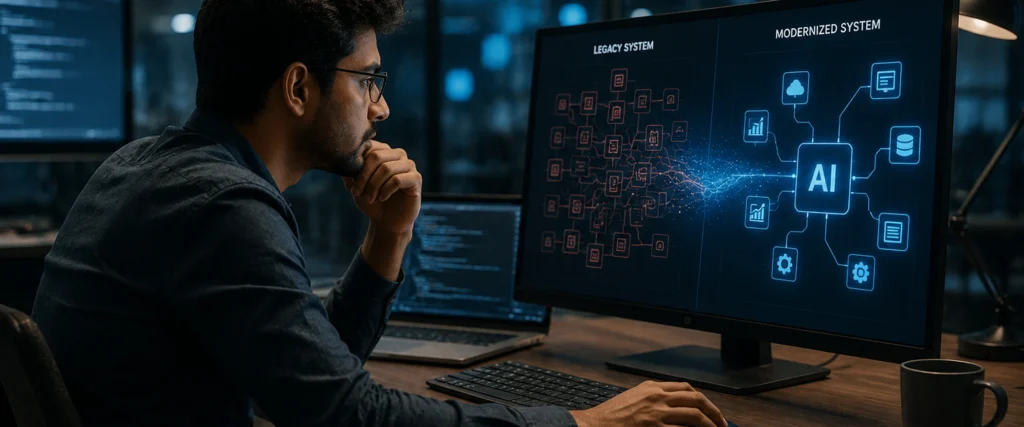
Where traditional modernization approaches required extensive manual analysis , reading code, interviewing developers, reconstructing architecture , AI tools can now accelerate discovery dramatically. Automated dependency mapping, AI-generated documentation, code comprehension tools that explain legacy logic in plain language ,these capabilities don’t eliminate the challenges of legacy modernization, but they significantly reduce the time and expertise required to navigate them safely.
This matters especially for organizations facing the skills gap challenge. When AI can help a modern engineer understand what an older COBOL module does, the pool of people who can safely participate in modernization expands substantially.
Our team has seen this shift firsthand in real-world modernization programs, where AI-assisted analysis has helped reduce dependency discovery time and improved system understanding across legacy environments. It allows teams to move faster while still maintaining accuracy and control. These improvements directly help reduce the main challenges of legacy system modernization that typically slow down transformation efforts.
The most effective modernization programs today typically combine experienced human judgment with AI-assisted tooling , using technology to handle the pattern recognition and documentation tasks that slow teams down, while keeping architectural decisions and risk management in human hands.
Conclusion
Legacy modernization is not just a technical upgrade, it is a complex, high-impact business decision. The legacy modernization challenges discussed throughout this guide may seem overwhelming, but they are largely predictable. Based on AI-IoT Geeks experience, organizations that focus on structured planning, system understanding, and phased execution are far more likely to succeed and build systems that support long-term growth.
Organizations that succeed are the ones that invest time in understanding their systems, plan for uncertainty, involve their teams early, and adopt a phased approach rather than rushing into large-scale transformation. With the growing role of AI, teams now have better tools to reduce complexity, accelerate discovery, and make more informed decisions throughout the process.
In the end, overcoming legacy modernization challenges is not about replacing old systems quickly, it is about building a stronger, more adaptable foundation that supports long-term growth without disrupting the business along the way.
Transform legacy systems confidently with AI-IoT Geeks’ scalable, risk-managed modernization solutions built for long-term growth.
Book a Free Strategy Call at aiiotgeeks.com
Have any questions in mind
Frequently Asked Questions?
Why do legacy systems become difficult to manage over time?
Legacy systems grow more complex due to years of updates, quick fixes, and outdated technologies, making them harder to understand, maintain, and scale.
When should a business consider legacy modernization?
A business should consider modernization when systems slow down operations, limit scalability, create security risks, or increase maintenance costs.
What are the most common legacy modernization challenges organizations face?
Common challenges include technical debt, monolithic architecture, complex data migration, lack of documentation, skills gaps, resistance to change, security risks, operational continuity, and budget overruns.
How can organizations reduce risks during legacy modernization?
Organizations can reduce risks by conducting a discovery phase, mapping dependencies, modernizing in phases, maintaining documentation, and implementing strong governance.
How does AI help address legacy modernization challenges?
AI helps by automating code analysis, generating documentation, mapping dependencies, and enabling engineers to better understand legacy systems faster.
What is the best approach to handle main challenges of legacy system modernization effectively?
The best approach includes a phased strategy, strong planning, stakeholder involvement, continuous monitoring, and the use of AI tools alongside expert decision-making, as practiced by teams like AIIoT Geeks.
How can AI-IoT Geeks help overcome legacy modernization challenges?
AI-IoT Geeks helps organizations address legacy modernization challenges through structured discovery, dependency mapping, phased modernization strategies, and AI-assisted analysis to reduce risk and improve outcomes.