


Introduction To Legacy System Modernization Strategies
An Overview Of Legacy System Modernization Strategies.
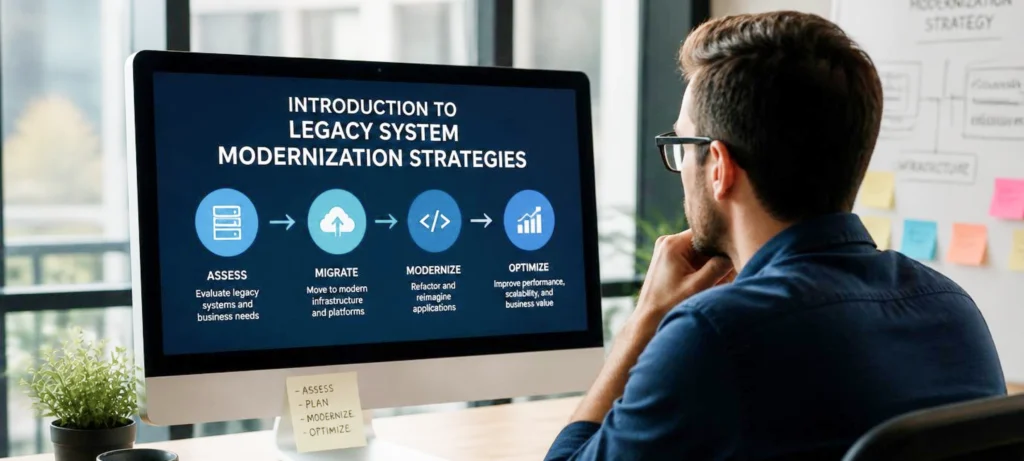
Legacy system modernization refers to the process of upgrading, transforming, or optimizing outdated software, infrastructure, and workflows so they can integrate with modern technologies, improve performance, and support long-term business goals. It focuses on extending the value of existing systems by making them more scalable, maintainable, and adaptable rather than replacing them entirely.
This process can involve improving infrastructure, updating code, enhancing user interfaces, or enabling integration through APIs and cloud technologies. The goal is to ensure that legacy systems continue to deliver business value while aligning with current technological standards and future requirements. Understanding how to modernize legacy systems starts with assessing their architecture, dependencies, risks, and business importance before selecting the appropriate modernization strategy.
Legacy system modernization strategies 2026 come into play when deciding how to carry out this transformation. Instead of taking a one-size-fits-all approach, these strategies help determine the most effective path based on system complexity, dependencies, and business impact. Some systems may require minimal changes, while others may need deeper transformation.
The focus is on making informed decisions that reduce risk, optimize cost, and ensure long-term scalability.
At AI-IoT Geeks, we apply legacy system modernization strategies through structured system audits, architecture planning, and phased modernization aligned with business priorities. Our experience across cloud, AI/ML, and enterprise systems ensures that modernization efforts are not only technically sound but also practical, secure, and scalable for long-term use.
What Are The 8 Core Legacy System Modernization Strategies?
The 8 Core Legacy System Modernization Strategies Explained.
These legacy system modernization strategies represent the full spectrum of modernization options available to enterprise transformation programs. Most organizations use a combination of these across their application portfolio, tailored to the specific characteristics and business criticality of each system.
What are the main legacy system modernization approaches? The main approaches include rehosting, replatforming, refactoring, rearchitecting, API encapsulation, SaaS replacement, complete rebuilding, and incremental replacement.
Cloud Migration (Rehosting / Lift & Shift)
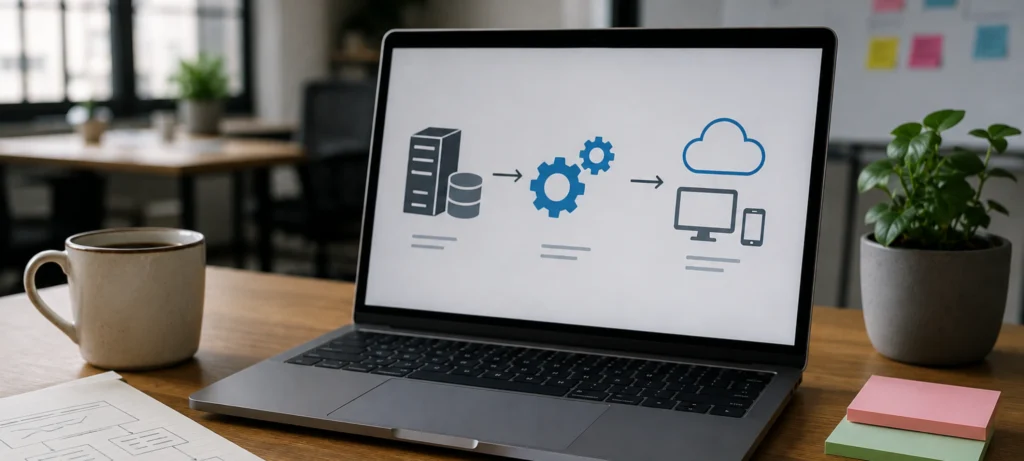
Cloud migration via rehosting, often called lift and shift, involves moving an existing application to a cloud environment (AWS, Azure, GCP) with minimal or no changes to the application code, features, or architecture. The underlying hardware platform is replaced with modern cloud infrastructure, but the application itself runs largely unchanged.
This is usually the fastest and least disruptive modernization strategy. It reduces dependence on on-premises hardware and shifts costs from large upfront investments (CapEx) to pay-as-you-go cloud expenses (OpEx). It also allows businesses to take advantage of cloud benefits like flexibility, managed services, and global access.
At AI-IoT Geeks, we help organizations migrate legacy applications to secure and scalable cloud environments using modern infrastructure services. Our approach focuses on minimizing downtime, improving infrastructure flexibility, and creating a stable foundation for future modernization initiatives.
Replatforming
Replatforming makes targeted changes to an application to take advantage of a modern environment , typically cloud-native services without redesigning the core architecture or rewriting business logic. Common replatforming activities include upgrading the database to a managed cloud database, switching to a modern application server, containerizing the application, or adopting a managed message queue in place of a custom one.
The advantage of replatforming over pure rehosting is that it unlocks real operational benefits , improved scalability, reduced administrative overhead, better observability , while keeping transformation risk low. It is particularly valuable for systems where the core functionality is sound but the surrounding technology stack is holding back performance and integration capabilities. Among modern legacy system modernization strategies, replatforming is widely adopted because it balances modernization benefits with lower implementation risk.
Code Refactoring
Refactoring restructures existing application code to improve efficiency, maintainability, and scalability without changing its external behavior or business functionality. Common legacy modernization techniques include simplifying complex logic, removing duplicated code, and decomposing large modules into smaller units. The goal is to reduce technical debt incrementally and prepare codebases for eventual migration to microservices or cloud-native patterns.
AI-IoT Geeks uses AI-assisted development workflows, intelligent code analysis, and modern engineering practices to support legacy system modernization strategies 2026 by reducing technical debt and improving long-term maintainability across enterprise applications. Our refactoring approach prioritizes scalability, performance optimization, and future cloud readiness.
Rearchitecting & Microservices Decomposition
Rearchitecting involves redesigning an application using modern architectural patterns such as microservices, event driven architecture, domain driven design, or serverless computing, without necessarily replacing all existing code. Monolithic applications are broken down into smaller, independently deployable services that can be developed, scaled, and updated separately.
This strategy delivers strong long term value in terms of faster development, improved system reliability, and better scalability. Teams that have completed microservices transformations often find they can release new features much more quickly than before. The main challenge is organizational, as this approach requires changes not only in architecture but also in team structure, DevOps practices, and testing processes.
API Encapsulation & Wrapping
API encapsulation, also called the wrapper strategy , involves building a modern API or service layer around an existing legacy system without modifying the underlying code. New applications, mobile front-ends, and cloud services communicate with the legacy system through these modern interfaces, effectively hiding its complexity and extending its functional life.
This strategy is particularly valuable when a complete modernization isn’t feasible in the near term, but integration with modern systems or cloud services is urgently needed. It’s often used as a transitional measure that buys time for deeper modernization, while immediately delivering integration capabilities and enabling API-first development patterns across the organization.
SaaS Replacement
For non-differentiating business functions such as HR management, generic CRM, payroll, standard finance operations , replacing a legacy custom-built system with a modern SaaS platform is frequently the most practical and cost-effective modernization strategy. Modern SaaS solutions deliver enterprise-grade functionality, regular feature updates, compliance management, and vendor-managed security at a fraction of the cost of maintaining custom- built legacy systems.
The key challenge with SaaS replacement is data migration and user adoption , not technical implementation. Organizations must plan carefully for business continuity during the transition, invest in change management and training programs, and map complex customizations to standard platform features before cutover.
Complete Rebuild
A complete rebuild means developing a new version of the application from scratch using modern technologies, frameworks, and architectural patterns. Business logic and requirements from the legacy system are preserved and reimplemented, but no code is carried forward. This approach is usually chosen when the existing system is too outdated, poorly documented, or difficult to maintain, making gradual improvements impractical.
While this is often the most expensive and higher-risk strategy, modern development tools and AI-assisted coding have made rebuilds faster and more manageable than before. What once took years to complete can now be delivered in a much shorter time with better planning and automation. The result is a clean, modern platform that is easier to maintain, supports cloud environments, and works well with current development and deployment practices.
Strangler Fig (Incremental Replacement)
The Strangler Fig pattern, inspired by the way a fig tree gradually grows around and replaces its host, is a practical approach for modernizing large and complex enterprise systems. Instead of replacing everything at once, new features are built in modern systems, while existing functionality is moved step by step. During this process, the legacy system continues to run alongside the new one. Over time, the old system is fully replaced without causing major disruption. AWS perspective guidance describes this precisely , “The strangler fig pattern is a modernization approach in which the existing functionalities of a legacy system are incrementally replaced with new applications and services until the new system eventually replaces all the old or key parts of the legacy system.”
This approach allows organizations to deliver value continuously while reducing risk. It avoids major system downtime, supports ongoing business operations, and gives teams time to adapt to new technologies and processes. It is especially useful for systems that are critical to the business, tightly connected with other systems, and too large to replace in a single effort.
Before selecting any of these strategies, it is equally important to understand the system you are dealing with, its type, structure, and risk profile. Our guide on legacy system risks, types and modernization signs covers that diagnostic foundation in detail.
What Are Industry-Specific Legacy System Modernization Strategies?
Legacy Modernization Strategies Across Different Industries.
The right modernization strategy is not universal , it varies significantly by industry, driven by regulatory environment, customer expectations, system criticality, and competitive dynamics. Here is how the calculus differs across key sectors.
Banking & Financial Services
Strangler Fig and API encapsulation are preferred for core banking systems. Zero Trust architecture, open banking API compliance, and real-time fraud detection capabilities are top modernization drivers. COBOL replacement is the most critical and costly challenge.
We deliver secure modernization solutions for financial platforms with a focus on compliance, API security, cloud scalability, and real-time transaction processing while maintaining regulatory alignment and system reliability.
Healthcare
EHR modernization with HIPAA compliance is the primary focus. Cloud migration with AI-powered clinical decision support is driving investment. Healthcare organizations using modernized platforms report significant reductions in IT maintenance costs within a short period after deployment.
Our experience at AI-IoT Geeks includes building secure, compliant healthcare solutions where data privacy and system reliability are critical. We integrate AI-driven insights with cloud infrastructure to support better clinical decisions while maintaining strict compliance and system integrity.
Retail & Commerce
Composable, API-driven architecture replacing siloed POS and ERP systems is the dominant strategy. Organizations that completed retail modernization report improved customer order accuracy and significantly faster omnichannel rollouts.
We help retail and eCommerce businesses modernize ERP, POS, and customer engagement systems using scalable cloud infrastructure, API-first architectures, and AI-powered analytics to improve operational efficiency and customer experience.
Government & Public Sector
Low-risk, incremental strategies dominate. Encapsulation and replatforming are common first steps. Citizen-facing services drive UI modernization priorities. Procurement constraints often make the Strangler Fig pattern the only viable long-term path.
We understand the unique constraints of public sector modernization, including compliance, procurement processes, and legacy dependencies. AI-IoT Geeks focuses on secure, phased transformations that enhance citizen services while ensuring transparency, reliability, and long-term sustainability.
Manufacturing & Supply Chain
Legacy ERP system modernization strategies often focus on ERP modernization to cloud-native platforms, API integration, and IoT connectivity to improve operational efficiency, scalability, and real-time visibility across supply chain operations. Organizations modernizing operational technology (OT) alongside IT systems face unique security and real-time performance requirements that demand careful phasing. For a detailed walkthrough, see our legacy ERP system migration guide.
Insurance
Policy administration systems are often decades old and deeply integrated. Replatforming to modern cloud platforms combined with API encapsulation of core policy engines is the dominant strategy. AI-powered underwriting and claims automation are the main business drivers.
Strategy vs. Approach
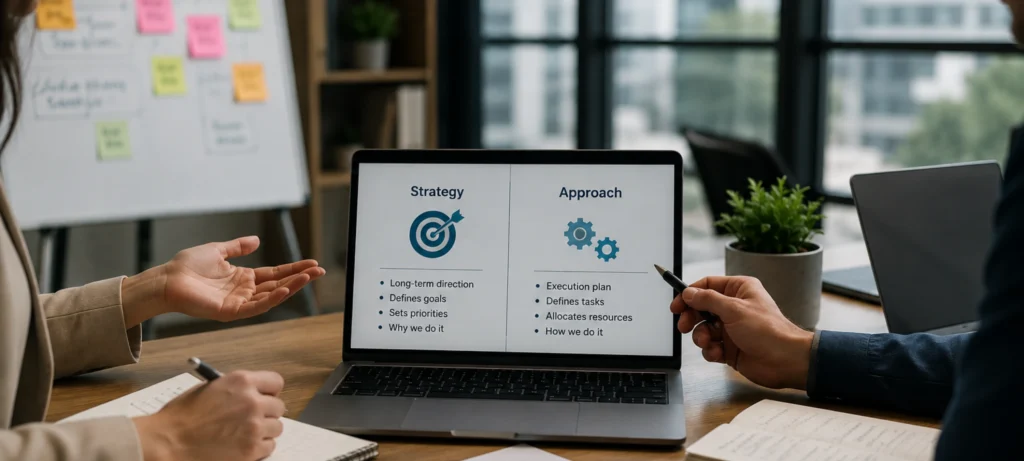
Difference Between Legacy System Modernization Strategy And Approach.
At AI-IoT Geeks, we help organizations define clear modernization roadmaps before selecting the technical implementation methods best suited for their systems, infrastructure, and long-term business goals. Through our legacy system modernization service, our experience across cloud, AI/ML, ERP, and enterprise modernization projects allows us to align technical execution with measurable business outcomes. A structured legacy system modernization process typically begins with defining business goals, assessing existing systems, prioritizing modernization needs, and selecting the right technical approach for execution.
Aspect
Definition
Focus
Scope
Key Elements
Purpose
Risk If Ignored
Role In Process
Outcome
Strategy
A broader plan that defines why, what, and how modernization will happen across the organization
Business goals, priorities, governance, and long-term outcomes
Organization-wide or portfolio-level
Business objectives, system prioritization, sequencing, governance, success metrics
Ensures modernization efforts are aligned, coordinated, and measurable
Leads to fragmented modernization, poor alignment, and increased complexity
Comes first – defines direction and decision-making framework
A clear, structured modernization roadmap
Approach
A technical method used to modify or upgrade a specific system
Technical execution of changes within a system
System-level or application-level
Methods like rehosting, refactoring, rearchitecting
Implements the actual transformation of systems
Leads to inefficient or unsuitable technical implementation
Comes after strategy – selected based on strategic goals
Execution of specific system changes
How Do You Prioritize And Sequence Legacy System Modernization?
Building a Practical Modernization Roadmap.
Not every legacy system needs to be modernized at once, and not every system needs the same level of transformation. One of the most common questions organizations ask is how do you modernize a legacy system without a full rewrite, and the answer usually starts with sequencing, not technology choice.
Prioritization Framework
Most modernization roadmaps score applications against four dimensions:
Business Criticality
How central is the system to revenue generation, customer experience, or core operations? Systems that directly touch customers or revenue typically move to the front of the queue.
Technical Risk
How fragile is the system? Consider unsupported platforms, disappearing vendor support, undocumented code, or a shrinking pool of engineers who understand it. Our guide to assessing legacy system risk walks through this evaluation in more depth.
Integration Complexity
How many other systems depend on this one? Highly connected systems carry more modernization risk but often deliver more value once addressed.
Cost Of Inaction
What is the ongoing cost of leaving the system as is? This includes compliance exposure, rising maintenance spend, security vulnerabilities, and lost competitive agility.
Systems that score high on both business criticality and technical risk are usually addressed first. Stable, low risk systems can often wait, or receive lighter touch treatment such as replatforming or API encapsulation rather than a full transformation.
Modernizing Without A Full Rewrite
A complete rebuild is rarely the first, or even the best, option. Several of the core strategies covered above are specifically designed to modernize incrementally:
API encapsulation
Wraps a modern interface around the legacy system, allowing new applications to integrate with it without touching the underlying code.
Strangler Fig (incremental replacement)
Gradually replaces functionality piece by piece while the legacy system continues running in parallel, avoiding a risky big bang cutover.
Replatforming
Upgrades the surrounding technology stack, including the database, containerization, and messaging, without rewriting core business logic.
These approaches let organizations reduce technical debt and improve integration capability while preserving business continuity, which is often the deciding factor for systems that cannot tolerate downtime or a lengthy freeze on new features.
At AI IoT Geeks, we build modernization roadmaps that sequence applications by business impact and risk, then match each one to the lightest touch strategy that achieves the required outcome, reserving full rebuilds for the systems that genuinely need them.
What Are The Key Risks And Mitigation Approaches In Legacy System Modernization Strategies?
Legacy System Modernization Risks And Mitigation Strategies.
Even well designed legacy system modernization strategies encounter predictable risks.Our piece on common legacy modernization challenges explores these in more depth. AI-IoT Geeks minimizes modernization risks through phased implementation models, security-first architecture, continuous monitoring, stakeholder collaboration, and proactive system validation processes. Our enterprise modernization experience helps organizations modernize with greater stability, security, and operational confidence.
Data Migration Failures
Data migration is one of the highest risk areas in legacy system modernization strategies because it involves moving large volumes of critical business data. Issues such as data loss, corruption, or inconsistency can severely impact operations.
Mitigation strategies include automated validation checks, parallel system environments, phased migration, and rollback mechanisms to ensure safe transitions. At AI-IoT Geeks, we implement structured migration frameworks, backup validation processes, and continuous monitoring to minimize disruption during enterprise-scale migrations.
Hidden Business Rules
Legacy systems often contain undocumented business logic embedded over many years. Without identifying these rules, modernization efforts can break existing workflows and processes.
Mitigation strategies include AI assisted code analysis, collaboration with domain experts, detailed process mapping, and running systems in parallel before full transition.
Security Risks
Hybrid environments created during modernization introduce integration points between old and new systems, which can increase security vulnerabilities.
Mitigation strategies include implementing Zero Trust architecture, encrypting all data in transit, and performing continuous security assessments at each stage of modernization. Explore our cyber security services for more on securing hybrid modernization environments.
Stakeholder Resistance
Resistance from users and teams familiar with legacy systems can slow down or disrupt modernization efforts, especially when workflows change significantly.
Mitigation strategies include early stakeholder involvement, clear communication, phased rollouts, and structured training programs to support adoption.
Skill Gaps
Modernization often requires skills such as cloud architecture, DevOps, and modern programming frameworks that existing teams may not fully possess.
Mitigation strategies include upfront skills assessment, targeted upskilling programs, and collaboration with specialized technology partners to support delivery.

How Is Generative AI Transforming Legacy System Modernization?
The Role Of Generative AI In Legacy System Modernization.
Legacy system modernization with AI is reshaping how enterprises approach transformation projects, from analyzing undocumented code to accelerating testing and deployment. Through our AI and machine learning development, we integrate AI-assisted development, intelligent automation, advanced code analysis, and AI-powered testing workflows into modernization projects to accelerate delivery timelines and improve modernization accuracy.
Our AI-driven modernization capabilities help organizations modernize complex systems more efficiently while maintaining compliance and security standards.
Automated Codebase Analysis
AI can analyze large volumes of undocumented legacy code, identify embedded business logic, map dependencies, and highlight technical debt areas.This reduces the need for time-consuming manual reviews and helps teams understand complex systems more quickly before modernization begins.
Automated Code Translation
AI tools can convert legacy code into modern programming languages with higher accuracy compared to traditional methods. This allows organizations to move from outdated technologies to modern, scalable systems while preserving existing functionality and reducing redevelopment effort.
Our engineering teams use intelligent code analysis workflows to support legacy system modernization strategies by improving visibility into enterprise applications and accelerating modernization planning across large-scale systems.
Documentation Generation
AI can automatically generate technical documentation, including system architecture details, data structures, and process flows directly from code.This removes a major challenge in modernization projects and makes systems easier to maintain and scale over time.
Accelerated Testing
AI-assisted test generation can automatically produce unit tests, integration tests, and regression suites for modernized code , dramatically reducing the time required to validate that migrated functionality behaves correctly.
Our QA and DevOps teams integrate AI-powered testing workflows with continuous integration pipelines to strengthen legacy system modernization strategies, improve software quality, reduce deployment risk, and accelerate release cycles.
Timeline Compression
AI streamlines multiple stages of modernization, from code analysis to deployment.This enables faster project completion, making modernization more practical and achievable without compromising system quality or performance.
Security note: When selecting AI-assisted modernization tools, enterprise organizations in regulated industries should prioritize platforms that operate on-premises or within private cloud environments. Sending proprietary business logic and legacy code to third-party AI APIs can create unacceptable compliance and IP exposure risks.
Security note:
When selecting AI-assisted modernization tools, enterprise organizations in regulated industries should prioritize platforms that operate on-premises or within private cloud environments. Sending proprietary business logic and legacy code to third-party AI APIs can create unacceptable compliance and IP exposure risks.

Conclusion
Legacy system modernization strategies 2026 provide a practical framework for evolving outdated systems without unnecessary disruption. By combining approaches like rehosting, refactoring, replatforming, or incremental replacement, organizations can modernize at the right pace based on system complexity and business priorities.
At AI-IoT Geeks, our experience across cloud, AI/ML, and enterprise system transformations allows us to evaluate legacy environments with a clear, structured approach. We focus on aligning each modernization strategy with real business needs, ensuring secure, scalable, and sustainable outcomes.
The real value lies in selecting the right strategy for each system rather than applying a single approach across the board. When executed with the right expertise and planning, these strategies reduce risk, improve scalability, and prepare systems for future growth.
Your legacy systems deserve better performance, scalability, and security. AI-IoT Geeks delivers reliable modernization solutions.
Book a Free Strategy Call at aiiotgeeks.com
Have any questions in mind
Frequently Asked Questions?
Why do businesses need to modernize legacy systems?
Businesses modernize legacy systems to reduce maintenance costs, improve scalability, enable integration with modern tools, and support faster innovation and growth.
What are the main types of legacy system modernization strategies?
The core strategies include rehosting (lift and shift), replatforming, refactoring, rearchitecting, API encapsulation, SaaS replacement, complete rebuild, and the Strangler Fig approach.
How do I choose the right modernization strategy?
The right strategy depends on system condition, business criticality, technical constraints, and long-term goals. Most organizations use a combination of strategies across their application portfolio.
How does AI-IoT Geeks approach legacy system modernization?
AI-IoT Geeks follows a structured process that includes system audits, architecture planning, and phased execution across cloud, AI/ML, and data environments to ensure strategies align with business objectives.