


What Is An SEO Audit? Complete Website SEO Guide
Understanding The Importance Of SEO Audits For Website Performance.
Your website might look great. It might even load fast. But if it’s not showing up when your customers search for what you offer, something is broken and you may not even know where the problem is. That’s exactly what an SEO audit is designed to fix.
An SEO audit is one of the most important investments a business can make in its digital presence. It’s the process of systematically examining every element of your website that affects how search engines find, understand, and rank your content. Without one, you’re essentially flying blind spending money on marketing while ignoring the foundational problems that are quietly suppressing your visibility in search results.
At AI-IoT Geeks, this process is guided by hands-on SEO experience, deep technical expertise, and real-world campaign insights, ensuring every issue identified is accurate, relevant, and actionable.
In this blog, we’ll break down what is an SEO audit, what is included in an SEO audit, why it matters, how frequently you should run one, and the step-by-step process to conduct one effectively.

What Is An SEO Audit?
Understanding What Is An SEO Audit And How It Works.
An SEO audit refers to the process of comprehensive analysis of a website’s adherence to best practices for search engine optimization. It involves examining various elements including technical SEO, on-page SEO, off-page SEO, and user experience to identify areas that need improvement.
In simple terms, what is an SEO audit can be explained as a full website health check that evaluates technical SEO, on-page SEO, off-page SEO, and user experience.
The ultimate goal of an SEO audit is to enhance a website’s organic traffic, search engine rankings, and overall performance all without spending a single extra dollar on paid advertising.
At AI-IoT Geeks, audits are conducted using proven methodologies, real campaign data, and industry best practices, ensuring every recommendation is backed by evidence and aligned with measurable outcomes.

What Is Site Audit In SEO?
Understanding How An SEO Site Audit Improves Website Health.
Many people ask what is site audit in SEO and whether it is different from an SEO audit. To answer what is website SEO audit, it is a comprehensive evaluation of your website’s technical health, content, user experience, and overall SEO performance to identify issues that affect search visibility. In reality, both terms are often used interchangeably. A site audit in SEO is the process of evaluating a website’s overall health to identify technical issues, content gaps, user experience problems, and optimization opportunities that may be affecting search engine rankings.
A site audit examines whether search engines can efficiently crawl, index, and understand your website while also reviewing on-page optimization, backlink quality, website speed, mobile usability, internal linking, and Core Web Vitals. The goal is to uncover issues that prevent your website from achieving its full organic search potential.
Unlike a quick website scan, a comprehensive SEO site audit provides prioritized recommendations that help businesses improve rankings, increase organic traffic, enhance user experience, and build a stronger foundation for long-term SEO success.
Why Is An SEO Audit Important?
The Importance Of SEO Audits For Online Growth.
Consider this: a majority of online experiences begin with a search engine. If your website isn’t optimized to appear in those searches, you’re missing a significant portion of your potential audience before they even know you exist.
The importance of an SEO audit lies in its ability to diagnose hidden issues or weaknesses that may be quietly holding back your search engine performance. By uncovering and addressing these problems, businesses can improve their website’s user experience, climb the search rankings, and drive more qualified traffic and conversions. This addresses two of the most common questions businesses ask: why you need an seo audit and why an seo audit is important.
Here’s why businesses of every size need regular SEO audits:
1.Uncover Invisible Technical Problems
Many of the most damaging SEO issues such as crawl errors, broken redirects, duplicate content, and slow page speed are completely invisible to the naked eye. You won’t know they exist until an audit surfaces them.
2.Stay Ahead Of Algorithm Changes
Search engines regularly update their algorithms. These changes can significantly impact rankings, and a routine SEO audit helps you identify whether your site has been affected and what needs to change.
3.Benchmark Against Competitors
An SEO audit doesn’t just analyze your website in isolation. It also measures how you compare to competitors ranking for the same keywords. Understanding that gap is the first step toward closing it.
4.Get More Value From Your Existing Content
Many businesses have pages that rank for nothing, convert no one, and waste crawl budgets. An audit identifies these underperformers and shows you how to improve, consolidate, or repurpose them effectively.
5.Provide A Foundation For Your Entire SEO Strategy
By regularly conducting SEO audits, businesses can stay aligned with evolving trends, algorithm updates, and competitive shifts, ensuring their website remains visible, relevant, and performance driven. This is why an SEO audit works best as part of a wider digital marketing audit, rather than in isolation.
At AI-IoT Geeks, these insights are derived from continuous analysis, technical expertise, and real-world SEO performance data, ensuring businesses make decisions based on accuracy, not assumptions.

What Is Included In An SEO Audit?
Core Components Of An SEO Audit Explained.
When learning what is an SEO audit, it is equally important to understand what does an seo audit include. A comprehensive SEO audit examines your website across three primary pillars: technical SEO, on-page SEO, and off-page SEO. Each plays a distinct role in how search engines evaluate your site.
1.Technical SEO Audit
Technical SEO is the foundation everything else is built on. If search engines can’t properly crawl and index your site, none of your content or link-building efforts will reach their full potential.
A technical SEO audit examines:
Crawlability And Indexability
Can search engine bots access and understand all the pages you want to rank? Are there pages being accidentally blocked by your robots.txt file or no index tags?
XML Sitemap
Is your sitemap up to date, correctly formatted, and submitted to Google Search Console? A well-structured sitemap helps search engines discover and prioritize your pages.
URL Structure
Are your URLs clean, descriptive, and logically organized? Inconsistent URL structures confuse both users and search engines.
Page Speed And Core Web Vitals
Google uses Core Web Vitals (Largest Contentful Paint, First Input Delay, Cumulative Layout Shift) as direct ranking signals. Slow-loading pages not only hurt rankings but drive users away before your content even loads. A well-built website is the first line of defense, learn how our Website Development service ensures your site is built for speed and performance from the ground up. And the importance of this goes straight to the source , according to Google Search Central, “We highly recommend site owners achieve good Core Web Vitals for success with Search and to ensure a great user experience generally.”
Mobile SEO
With Google operating on a mobile-first indexing model, your site must perform flawlessly on smartphones and tablets. Any mobile usability issues are a direct ranking liability.
Redirects And Status Codes
The audit checks for broken links (404 errors), redirect chains, and incorrect server responses that waste crawl budgets and create poor user experiences.
Canonical Tags
Duplicate content confuses search engines about which version of a page to rank. Canonical tags tell Google which URL is the “master” version an audit verifies these are set correctly across your site.
HTTPS And Security
Sites without HTTPS are flagged as “not secure” in browsers and may rank lower. An audit confirms your security certificates are valid and properly configured.
Structured Data And Schema Markup
Properly implemented schema markup can unlock rich results in search (star ratings, FAQs, product information). An audit identifies schema opportunities you may be missing.
At AI-IoT Geeks, technical audits are conducted with advanced tools and deep technical expertise, ensuring even the most complex issues are accurately diagnosed and resolved.
2. On-Page SEO Audit
On-page SEO covers everything on individual pages that signals relevance and quality to search engines.
Keyword Research And Targeting
Are your pages targeting the terms your audience actually searches for? An audit identifies keyword gaps , high-value terms your competitors rank for but you don’t yet have content covering.
Title Tags
Title tags are one of the most important on-page ranking signals. An audit checks whether each page has a unique, keyword-rich title tag within the recommended character limit.
Meta Descriptions
While not a direct ranking factor, compelling meta descriptions drive click-through rates from search results. An audit flags missing, duplicate, or poorly written meta descriptions.
Header Structure (H1–H6)
A logical heading hierarchy helps both users and search engines understand what a page is about. An audit checks for missing H1 tags, keyword usage in headings, and structural issues.
Content Quality And Depth
Is your content comprehensive, accurate, and genuinely useful to the user’s search intent? Thin content pages with little substance is a significant ranking liability in the current search landscape.
Internal Linking
Strategic internal links help search engines discover pages, understand site architecture, and distribute authority across your content. An audit maps your internal link structure and identifies orphan pages (pages with no internal links pointing to them).
Image Optimization
Images without alt text are invisible to search engines and inaccessible to screen readers. An audit checks alt text, image file sizes, and format optimization.
Duplicate Content
Content that appears on multiple URLs confuses search engines and splits ranking authority. An audit identifies all instances of duplicate or near-duplicate content.
Our Digital Marketing Strategies team combines keyword intelligence, content expertise, and user intent mapping to ensure every page is optimized for both search engines and real users.
3. Off-Page SEO Audit (Backlink Analysis)
Off-page SEO primarily refers to the quality and quantity of websites linking back to yours. Backlinks remain one of the most powerful ranking signals in Google’s algorithm.
Backlink Profile Analysis
Who is linking to your site, and are those links helping or hurting you? High-quality backlinks from authoritative, relevant websites boost rankings. Toxic or spammy backlinks can trigger manual penalties.
Domain Authority Benchmarking
How does your site’s overall authority compare to competitors? Understanding this gap helps prioritize link-building efforts.
Competitor Backlink Gaps
Which sites link to your competitors but not to you? These represent direct link-building opportunities you can pursue.
Anchor Text Distribution
Over-optimized anchor text (too many exact-match keywords) can be a red flag for Google. An audit checks for natural, diverse anchor text patterns.
Our off page SEO experts conduct backlink analysis backed by competitive research and authority evaluation, ensuring link building strategies are safe, effective, and aligned with long term SEO growth.
4. User Experience (UX) Audit
Search engines increasingly use user behavior signals to evaluate quality. An SEO audit therefore includes a review of the experience your site delivers to real users.
Navigation Structure
Is your website easy to navigate, with clear paths that help users find information quickly?
Page Layout And Design
Are pages structured in a way that is visually clear, engaging, and easy to scan?
Mobile Usability
Does your website provide a seamless experience across all devices, especially smartphones and tablets?
Content Readability
Is your content easy to read, well-structured, and aligned with user intent?
Conversion Flow
Are users guided effectively toward key actions such as form submissions, purchases, or sign-ups?
Poor user experience not only frustrates visitors but also sends negative signals to search engines, directly impacting rankings. Our UI/UX Product Design team conducts UX audits informed by real user behavior data and performance insights, ensuring improvements directly enhance both rankings and conversions. For a deeper look at this process, see our dedicated guide on UX Audit.

How Many Times Should You Audit Your Site For SEO?
SEO Audit Frequency And Timing Guidelines.
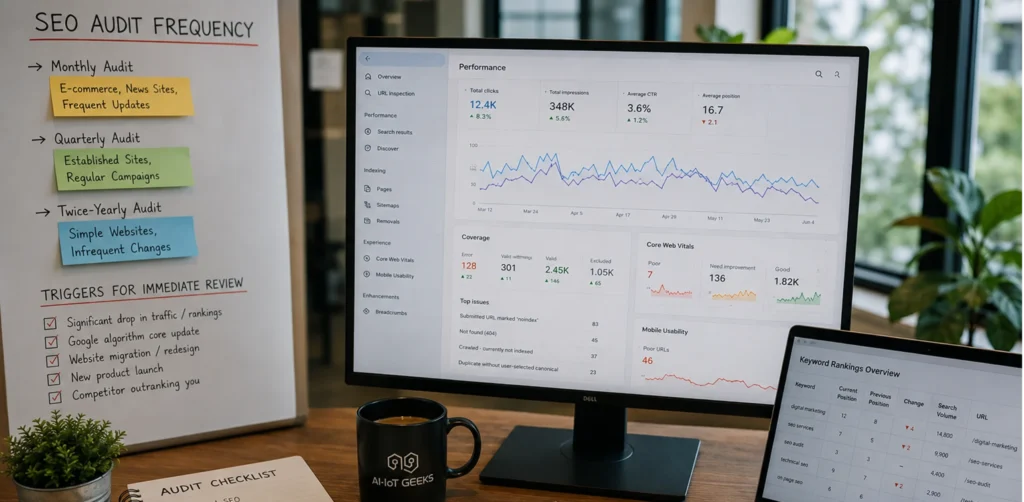
The right audit frequency depends on your website’s size, rate of change, and competitive landscape. If you’re wondering how many times you should audit your site for SEO, the answer depends on how often your website changes and how competitive your industry is.
Here are general guidelines for how many times should you audit your site for SEO.
- Monthly audits are recommended for sites with frequent content updates or active development such as e-commerce sites, news sites, or any site with a large or rapidly changing page count.
- Quarterly audits suit established websites that update content seasonally or run regular marketing campaigns.
- Twice-yearly audits are appropriate for simpler websites that change infrequently, such as small business service pages.
Beyond scheduled audits, there are specific triggers that should prompt an immediate review:
- A significant, unexplained drop in organic traffic or keyword rankings
- A major Google algorithm core update
- A website migration, redesign, or platform change
- New product launches or major content strategy shifts
- A competitor has begun outranking you in search
No matter how many times you audit your site for SEO, continuous monitoring of critical technical issues such as crawl errors, 404 pages, and site speed regressions through Google Search Console and Core Web Vitals reports is essential for maintaining long-term search performance.
How To Perform An Seo Audit?
Complete Process Of How To Perform An Seo Audit.
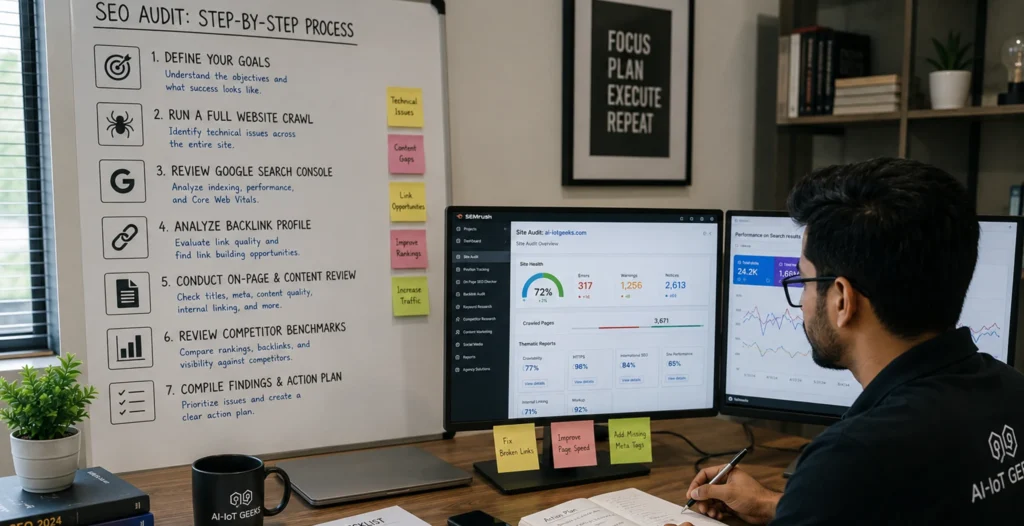
Step 1: Define Your Goals
Before collecting a single data point, establish what success looks like. Are you trying to recover lost rankings? Increase organic traffic by a specific percentage? Improve lead generation from organic search? Your goals determine which issues to prioritize.
Step 2: Run A Full Website Crawl
Use a crawling tool to simulate how Google’s bots explore your website. This surfaces technical issues at scale such as broken links, redirect chains, duplicate content, missing metadata, and more across every page of your site.
Key tools: Screaming Frog, Sitebulb, SEMrush Site Audit, Ahrefs Site Audit
Step 3: Review Google Search Console
Google Search Console is your direct line to how Google sees your site. Review the Page Indexing report for coverage errors, the Core Web Vitals report for performance issues, and the Performance report for keyword rankings, impressions, and click-through rates.
Step 4: Analyze Your Backlink Profile
Export your backlink data and evaluate the quality, relevance, and diversity of sites linking to you. Identify any toxic or low-quality links that may need to be disavowed, and map out link-building opportunities based on competitor analysis.
Key tools: Ahrefs, SEMrush, Moz Link Explorer, Google Search Console
Step 5: Conduct On-Page And Content Review
Audit all key pages for title tags, meta descriptions, header structure, keyword targeting, content quality, and internal linking. Flag thin content, duplicate content, and keyword cannibalization where multiple pages compete for the same search term.
Step 6: Review Competitor Benchmarks
Use tools like SEMrush or Ahrefs to compare your keyword rankings, organic visibility, and backlink profile against your top competitors. This reveals both the gaps you need to close and the opportunities they’ve left open for you.
Step 7: Compile Findings Into A Prioritized Action Plan
Organize your findings by category and prioritize them based on impact versus effort. Quick wins such as fixing broken redirects, adding missing title tags, and improving page speed should come first. Longer term strategic improvements follow. This output is often what people are asking about when they search what is seo audit report. If you’re wondering what is SEO audit report, it is a detailed report that outlines technical SEO issues, on-page and off-page optimization opportunities, user experience concerns, and prioritized recommendations to improve your website’s rankings, organic traffic, and overall search performance.
A good SEO audit report does not stop with a data dump. It translates every finding into a specific, actionable task with a clear owner, timeline, and expected outcome.
What Are The Best SEO Audit Tools?
Essential Tools Used For Comprehensive SEO Audits.
At AI-IoT Geeks, industry-leading SEO tools are combined with expert interpretation to ensure accurate insights and actionable strategies.
You don’t need to run an SEO audit blind. Here are the most widely used tools:
Google Search Console
Free, direct data from Google on how your site is indexed, what keywords it ranks for, and what technical errors exist.
Google Analytics 4
Tracks user behavior, traffic sources, and conversion data that contextualizes your SEO findings.
Screaming Frog SEO Spider
Industry-standard desktop crawler that surfaces technical SEO issues across your entire site.
SEMrush Or Ahrefs
All-in-one platforms for site auditing, keyword research, backlink analysis, and competitor benchmarking.
Google PageSpeed Insights / GTmetrix
Analyze page loading speed and Core Web Vitals performance in detail.
Moz Pro
Site crawl, keyword tracking, and link analysis in one platform.

How AI-IoT Geeks Approaches SEO Audits?
A Data-Driven SEO Audit Approach Built For Long-Term Growth.
At AI-IoT Geeks, our Digital Marketing Strategies service is rooted in data and every engagement begins with a structured SEO audit that gives us (and you) a clear, honest picture of where your site stands. If you want to see how this fits into a broader marketing evaluation, our Digital marketing audit post covers that wider process. If you’re weighing whether to run this in-house or bring in outside help, our post on benefits of outsourcing digital marketing breaks down that decision.
Our SEO audit process covers:
- Full technical crawl and indexation analysis
- On-page SEO review across all key pages
- Backlink profile analysis and competitor benchmarking
- Core Web Vitals and mobile performance assessment
- Content gap analysis and keyword opportunity mapping
- A prioritized action roadmap with defined timelines and expected impact
We’ve delivered measurable SEO improvements for clients across healthcare, SaaS, retail, financial services, government and manufacturing globally, across time zones. Whether your site has 10 pages or 10,000, we tailor our audit methodology to your industry, audience, and growth goals. Beyond SEO, our broader design and marketing capabilities including Branding and Visual Design and Logo Design ensure that once your technical foundation is fixed, your brand presentation is just as strong.

Conclusion
Understanding what is an SEO audit is a critical process for improving website performance, fixing hidden issues, and boosting search visibility. It helps businesses understand what is working, what is not, and what needs improvement to achieve better rankings, traffic, and conversions.
Regular SEO audits ensure your website stays optimized, competitive, and aligned with search engine updates. They turn complex data into clear, actionable steps for sustainable growth.
At AI-IoT Geeks, we apply strong principles in every SEO audit. Our approach is backed by real campaign experience, technical SEO knowledge, and data-driven insights across multiple industries. This ensures every recommendation is practical, accurate, and focused on measurable results.
With the right audit strategy and expert execution, businesses can consistently improve their online visibility and long-term digital performance.
Improve rankings, traffic, and website performance with AI-IoT Geeks’ data-driven SEO audit expertise today.
Book a Free Strategy Call at aiiotgeeks.com
Have any questions in mind
Frequently Asked Questions?
Why do businesses need an SEO audit?
Businesses need an SEO audit to identify hidden technical issues and understand what is an SEO audit is in practice and how it improves visibility.
How does an SEO audit help improve website performance?
It highlights problems in technical SEO, content, and user experience that may be preventing your website from ranking higher on Google.
What does a full SEO audit include?
A full SEO audit includes technical SEO checks, on-page SEO analysis, off-page backlink review, and user experience evaluation.
How often should I conduct an SEO audit?
Most websites should run an SEO audit every 3–6 months, or immediately after major updates, traffic drops, or algorithm changes.
Which tools are best for SEO audits?
Popular tools include Google Search Console, Google Analytics 4, Screaming Frog, SEMrush, Ahrefs, and PageSpeed Insights.
Why choose AI-IoT Geeks for an SEO audit?
AI-IoT Geeks delivers data-driven SEO audits backed by real experience, technical expertise, and industry insights to ensure measurable improvements in rankings, traffic, and conversions.