


Odoo ERP For Healthcare: A Complete Guide To Smarter Patient Care And Operations
Healthcare providers are under more operational pressure than ever. Patient volumes are rising, staff time is limited, and compliance requirements keep getting stricter. Yet many hospitals and clinics still run on a patchwork of disconnected tools: one system for appointments, another for billing, a third for inventory, and spreadsheets holding everything else together.
Odoo ERP for healthcare replaces that patchwork with a single, modular platform that connects patient records, billing and invoicing, inventory, HR, and compliance in one place.This guide breaks down why healthcare organizations are adopting Odoo, which modules matter most, and how it specifically solves billing and invoicing challenges that eat into staff time and delay reimbursements.
Why Odoo ERP Is A Strong Fit For Healthcare Organizations?
Key Advantages of Odoo ERP for healthcare providers.
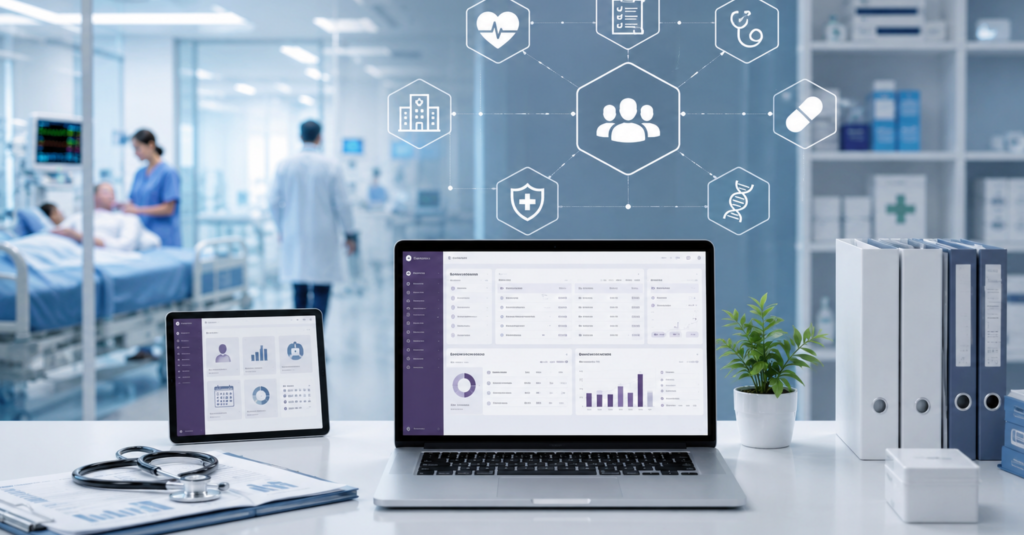
Healthcare organisations need a system that can streamline operations while maintaining accuracy, security, and compliance. Odoo is an open-source, modular ERP that adapts to the needs of healthcare providers, whether it’s a single clinic, a diagnostic center, or a multi-location hospital network. Its flexibility allows organisations to improve efficiency today while supporting future growth.
Modular by Design
Odoo lets healthcare providers implement only the modules they need, such as patient management, billing, inventory, or accounting, and add more as operations expand. This makes implementation cost-effective and easy to scale. With Odoo ERP for healthcare, providers can choose the features that match their current workflows and expand functionality as their operational needs grow.
Centralized Data Management
Odoo brings patient records, billing, inventory, and administrative data into one centralized platform. With real-time access to shared information, healthcare teams can reduce duplicate work, improve collaboration, and make faster, more informed decisions. Odoo ERP for healthcare gives authorized teams a unified view of patient, financial, inventory, and administrative information.
Role-Based Access and Security
Sensitive patient information is protected through role-based access controls, ensuring that only authorized staff can access specific records. This strengthens data security and helps organizations meet healthcare compliance requirements.
Scalability for Growth
From small clinics to large multi-specialty hospitals, Odoo scales with your organization. As healthcare operations grow, new modules, users, and workflows can be added without replacing the existing system — the kind of long-term fit we’ve built toward in our healthcare-focused ERP work.

Odoo ERP Workflow in a Hospital or Clinic
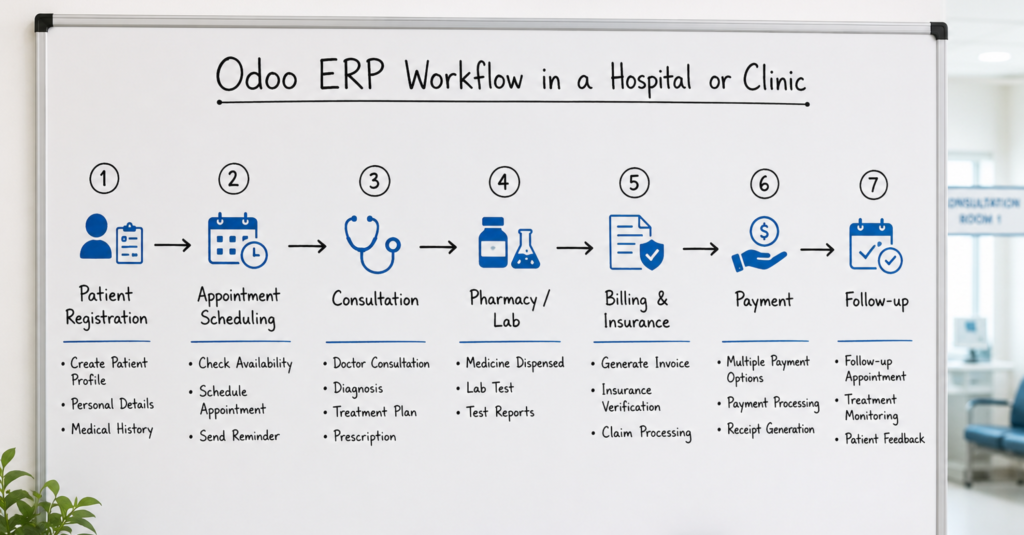
Understanding how Odoo ERP for healthcare actually functions day-to-day makes the value click faster than any feature list. Here’s what a typical patient journey looks like once everything runs on one connected system: This connected approach makes Odoo ERP for healthcare useful for coordinating every stage of the patient journey.
Patient Registration → Appointment Scheduling → Consultation → Pharmacy/Lab → Billing & Insurance → Payment → Follow-up
Here’s what happens at each stage:
Patient Registration
A new or returning patient’s details are captured once and stored centrally, so front-desk staff, doctors, and billing teams are all working from the same record.
Appointment Scheduling
The system checks doctor availability in real time and books the slot, automatically triggering reminder notifications to cut down on no-shows.
Consultation
The doctor pulls up the patient’s history, previous prescriptions, and lab results in one screen, and logs the visit directly into the same record.
Pharmacy/Lab
Prescriptions and lab orders flow straight from the consultation into inventory and lab modules, so stock and test requests update instantly.
Billing & Insurance
Charges generate automatically based on the services rendered, with insurance details already linked to the patient profile.
Payment
Patients can pay via multiple methods, with the payment reconciled against the invoice in real time.
Follow-up
Automated reminders for follow-up visits or ongoing treatment plans keep patients engaged without manual tracking.
The Operational Challenges Healthcare Providers Face Today
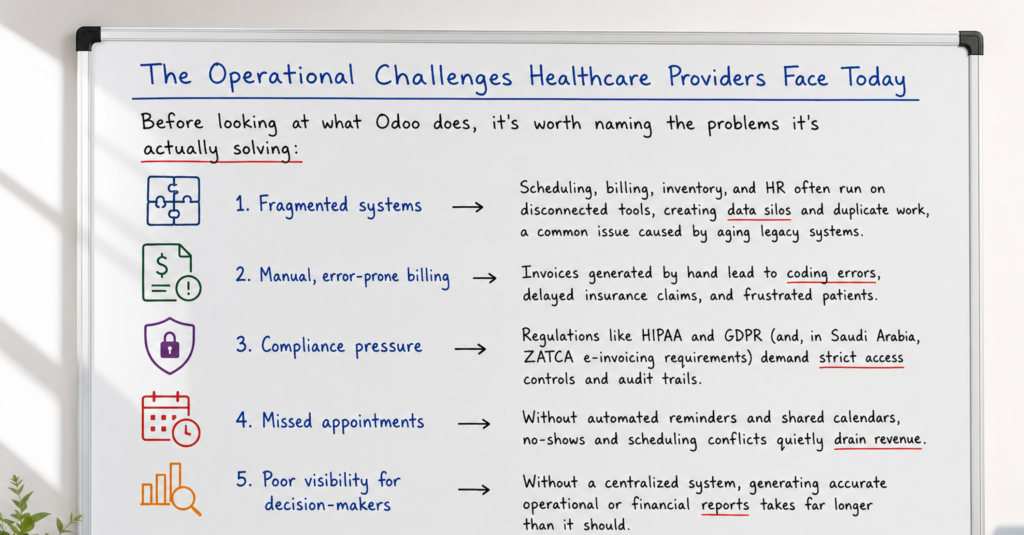
Before looking at what Odoo does, it’s worth naming the problems it’s actually solving:
Fragmented systems
Scheduling, billing, inventory, and HR often run on disconnected tools, creating data silos and duplicate work,a common issue caused by aging legacy systems.
Manual, error-prone billing
Invoices generated by hand lead to coding errors, delayed insurance claims, and frustrated patients, the kind of repetitive work our RPA development solutions are designed to eliminate.
Compliance pressure
Regulations like HIPAA and GDPR (and, in Saudi Arabia, ZATCA e-invoicing requirements) demand strict access controls and audit trails.
Missed appointments
Without automated reminders and shared calendars, no-shows and scheduling conflicts quietly drain revenue.
Poor visibility for decision-makers
Without a centralized system, generating accurate operational or financial reports takes far longer than it should.
These issues don’t just slow down administrative staff they directly affect patient trust and clinic profitability.
Key Modules In Odoo ERP For Healthcare
A healthcare-focused Odoo implementation typically draws on these core modules:
Patient Management
Centralized patient profiles covering personal details, appointment history, and medical records, connected directly to billing and pharmacy data.
Appointments & Scheduling
Shared calendars, automated reminders, and doctor/department coordination to reduce no-shows and double-booking.
Accounting, Billing & Invoicing
Automated patient invoicing, insurance claim tracking, and multi-departmental financial reporting.
Inventory & Pharmacy
Real-time stock tracking, expiry alerts, and automated reordering for medicines and consumables.
HR & Staff Management
Attendance, shift scheduling, payroll, and credential tracking for clinical and administrative staff.
Compliance & Security
Role-based permissions, encrypted storage, and audit trails to support HIPAA, GDPR, and regional data protection standards, part of our broader cyber security and ERP services and support offerings.

Odoo ERP for Billing and Invoicing in Healthcare
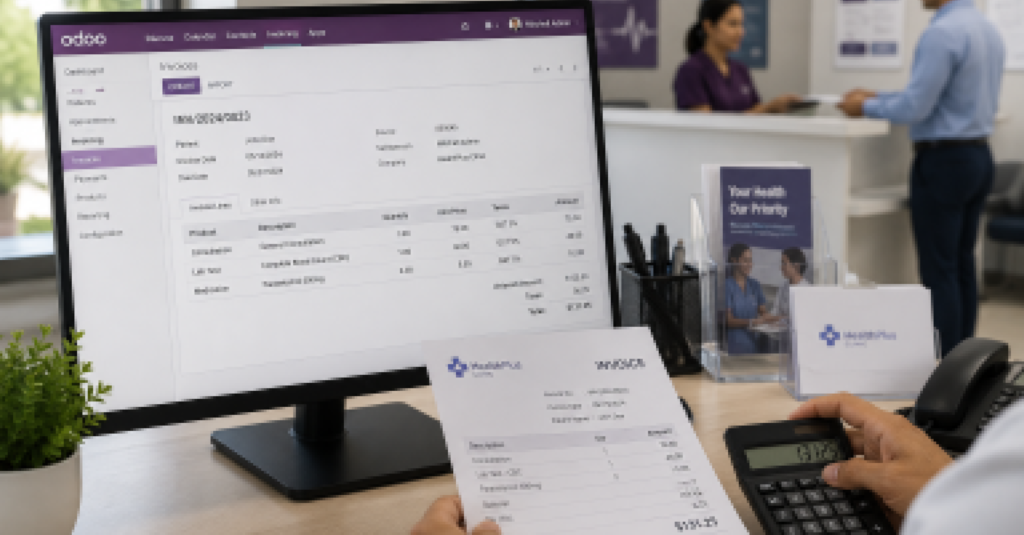
Billing is where a lot of healthcare ERP value gets realized and where a lot of manual processes quietly fail. Odoo’s accounting and invoicing tools are built to remove the friction points that typically slow down healthcare billing teams:
Automated invoice generation:
From treatment and consultation records, so charges are captured accurately without manual re-entry.
Insurance claim tracking:
That ties treatment codes to claims, reducing rejected or delayed reimbursements.
Custom billing templates:
That matches a clinic’s format and pre-configured insurer specifications, cutting down on repeated back-and-forth with patients.
Multi-departmental accounting:
So finance teams get a single, audit-ready view across every department instead of reconciling disconnected ledgers.
Tax and compliance-ready reporting:
Relevant for organisations operating under region-specific requirements such as e-invoicing mandates.
Benefits at a Glance
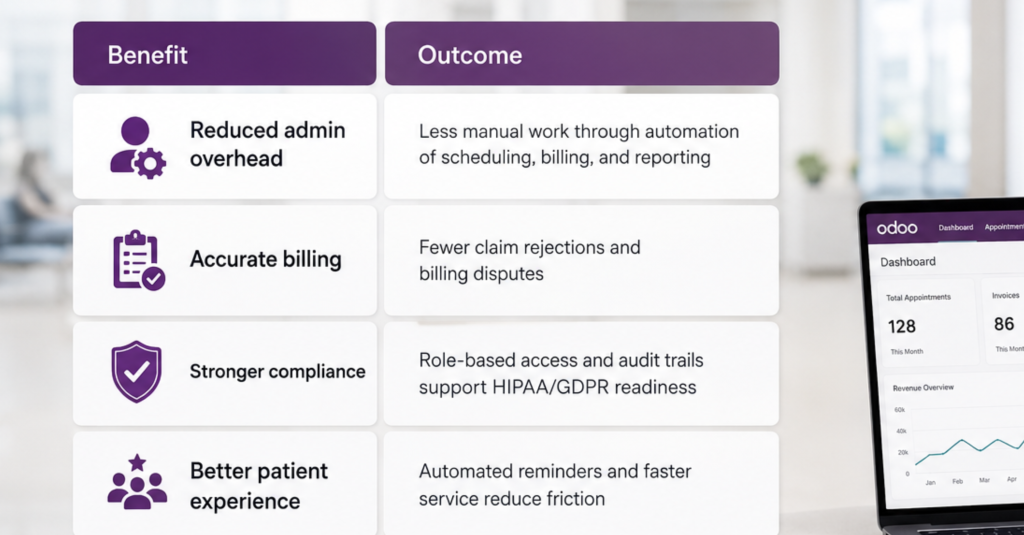
Benefit | Outcome |
Reduced admin overhead | Less manual work through automation of scheduling, billing, and reporting |
Accurate billing | Fewer claim rejections and billing disputes |
Stronger compliance | Role-based access and audit trails support HIPAA/GDPR readiness |
Better patient experience | Automated reminders and faster service reduce friction |
Centralized visibility | Real-time reporting across departments for faster decisions |
Challenges of Implementing Odoo ERP in Healthcare
No ERP rollout is friction-free, and healthcare brings its own specific hurdles worth planning for upfront:
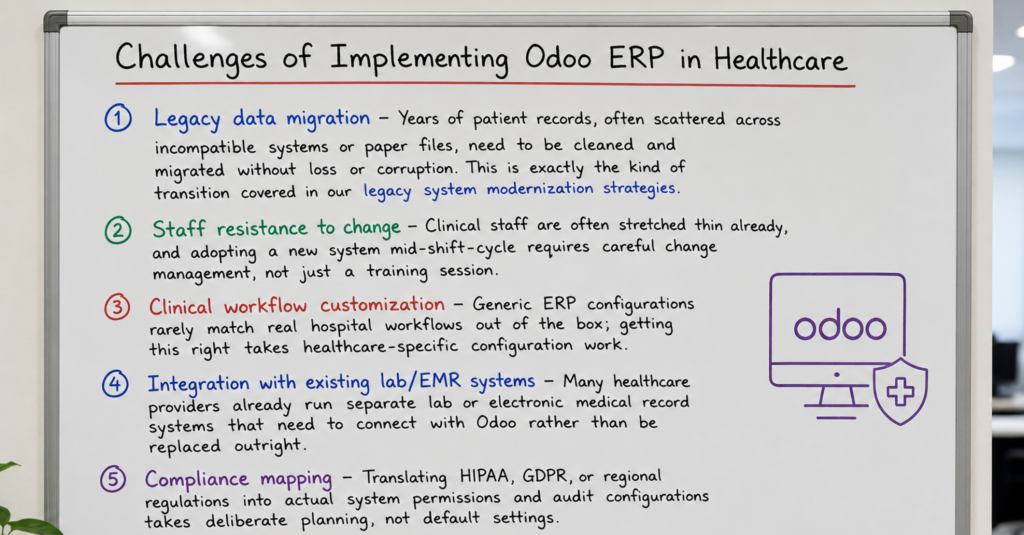
Legacy data migration
Years of patient records, often scattered across incompatible systems or paper files, need to be cleaned and migrated without loss or corruption. This is exactly the kind of transition covered in our legacy system modernization strategies. Careful planning is essential to ensure Odoo ERP for healthcare fits existing clinical, administrative, and compliance workflows.
Staff resistance to change
Clinical staff are often stretched thin already, and adopting a new system mid-shift-cycle requires careful change management, not just a training session.
Clinical workflow customization
Generic ERP configurations rarely match real hospital workflows out of the box; getting this right takes healthcare-specific configuration work.
Integration with existing lab/EMR systems
Many healthcare providers already run separate lab or electronic medical record systems that need to connect with Odoo rather than be replaced outright.
Compliance mapping
Translating HIPAA, GDPR, or regional regulations into actual system permissions and audit configurations takes deliberate planning, not default settings.
Budget and timeline overruns
Without a clear scope upfront, healthcare ERP projects are especially prone to scope creep, given how many departments and edge cases are involved. Our Odoo implementation cost 2026 guide can help you budget more accurately from the start, and our IT resource outsourcing model helps keep timelines under control.
Why AI-IoT Geeks Is The Right Partner For Your Odoo ERP For Healthcare Implementation ?
We don’t just configure modules and hand over a login. We build Odoo ERP for healthcare healthcare ERP systems that feel like they were designed specifically for your clinic or hospital, because they are. Our team combines deep Odoo implementation expertise with real experience across custom software, AI, and cloud infrastructure which means your ERP doesn’t just sit there processing invoices, it becomes the intelligent backbone of your entire operation.
Zero-guesswork discovery
We map every clinical and administrative workflow before writing a single line of configuration, so nothing gets bolted on as an afterthought.
Billing and invoicing built to be bulletproof – We configure Odoo’s accounting engine so claims stop bouncing back, invoices stop confusing patients, and your finance team stops firefighting.
Compliance baked in from day one
Role-based access, audit trails, and data protection aren’t an add-on with us they’re part of the foundation, engineered to hold up under HIPAA, GDPR, and regional standards like ZATCA.
Migration without the migraines
We securely migrate patient, financial, and operational data from legacy systems or spreadsheets while minimizing disruption and ensuring data accuracy.
A system that scales with you
Whether you’re a single clinic today or planning to become a multi-location hospital network tomorrow, we build the ERP to grow without needing to be rebuilt.

Conclusion
AI IoT Geeks believes that healthcare organizations need more than just software they need an integrated platform that simplifies operations, improves patient experiences, and supports long-term growth. Odoo ERP for healthcare brings together patient management, appointment scheduling, billing and invoicing, inventory, HR, and compliance into a single system, helping clinics and hospitals replace disconnected processes with streamlined, data-driven workflows.
Whether you’re a small clinic looking to automate administrative tasks or a multi-location healthcare provider planning a digital transformation, Odoo’s modular architecture allows you to implement the features you need today while scaling as your organization grows. With the right implementation strategy, healthcare providers can reduce manual work, improve billing accuracy, strengthen regulatory compliance, and gain real-time visibility into every aspect of their operations.
As healthcare continues to evolve, investing in the right ERP solution can improve operational efficiency while allowing medical professionals to focus on what matters most delivering high-quality patient care. A well-planned Odoo ERP implementation provides the flexibility, scalability, and automation healthcare organizations need to meet today’s challenges and prepare for tomorrow’s opportunities.
Ready to Modernize Your Healthcare Operations?
Have any questions in mind
Frequently Asked Questions?
1.Is Odoo suitable for hospitals as well as small clinics?
Yes. Odoo’s modular structure means small clinics can start with just patient management and billing, while larger hospital networks can scale up to include HR, pharmacy, and multi-location reporting.
2.How does risk management improve software project success?
Odoo’s accounting module can be configured with custom billing templates and claim tracking to align with insurer-specific requirements, reducing rejected claims and speeding up reimbursements.
3.How does Odoo help with healthcare compliance like HIPAA or GDPR?
Through role-based access controls, encrypted data storage, and detailed audit trails that track who accessed what data and when.
4.Is Odoo Community or Enterprise better for healthcare?
Community is free and suitable for smaller setups with basic needs; Enterprise adds advanced healthcare-relevant features (like more robust reporting and support) that most mid-size to large providers eventually need.