


Understanding Odoo Implementation Costs
Understanding The Scope Behind Odoo Implementation Costs.
If you’ve started researching Odoo implementation cost, you’ve probably noticed that every source quotes a different number. One blog says implementation starts at $5,000. Another says a mid size rollout costs $50,000. A third throws around six figure totals for enterprise deployments. None of them are wrong, they’re just describing different projects.
Odoo’s pricing is modular by design, which is exactly why “how much does Odoo cost” and odoo implementation pricing don’t have a single answer. A five-person company running CRM and invoicing pays almost nothing. A 200-person manufacturer integrating Odoo with a legacy ERP and three regional warehouses pays six figures. This guide breaks down the full odoo implementation cost breakdown licensing, implementation services, customization, data migration, and ongoing support, so you can build a realistic budget instead of anchoring on a number that doesn’t apply to your business. This is often referred to as the odoo implementation cost for small business discussion in ERP planning, and it scales very differently once you move into mid-size and enterprise territory.
At AI-IoT Geeks, Odoo ERP implementation is one of our core service lines, alongside broader ERP services and SAP implementation work. We handle end to end Odoo deployments, including configuration, custom module development, third party integrations, and ongoing support, for manufacturing, retail, services, and distribution businesses. The ranges below reflect how those projects actually scope and price, not just a rate card.
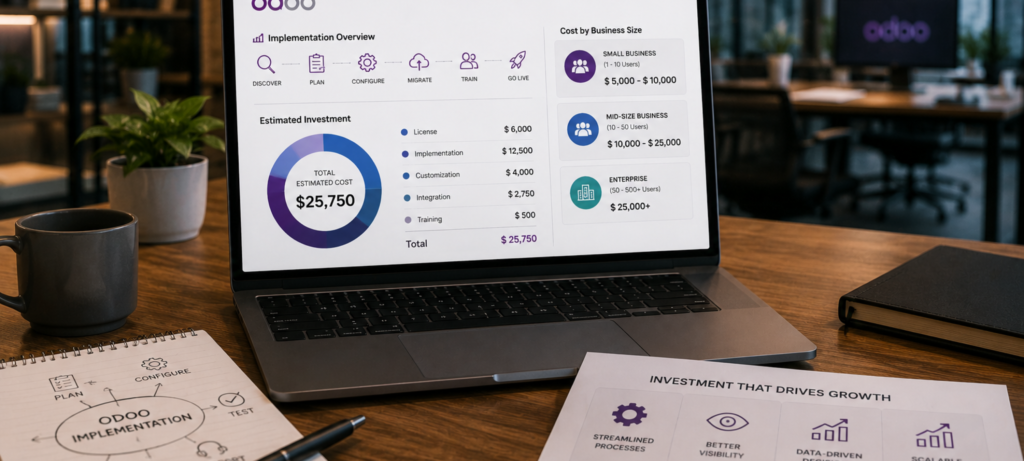
Odoo Implementation Cost at a Glance
Typical implementation requirements based on business size and operational complexity.
Business Size | Typical Implementation Scope | What’s Usually Included |
Small Business (1 to 10 users) | Basic ERP deployment | Core modules, standard configuration, user training, and data setup |
Mid-Size Business (10 to 50 users) | Department-wide implementation | Multiple modules, workflow customization, integrations, and process optimization |
Enterprise (50 to 500+ users) | Large-scale ERP transformation | Advanced customizations, multiple integrations, multi-company support, and complex business processes |
These examples illustrate how odoo erp implementation cost typically increases as businesses grow. Factors such as the number of users, business processes, integrations, custom development needs, and deployment complexity all influence the overall scope, and ultimately the total cost of Odoo implementation of a project.
At AI-IoT Geeks, we’ve found that every organization has unique operational requirements. That’s why a discovery and assessment phase is essential for understanding workflows, data sources, integrations, and business objectives before defining the implementation roadmap. A structured planning process helps reduce risks, align expectations, and support a smoother Odoo deployment.
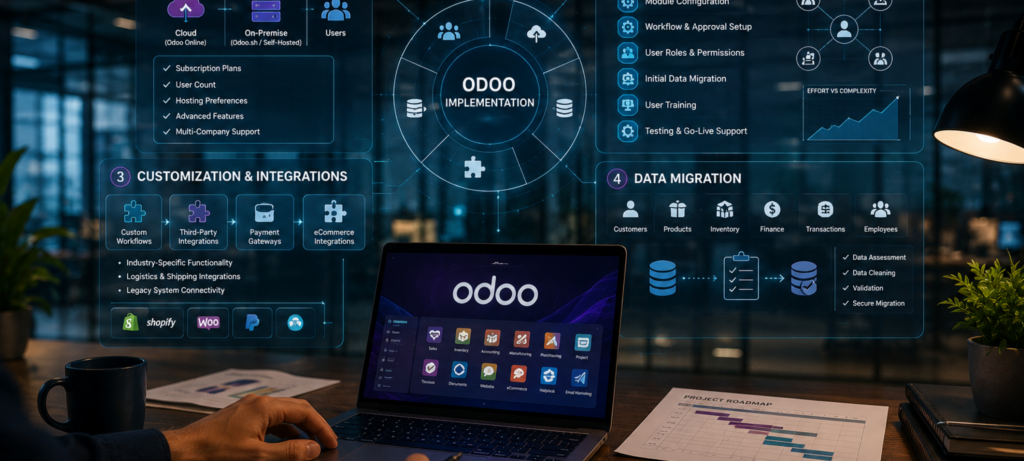
What You're Actually Paying For?
Breaking down the key components that shape an Odoo implementation project.
Odoo’s overall investment consists of several components, and many businesses underestimate the effort involved because they focus only on software licensing. Understanding these layers helps set realistic expectations and supports smoother project planning.
1. Licensing (Subscription Requirements)
Odoo’s overall investment consists of several components, and many businesses underestimate the effort involved because they focus only on software licensing. Understanding these layers helps set realistic expectations for odoo implementation cost and supports smoother project planning.
2. Implementation Services
Implementation is often the most significant part of an Odoo project because it transforms the platform from a standard ERP system into a solution tailored to your business operations.
Implementation services typically include:
- Requirements gathering and process mapping
- Module configuration
- Workflow and approval setup
- User roles and permissions
- Initial data migration
- User training
- Testing and go-live support
The level of effort required depends on the number of departments involved, process complexity, and the extent of business-specific requirements.
At AI-IoT Geeks, we typically recommend defining a clear scope, timeline, and deliverables before implementation begins. A structured planning phase helps reduce project risks and ensures alignment between business objectives and technical execution.
3. Customization And Integrations
While Odoo provides extensive functionality out of the box, businesses often require additional customization to support unique workflows or integrate with existing systems and customization is typically where odoo implementation cost climbs fastest.
Common requirements include:
- Custom workflows and approval processes
- Industry-specific functionality
- Third-party software integrations
- Payment gateway connections
- eCommerce platform integrations
- Logistics and shipping integrations
- Legacy system connectivity
The complexity of these requirements can significantly influence project scope, implementation timelines, and ongoing maintenance needs.
In many cases, leveraging Odoo’s native capabilities wherever possible can simplify implementation and improve long-term maintainability.
We have also seen organizations enhance their Odoo environments through AI & Machine Learning solutions and RPA Development, helping automate repetitive workflows and improve operational efficiency without introducing excessive custom development.
4. Data Migration
Data migration is one of the most important yet frequently underestimated parts of an Odoo implementation. It directly impacts the odoo implementation cost for small business as well as enterprise setups.
Migration may involve:
- Customer and vendor records
- Product catalogs
- Inventory data
- Financial information
- Historical transactions
- Employee records
The effort required largely depends on the quality, structure, and consistency of existing data sources. Organizations using multiple systems, disconnected spreadsheets, or legacy systems often require additional preparation and validation before migration begins. A well-planned legacy system modernisation strategy can simplify migration and reduce implementation risks.
Based on our experience, conducting a data assessment early in the project helps identify potential challenges, reduce risks, and create a more accurate implementation roadmap.
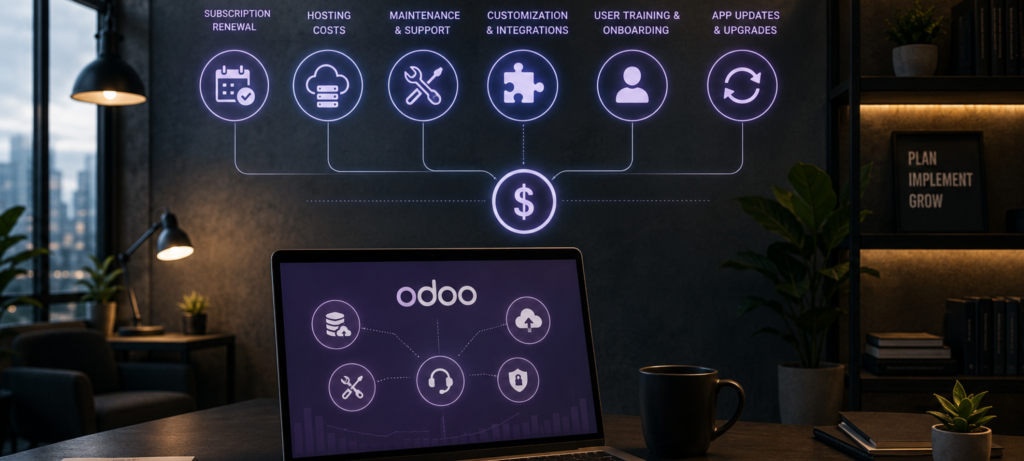
What Ongoing Costs Should You Expect After Odoo Goes Live?
Understanding the support, maintenance, and optimization activities required after deployment.
Implementation is only the beginning of your Odoo journey. After go-live, businesses should plan for ongoing operational and maintenance requirements to ensure the system remains secure, efficient, and aligned with evolving business needs.
Common ongoing requirements include:
1.Subscription renewals to maintain access to Odoo features and updates.
2.Technical support and maintenance through managed IT services for bug fixes, user assistance, and system improvements.
3.Hosting and infrastructure management through cloud management services for self-hosted deployments or cloud environments.
4.Version upgrades to stay current with new features, security enhancements, and platform improvements.
5.Additional customizations and integrations as business processes evolve.
6.User training and onboarding for new employees and changing workflows.
7.Performance monitoring and optimization to maintain system reliability as usage grows.
A useful planning approach is to treat implementation activities and ongoing operational requirements as separate phases. While implementation focuses on deployment and configuration, long-term success depends on continuous support, maintenance, optimization, and user adoption.
Our ERP specialists often recommend proactive support after go-live rather than waiting for issues to arise. Small configuration errors, workflow bottlenecks, or automation issues are typically easier to resolve when identified early, helping businesses maintain operational efficiency, minimize disruption, and maximize the return on their Odoo implementation cost investment.
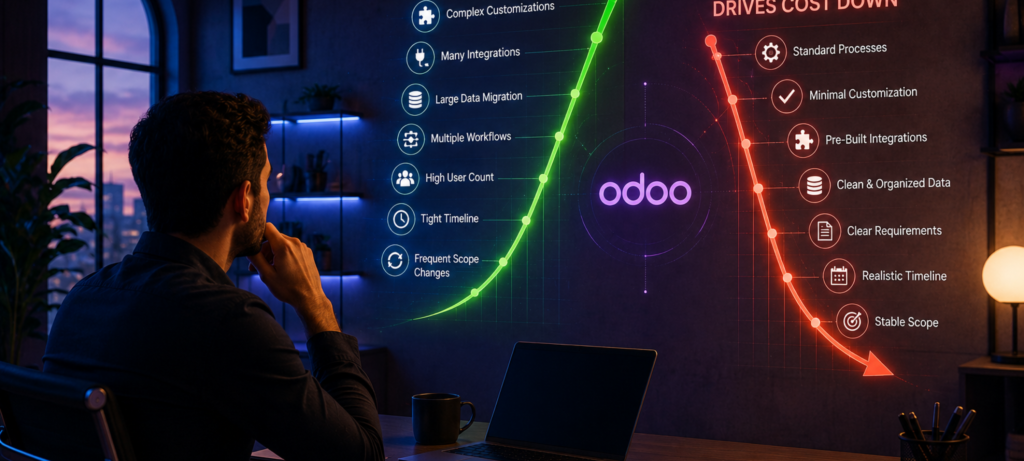
What Drives Cost Of Odoo Implementation Up Or Down?
The key factors that influence project complexity, effort, and implementation requirements.
Factor | Lowers Cost | Raises Cost |
Number of modules | 2 to 3 core apps | Full suite across departments |
Customization | Standard configuration | Custom coded workflows |
Data migration | Clean, modern source system | Multiple legacy systems, messy data |
Integrations | None or simple API based | Legacy/mainframe system bridges |
Hosting | Odoo Online (included) | Self hosted or Odoo.sh at scale |
Partner location | Offshore/remote partner | Onshore enterprise consultancy |
Internal readiness | Documented processes, ready data | Undefined processes, scattered data |
The single biggest cost driver isn’t licensing. It’s how much your business deviates from Odoo’s standard workflows. Companies that adapt their processes to fit Odoo’s native modules consistently spend less than companies that insist on replicating their exact legacy workflow through custom code.
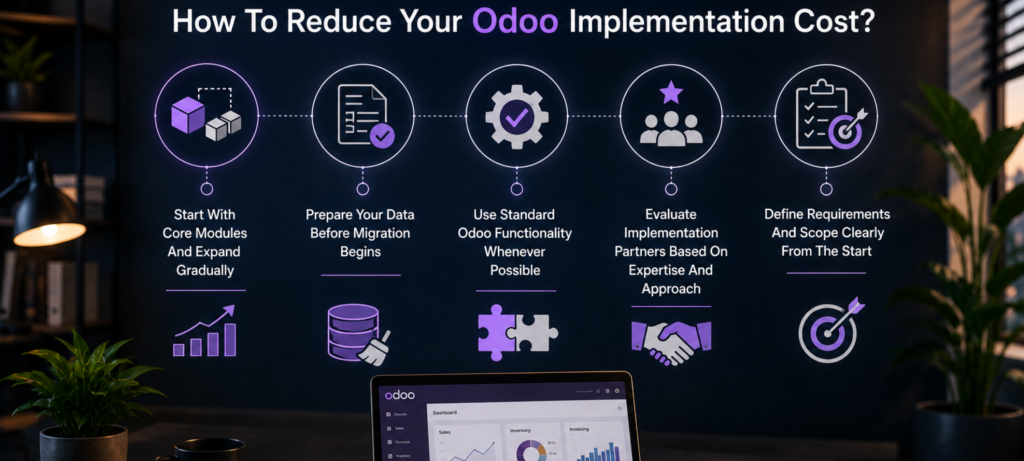
How To Reduce Your Odoo Implementation Cost?
Best practices for controlling implementation scope and improving project efficiency.
These practices help reduce overall odoo implementation cost.
1.Start With Core Modules And Expand Gradually
Implementing essential functions first allows teams to adapt to the platform before introducing additional modules and workflows, helping businesses control odoo implementation cost during the initial deployment.
2.Prepare Your Data Before Migration Begins
Cleaning, standardizing, and validating data early helps reduce migration challenges and improves overall implementation quality.
3.Use Standard Odoo Functionality Whenever Possible
Many business requirements can be addressed through configuration rather than custom development, making the system easier to maintain and upgrade.
4.Evaluate Implementation Partners Based On Expertise And Approach
Industry experience, technical capabilities, and a structured implementation methodology often have a greater impact on project success than any single factor.
5.Define Requirements And Scope Clearly From The Start
Well-documented business processes, objectives, and deliverables help minimize misunderstandings, prevent scope creep, and keep odoo implementation cost aligned with the planned budget.
Based on AI-IoT Geeks’ experience delivering ERP, automation, and digital transformation solutions across multiple industries, organizations achieve the best outcomes when they adopt proven Odoo workflows instead of recreating every existing process. Aligning business processes with the platform’s built-in capabilities leads to smoother deployments, simpler maintenance, and greater long-term scalability.
At AI-IoT Geeks, every Odoo implementation begins with detailed discovery, business process analysis, and strategic planning. This practical experience enables our consultants to build realistic implementation roadmaps that reduce risks, control Odoo implementation costs, and deliver scalable ERP solutions aligned with long-term business goals.
How Does Odoo Compare To Other ERP Platforms?
Evaluating Odoo’s flexibility, scalability, and implementation approach against traditional ERP solutions.
Comparison Area | Odoo | Traditional Enterprise ERPs |
Implementation Complexity | Flexible and modular implementation approach | Typically involves more complex implementation requirements |
Customization Flexibility | Highly customizable with a large module ecosystem | Customizations often require specialized expertise and processes |
Deployment Approach | Businesses can start small and scale gradually | Often designed for broader organizational rollouts from the outset |
User Adoption | Generally easier for teams to learn and adopt | May require more extensive training and change management |
Scalability | Suitable for startups, SMEs, and growing enterprises | Designed for large organizations with complex operational needs |
Industry Coverage | Supports a wide range of industries through modules and integrations | Strong support for highly regulated and industry-specific environments |
Implementation Timeline | Often allows phased deployment strategies | Deployments may involve longer planning and execution cycles |
Best Fit | Manufacturing, retail, distribution, services, and growing businesses | Large enterprises with advanced compliance, governance, or industry-specific requirements |
At AI-IoT Geeks, this comparison frequently arises during ERP evaluation discussions. In most cases, the decision is not simply about implementation effort or platform size. Instead, it comes down to business requirements, operational complexity, compliance needs, and long-term scalability goals.
For many growing businesses in manufacturing, retail, distribution, and services, Odoo’s modular architecture provides the flexibility needed to streamline operations without introducing unnecessary complexity, helping organizations manage Odoo implementation cost more effectively through phased deployments and modular adoption. Organizations with highly regulated environments or specialized enterprise requirements may also evaluate our SAP implementation services when comparing ERP platforms.
Conclusion
Odoo implementation cost is influenced by multiple factors, including implementation scope, business complexity, customization requirements, integrations, data migration, user training, and ongoing support needs. Since every organization has different processes and operational goals, implementation requirements can vary significantly from one business to another. Understanding these cost drivers early helps businesses plan more effectively, avoid unexpected challenges, and build a realistic ERP roadmap.
At AI-IoT Geeks, we’ve seen that a structured discovery process and clear implementation roadmap help organizations reduce risks, improve adoption, and maximize the value of their Odoo ERP investment. If you’re planning an Odoo implementation or need expert guidance, contact us to discuss your business requirements with our ERP specialists.
Reduce your Odoo implementation cost with AI-IoT Geeks. Contact us.
Have any questions in mind
Frequently Asked Questions?
1. Why does Odoo implementation cost vary between businesses?
Implementation costs vary based on factors such as business size, number of modules, customization requirements, integrations, data migration complexity, and deployment scope.
2. What factors have the biggest impact on the cost of Odoo implementation?
Key factors include implementation scope, custom development, third-party integrations, data migration requirements, user training, and ongoing support needs.
3. How can businesses reduce Odoo implementation costs?
Businesses can reduce costs by starting with core modules, preparing data before migration, limiting unnecessary customizations, and clearly defining project requirements.
4. What services are typically included in an Odoo implementation project?
Most projects include requirements analysis, module configuration, workflow setup, user permissions, data migration, testing, training, and go-live support.
5. How does Odoo compare to other ERP platforms?
Odoo offers a flexible, modular approach that supports phased implementations, while many traditional ERP platforms are designed for larger and more complex enterprise environments.
6. Why is a discovery phase important before Odoo implementation?
A discovery phase helps identify business requirements, process gaps, integration needs, and potential risks before implementation begins. At AI-IoT Geeks, discovery and assessment are key steps in defining project scope and supporting successful ERP adoption.
7. Does Odoo require ongoing support after implementation?
Yes, ongoing support helps maintain system performance, manage upgrades, resolve issues, optimize workflows, and support user adoption. AI-IoT Geeks provides ongoing Odoo support services to help businesses maximize long-term ERP value.
8. Why work with AI-IoT Geeks for Odoo ERP implementation?
AI-IoT Geeks delivers end-to-end Odoo ERP implementation services, including discovery, configuration, custom module development, integrations, migration, training, and ongoing support. Our experience across manufacturing, retail, distribution, and service industries helps businesses implement Odoo with greater confidence and scalability.