


Digital Marketing for Financial Services: How to Win Clients in a Compliance Driven World
Content Marketing Strategies for Financial Service Providers
There was a time when a financial services firm could rely almost entirely on word of mouth, a strong local reputation, and perhaps a print ad in the newspaper. That time is gone. Today, when someone needs a mortgage adviser, an insurance policy, or a wealth management consultant, the first thing they do is open a browser and start searching.
Digital marketing for financial services is no longer a nice addition to your strategy. It is the strategy. But it comes with its own challenges. Unlike most industries, financial services firms have to balance aggressive growth goals with regulatory compliance, client confidentiality, and an audience that is naturally cautious about who they trust with their money.
The firms succeeding today understand that digital marketing for financial services is not simply about visibility. It is about credibility, consistency, education, and trust built over time across multiple digital channels.

Why Digital Marketing For FInancial services Matters More Than Ever
The numbers make the case plainly. Financial services digital ad spend is projected to reach nearly 37 billion dollars, growing roughly 11 percent year over year. That investment reflects where customers actually are and how they make decisions.
Studies show that 80 percent of customers now expect personalized services in their financial interactions. At the same time, 94 percent of banking firms are not delivering personalized experiences, even though 50 percent of banking consumers want a seamless mix of physical and digital services. That disconnect is good news for firms willing to invest in the right digital infrastructure.
The rapid growth of digital marketing for financial services reflects how customers now research, compare, and choose financial providers online before speaking with anyone directly.

Know Who You Are Talking To Before You Spend a Single Rupee
Before choosing channels or creating content, get precise about your audience. A 28 year old asking about student loan refinancing has entirely different concerns than a 54 year old planning for retirement.
Successful digital marketing for financial services begins with understanding customer behavior, financial goals, life stage, and intent. Different financial products require entirely different messaging strategies.
A wealth management client wants stability and long-term planning. A fintech user wants speed and convenience. A first-time insurance buyer wants clarity and reassurance.
Without audience clarity, digital marketing for financial services campaigns waste budget quickly because generic messaging rarely connects with anyone. Once you understand your audience segments, you can build messaging that speaks to real people rather than abstract customer personas.
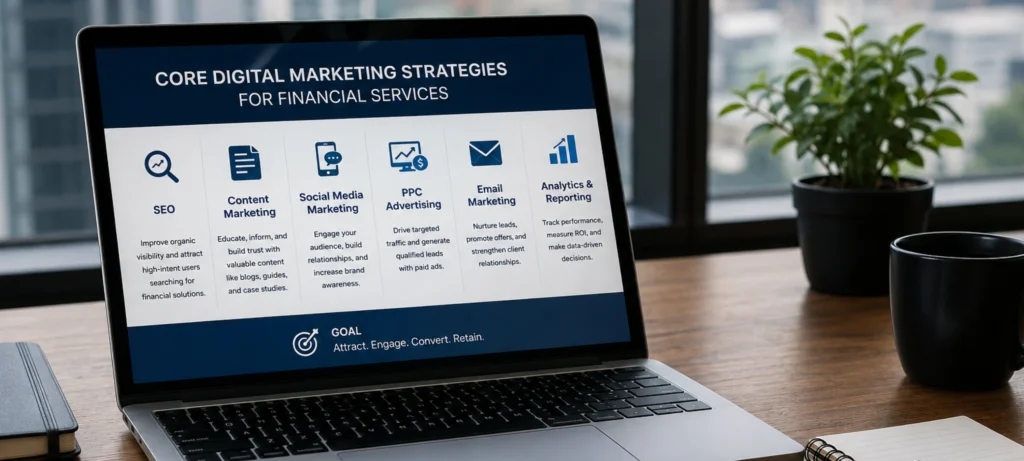
Core Digital Marketing Strategies for Financial Services
Search Engine Optimizationg
When a person types “best savings account rates” or “how to refinance a mortgage,” you want your institution showing up in those results. SEO remains one of the highest ROI channels in digital marketing for financial services because it captures high-intent traffic from people actively searching for solutions.
Google applies extra scrutiny to financial content under its “Your Money or Your Life” guidelines, so your content needs to demonstrate genuine expertise and follow strong UX & SEO best practices.
Local SEO matters equally. A well optimized Google Business Profile with authentic client reviews can significantly improve visibility in your area.
Content Marketing: Educate First, Sell Second
High quality content positions your firm as a trusted authority, educates clients, and builds long term loyalty. Educational content sits at the center of modern digital marketing for financial services because people research financial decisions carefully before committing.
The most effective content helps people make better decisions rather than pushing a sale.
Write about real experiences. Help a young professional understand what their retirement contribution actually means. Tell the story of a client who paid off debt for the first time.
Trust-based storytelling is helping digital marketing for financial services brands stand out in crowded markets where most competitors still sound overly corporate.
A financial advisory firm that published short explainer videos saw a 60 percent increase in email subscriptions and a 35 percent boost in lead conversions, simply by being more useful.
Social Media: Where Trust Is Built in Public
With over 81 percent of the population active on social media, ignoring these platforms is no longer an option.
Social proof now plays a major role in digital marketing for financial services because financial decisions are heavily influenced by trust and credibility.
LinkedIn is the natural home for B2B financial marketing, while Instagram, Facebook, and YouTube work well for consumer facing brands.
The most effective trend right now is employee generated and user generated content. When a team member explains a complex concept in plain language on a short video, it humanizes the brand in a way no polished corporate post can match.
Email Marketing: Your Most Reliable Revenue Channel
Email remains one of the most profitable channels in digital marketing for financial services because the audience is already warm and interested. The key is segmentation. A client who opened a savings account three months ago has entirely different needs from someone who has banked with you for a decade.
Automated sequences nurture prospects, re engage quiet clients, and build relationships over time. Every email should deliver something genuinely useful, a market update, a tax checklist, a plain English policy explanation, rather than a straight promotion.
Paid Advertising: Reaching the Right People at the Right Moment
Paid search is a critical component of digital marketing for financial services because it captures people at the exact moment they need help.
Programmatic advertising lets you reach qualified prospects without burning budget on people who will never need your products. You can target by income level, life stage, and financial intent signals with precision that traditional advertising simply cannot match.
Pay per click campaigns capture intent at the exact moment of need. Someone searching for “best high yield savings account” is ready to act, not just browsing. Retargeting brings back visitors who showed interest but did not convert, at a fraction of the cost of finding new ones.
Personalization and AI: The Competitive Edge Most Firms Are Ignoring
Artificial intelligence and machine learning are transforming digital marketing for financial services through predictive personalization, automation, and behavior analysis. These technologies predict customer needs, automate repetitive tasks, and create interactions that feel genuinely individual rather than broadcast.
Some banks are already delivering personalized loan offers through advanced mobile app development experiences based on spending habits, saving patterns, and credit profiles.
The future of digital marketing for financial services will be driven by automation and behavioral analytics that allow firms to deliver the right message at the right time without manual effort.
Personalization does not have to be complex. At its simplest it means sending the right message to the right person at the right time.
Mobile and Omnichannel Experience: Meeting Clients Where They Are
Mobile optimization is now mandatory in digital marketing for financial services because most users research products directly from their phones. Financial services consumers expect a seamless experience whether they are on a smartphone, a laptop, or walking into a branch.A poorly optimized website will lose prospects before they ever make contact, which is why businesses invest in professional website development services built for speed and scalability.
Mixing online touchpoints with offline communications like direct mail adds a personal dimension that purely digital experiences often lack, and clients notice the difference.
Compliance and Trust: The Non Negotiables
Every piece of content needs to be reviewed against financial regulations before it goes live. Firms that handle this well treat legal and marketing as collaborators rather than opponents.
Transparency is what separates successful digital marketing for financial services campaigns from ineffective ones.
Client testimonials, case studies, displayed qualifications, and transparent fee structures all tell a cautious prospective client the same thing: this firm is the real thing. In a market where money is on the line, that reassurance is often what closes the gap between interest and commitment.
How AI-IoT Geeks Is Rewriting the Rules of Financial Services Marketing
This is where digital marketing for financial services gets genuinely exciting. Artificial intelligence and the Internet of Things are not future concepts. They are already reshaping how financial institutions understand, reach, and serve their clients.
Here is what that looks like in practice:
- AI driven customer segmentation analyses thousands of data points to group clients by behaviour, financial life stage, and predicted needs, so your messaging reaches the right person at the right time without manual effort.
- Predictive analytics uses past behaviour to anticipate what a client might need next, whether that is a top up loan, a new insurance product, or a retirement planning conversation.
- AI powered chatbots handle routine queries around the clock, improving response times and freeing up human advisers for complex, high value conversations.
- Personalised loan and product offers generated by machine learning models based on spending habits, saving patterns, and credit behaviour, which improve both conversion rates and client satisfaction.
- IoT connected devices are beginning to feed real time data into financial products, particularly in insurance, where smart home sensors, connected vehicles, and wearable health devices are being used to offer dynamic, usage based premiums rather than fixed annual rates.
- Voice search optimisation is becoming relevant as smart speakers and voice assistants are increasingly used to ask financial questions, which means content needs to be structured around natural, conversational language
The firms that are investing in AI-IoT Geeks today are building a significant competitive advantage. They are not just marketing more efficiently. They are creating products and experiences that feel genuinely tailored to each client, which is the highest form of trust building available in this industry.

Measuring What Matters
Data analysis is essential for scaling digital marketing for financial services profitably. Real-time analytics allow firms to adjust campaigns quickly based on customer behavior and market trends.
The most effective digital marketing for financial services campaigns are measured against revenue, not vanity metrics.
Key metrics to track include customer lifetime value, conversion rates, and engagement scores. Real-time analytics powered by scalable cloud infrastructure services allow firms to adjust campaigns quickly based on customer behavior and market trends.
Beyond standard metrics, track these to get a clearer picture of real performance:
- Cost per qualified lead rather than cost per click, which filters out low intent traffic.
- Client acquisition cost broken down by channel so you know where your budget is actually working.
- Lifetime value by acquisition source to understand which channels bring the most loyal and profitable clients.
- Engagement rates on content to identify which topics and formats resonate most with your audience.
These numbers reveal which channels drive profitable growth versus which ones generate activity without result.

Conclusion
The future of digital marketing for financial services belongs to firms that use digital tools to become more helpful, more transparent, and more trustworthy at every stage of the client journey.
Every blog post that answers a real question, every email that arrives at the right moment, and every search result that helps someone make a better decision contributes to long-term client trust.Businesses that invest early in digital marketing for financial services will build stronger visibility, stronger customer relationships, and stronger competitive positioning over the next decade.
Financial services is ultimately a relationship business. The firms that win long term are not necessarily those with the biggest budgets. Businesses looking to modernize their strategy can connect with AI-IoT Geeks to build stronger digital experiences for financial services.
Grow faster with AI-IoT Geeks digital solutions
Book a Free Strategy Call at aiiotgeeks.com
Have any questions in mind
Frequently Asked Questions?
Which digital marketing channels work best?
The most effective channels depend on your audience and goals. Most successful firms use SEO, content, email, paid search, and social media in combination rather than relying on a single channel.
How do financial services firms stay compliant while marketing digitally?
Through close collaboration between marketing and legal teams, regular content reviews, and clear internal approval workflows before anything is published or goes live.
How important is personalization?
Extremely important. Firms that deliver personalized experiences see higher engagement, better conversion rates, and stronger client retention. AI tools now make this achievable even for smaller firms.
How are AI and IoT changing financial services marketing?
AI enables hyper personalized campaigns, predictive product recommendations, and automated client communication at scale. IoT devices are beginning to feed real time behavioural data into dynamic financial products, particularly in insurance, making marketing and product design more responsive to how clients actually live.