


Odoo vs Oracle: A Scalability Comparison for Growing Businesses
Discover which ERP platform scales better as your business expands.
As your business grows, your ERP system should be able to support increasing users, higher transaction volumes, multiple business entities, and evolving operational requirements without disrupting day-to-day operations. Both Odoo and Oracle are designed to scale, but they take very different approaches.
Odoo offers a modular and flexible platform that allows businesses to expand gradually by adding applications and functionality as needed, while Oracle is built to support large enterprises with complex global operations, advanced financial management, and extensive compliance requirements. Understanding how each platform scales in terms of performance, customization, deployment, and long-term growth can help you choose an ERP that not only meets your current needs but also supports your business as it evolves.
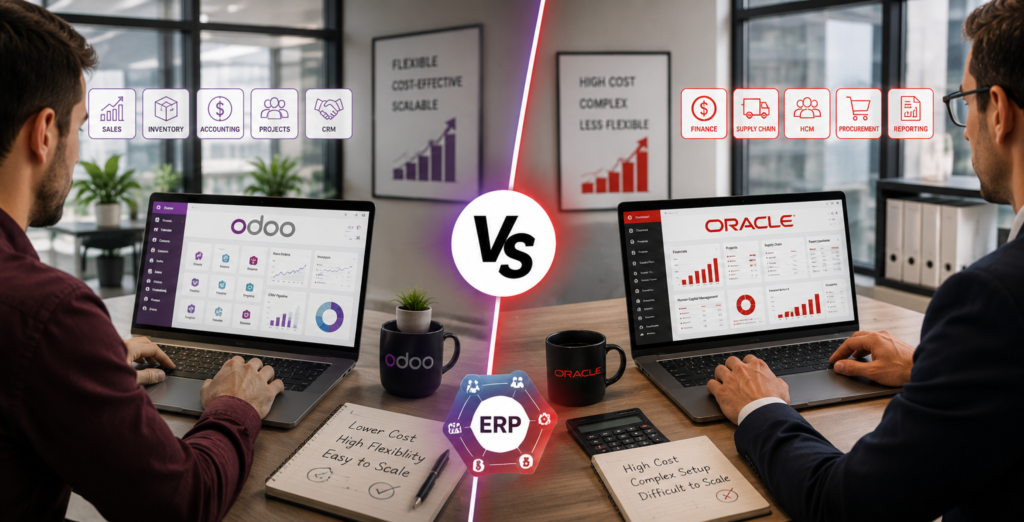
Odoo vs Oracle: Which ERP Offers More Cost-Effective Scalability?
While exact pricing depends on licensing, implementation scope, and customization requirements, the overall cost structure of each platform differs considerably.
Cost Factor | Odoo | Oracle |
Software Licensing | Lower | Higher |
Initial Implementation | Moderate | High |
Infrastructure Options | Cloud, On-premise, Hybrid | Primarily Cloud (Fusion/NetSuite), On-premise (EBS) |
Custom Development | Flexible and cost-effective | Typically more expensive |
Partner & Consulting Costs | Moderate | Premium enterprise consulting |
Ongoing Maintenance | Lower | Higher |
Scalability Costs | Add modules as needed | Often requires additional licensing |

User and Transaction Volume Scalability
As your business adds employees, customers, and daily transactions, your ERP needs to keep pace without slowing down or requiring a system overhaul.
Odoo scales in stages. A small team can start with a handful of users and a few core apps, then add seats and modules as headcount and workload grow. Performance stays solid through small and mid-size transaction volumes on standard cloud or on-premise setups. Very high transaction loads , think tens of thousands of daily orders or enterprise-level concurrent users,usually call for additional infrastructure tuning or a higher-tier hosting plan.
Oracle is built for volume from the start. Fusion Cloud and NetSuite are engineered to handle large concurrent user counts and heavy daily transaction processing without extra configuration work, which is why organizations with consistently high transaction volumes, banks, telecoms, large distributors tend to gravitate toward it.
- Odoo: ideal if your user base and transaction volume are growing steadily and predictably
- Oracle: ideal if you’re already operating at high volume or expect a rapid jump in scale
Scalability Aspect | Odoo | Oracle |
Growing User Base | Excellent for gradual growth | Excellent for enterprise-scale growth |
Concurrent Users | Suitable for SMEs and growing enterprises | Designed for very large user bases |
Transaction Processing | Moderate to high volumes | Extremely high transaction volumes |
Infrastructure Scaling | Scale infrastructure as needed | Enterprise-grade infrastructure from the start |
Best Choice For | Predictable business growth | High-volume enterprise environments |

Multi-Entity and Multi-Company Management
Many growing businesses eventually need to manage more than one company, branch, or subsidiary and this is where ERP platforms start to look very different.
Odoo supports multi-company setups natively. Businesses can run shared or separate charts of accounts, inventory, and reporting across entities, all from one system. This works well for mid-market companies expanding into new branches or regions, especially when the entities share similar operations.
Oracle is designed for more complex entity structures multiple legal entities across different countries, currencies, and regulatory environments which is often the same territory covered by enterprise platforms like SAP. It offers deeper consolidation, intercompany transaction handling, and compliance support, which is essential for multinational groups managing dozens of subsidiaries with different reporting requirements.
- Odoo: solid for a handful of related entities or regional branches
- Oracle: built for complex, global, multi-currency entity structures
Multi-Entity Capability | Odoo | Oracle |
Multi-Company Support | Native multi-company management from a single database | Advanced multi-entity management across global organizations |
Legal Entity Management | Suitable for regional branches and related companies | Designed for complex multinational legal entity structures |
Multi-Currency Operations | ✔ Supports multiple currencies | ✔ Advanced multi-currency accounting and reporting |
Intercompany Transactions | Supports standard intercompany operations | Advanced intercompany automation and reconciliation |
Financial Consolidation | Suitable for growing businesses with multiple entities | Enterprise-grade global financial consolidation |
Regulatory Compliance | Supports country-specific compliance requirements | Built for complex international compliance and governance |

Performance and Infrastructure Scalability
Growth doesn’t just mean more users it also means more data, more integrations, and more strain on the system behind the scenes.
Odoo’s performance holds up well for small to mid-size data volumes, and infrastructure can be scaled up through cloud hosting upgrades or on-premise server improvements as needed. Because it’s modular, businesses aren’t paying for processing power they don’t yet need.
Oracle is architected to absorb large data volumes and heavy processing loads with minimal tuning, which suits organizations that already generate significant data through high transaction counts, complex integrations, or large-scale reporting needs.
- Odoo: pay-as-you-grow infrastructure, well suited to gradual scaling
- Oracle: enterprise-grade infrastructure built to handle scale immediately
Capability | Odoo | Oracle |
Multi-Company | ✔ Native support | ✔ Advanced support |
Multi-Currency | ✔ | ✔ |
Intercompany Transactions | ✔ | ✔ Advanced automation |
Financial Consolidation | Good | Excellent |
Global Compliance | Good | Enterprise-grade |
Best For | Regional operations | Global enterprises |

Customization and Deployment Flexibility
How easily a system adapts to changing operations matters as much as raw scalability.
Odoo’s open architecture and accessible APIs make it straightforward to adjust workflows, build custom modules, or integrate third-party tools without a lengthy re-engineering process. It also offers real deployment flexibility,cloud, on-premise, or hybrid, giving businesses control over where their data lives.
Oracle allows customization too, but it typically requires certified developers and a more structured change management process, which adds time and cost to each modification. Deployment is primarily cloud-first through Fusion and NetSuite, with on-premise available through Oracle EBS for businesses with existing infrastructure commitments.
- Odoo: faster, more flexible customization; deployment options for every setup
- Oracle: customization is robust but slower and more resource-intensive
Feature | Odoo | Oracle |
Open-Source | ✔ Yes | ✖ No |
API Availability | Extensive | Extensive |
Custom Modules | Easy to develop | More complex |
Deployment Flexibility | Cloud, On-premise, Hybrid | Mainly Cloud + Oracle EBS |
Time for Customizations | Faster | Longer |
Development Cost | Lower | Higher |

Which Industries Are Best Suited for Each ERP?
Both Odoo and Oracle serve a wide range of industries, but they are designed to solve different business challenges. The right choice depends less on your industry itself and more on your organization’s size, operational complexity, regulatory requirements, and long-term growth strategy.
Odoo: Best for Agile and Growing Businesses
Odoo is well suited for organizations that need a flexible, cost-effective ERP capable of adapting as the business evolves. Its modular architecture allows companies to implement only the applications they need and expand functionality over time, making it a popular choice for businesses seeking faster deployment and lower implementation costs.
Industries that commonly benefit from Odoo include:
Manufacturing
Production planning, inventory management, and shop floor operations.
Wholesale & Distribution
Procurement, warehouse management, and order fulfillment.
Retail & Ecommerce
Point of Sale (POS), omnichannel inventory, and online store integration.
Healthcare
Patient administration, inventory tracking, and operational management.
Professional Services
Project management, timesheets, billing, and resource planning.
Education
Student information, admissions, finance, and campus operations.
Construction
Project costing, procurement, equipment management, and budgeting.
Small and Mid-Sized Businesses
Organizations looking for an ERP that grows with their business without requiring enterprise-level investment.
Oracle: Best for Large Enterprise Operations
Oracle is designed for organizations managing large-scale operations, multiple business entities, and complex regulatory environments. Its enterprise-grade capabilities make it well suited for businesses that require advanced financial consolidation, governance, global reporting, and high transaction volumes across multiple regions.
Industries that commonly choose Oracle include:
Banking & Financial Services
Complex financial reporting, compliance, and risk management.
Telecommunications
Large-scale customer operations, billing, and network asset management.
Energy & Utilities
Asset-intensive operations, regulatory compliance, and enterprise planning.
Global Manufacturing
Multi-site production, international supply chains, and enterprise resource planning.
Logistics & Supply Chain Enterprises
Global distribution networks, transportation management, and warehouse optimization.
Large Government Organizations
Budget management, procurement, compliance, and public-sector reporting.
Multinational Corporations
Multi-entity financial consolidation, global operations, and enterprise governance.
Which ERP Scales Better for Your Business?
There isn’t a one-size-fits-all answer to the Odoo vs Oracle scalability debate. The right choice depends on how your business plans to grow, the complexity of your operations, and the level of functionality you’ll need over the coming years. While both platforms are designed to support expansion, they take fundamentally different approaches to scalability.
Choose Odoo
If your priority is flexible, cost-effective growth. Its modular architecture allows you to start with the applications you need today and add new modules, users, and integrations as your business evolves. This makes Odoo an excellent choice for startups, small and medium-sized businesses, and growing enterprises that want faster implementation, lower total cost of ownership, and the freedom to customize workflows without unnecessary enterprise complexity.
Choose Oracle
If your organization operates at an enterprise scale with multiple legal entities, global subsidiaries, high transaction volumes, and strict regulatory or compliance requirements. Oracle’s ERP solutions are built to support complex financial consolidation, enterprise governance, and multinational operations, making them well suited for organizations that require advanced controls and extensive scalability across global business environments.

Why Choose AI-IoT Geeks for ERP Consulting?
Choosing between Odoo and Oracle isn’t really about comparing feature lists — it’s about matching a platform to how your business actually operates, where it’s headed, and what it can realistically support along the way. Get that wrong, and even a technically capable ERP can end up slowing you down instead of scaling with you.
At AI-IoT Geeks, we work through that decision with you not for you. Our consultants evaluate your current processes, growth plans, integration needs, and budget constraints before recommending a direction, so the choice is grounded in your business rather than a generic checklist.
Our ERP consulting covers:
Scalability assessment
Understanding how each platform handles your projected user growth, transaction volume, and entity structure
Customization and integration planning
Mapping what needs to connect to your ERP, and how much flexibility that requires
Implementation complexity and timeline
Realistic expectations on rollout time, resource needs, and disruption to daily operations
Total cost of ownership
Licensing, infrastructure, consulting, and maintenance costs modeled over the long term, not just year one
Conclusion
AI-IoT Geeks helps businesses look beyond feature comparisons to choose an ERP that can support long-term growth. While both Odoo and Oracle are highly capable platforms, the right choice depends on your organization’s size, operational complexity, scalability requirements, and future business goals. Odoo offers the flexibility, modularity, and cost-effective scalability that many growing businesses need, whereas Oracle is better suited for enterprises managing global operations, multiple legal entities, and complex compliance requirements.
By evaluating your current processes, projected growth, integration needs, and implementation strategy, AI-IoT Geeks helps you select and implement an ERP that delivers lasting business value and scales confidently with your organization.
Ready to choose the right ERP? Let AI-IoT Geeks help you
Have any questions in mind
Frequently Asked Questions?
1. How do I know whether Odoo or Oracle is the right ERP for my business?
The right choice depends on factors such as your business size, growth plans, number of users, operational complexity, compliance requirements, and budget. Growing businesses often benefit from Odoo’s modular scalability, while large multinational organizations may require Oracle’s enterprise-grade capabilities.
2. Can AI-IoT Geeks help evaluate whether Odoo or Oracle is a better fit?
Yes. AI-IoT Geeks provides ERP consulting services that assess your business processes, scalability requirements, existing technology stack, and long-term objectives to recommend the ERP platform that best aligns with your business strategy.
3. Can Odoo support enterprise growth as my business expands?
Yes. Odoo is designed to scale by allowing businesses to add users, modules, companies, and integrations over time. With the right infrastructure and implementation strategy, it can support both mid-sized organizations and large enterprises with evolving operational needs.
4. Is it possible to migrate from Oracle to Odoo?
Yes. Businesses can migrate from Oracle to Odoo through a structured implementation process that includes data migration, workflow mapping, system integration, testing, and user training. Proper planning helps minimize business disruption during the transition.
5. How long does an ERP implementation typically take?
Implementation timelines vary depending on the project’s complexity, number of modules, customizations, and integrations. Odoo implementations are generally completed faster than Oracle projects, while enterprise-scale Oracle deployments often require longer planning and rollout phases.
6. Why should I work with AI-IoT Geeks for ERP implementation?
AI-IoT Geeks provides end-to-end ERP consulting, implementation, customization, integration, migration, and post-deployment support. Our team focuses on delivering scalable ERP solutions that align with your business goals, helping you maximize your technology investment while preparing for future growth.