


ERP for Manufacturing Industry: How to Choose the Right Solution
Find the Right ERP for Your Manufacturing Business
Manufacturing companies today juggle production schedules, inventory, supply chains, and compliance requirements across multiple disconnected systems and it shows. Spreadsheets don’t scale, legacy tools don’t talk to each other, and decision-makers end up reacting to problems instead of preventing them.
ERP for the manufacturing industry solves this by unifying operations into a single platform. But with dozens of vendors and deployment models to choose from, picking the right system is harder than it should be. This guide breaks down what ERP for manufacturing industry actually does and how to evaluate your options with confidence.
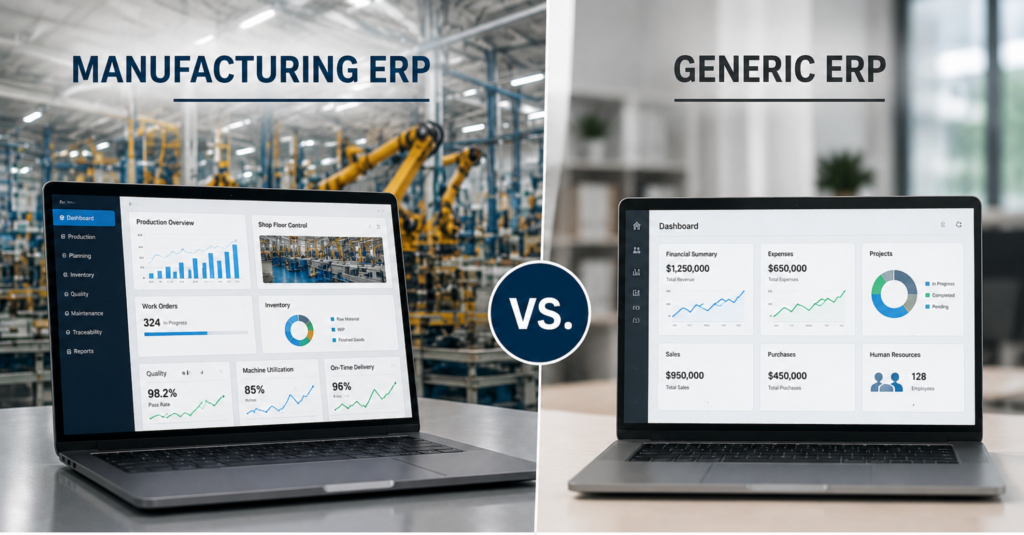
Manufacturing ERP vs. Generic ERP
Feature | Generic ERP | Manufacturing ERP |
Core focus | Finance, HR, general business operations | Production, BOM, shop floor, MRP |
Inventory handling | Basic stock tracking (in/out counts) | Multi-level BOM, raw materials, WIP, finished goods |
Production scheduling | Not typically included | Capacity planning, machine/labor scheduling, work orders |
Bill of Materials (BOM) | Not supported or very limited | Multi-level BOM with revisions and effectivity dates |
Material Requirements Planning (MRP) | Absent | Core capability — auto-calculates what to order, when, and how much |
Shop floor visibility | None | Real-time tracking of production status, machine uptime, labor hours |
Quality control & traceability | Minimal, often manual | Built-in inspections, lot/serial tracking, compliance documentation |
Costing | General ledger-level only | Job costing tied directly to production activity (materials, labor, overhead) |
Supply chain coordination | Basic purchase order tracking | Supplier portals, demand forecasting, procurement automation |
Deployment complexity | Simpler, faster to implement | More complex longer implementation depending on production model |
Industry fit | Service-based businesses, retail, professional services | Discrete, process, batch, and mixed-mode manufacturers |
Typical users | Small businesses, agencies, non-production companies | Manufacturers of all sizes, from job shops to enterprise plants |
Common vendors | QuickBooks, Zoho, generic SaaS ERPs | Odoo, SAP, NetSuite, Epicor, Microsoft Dynamics, QAD |
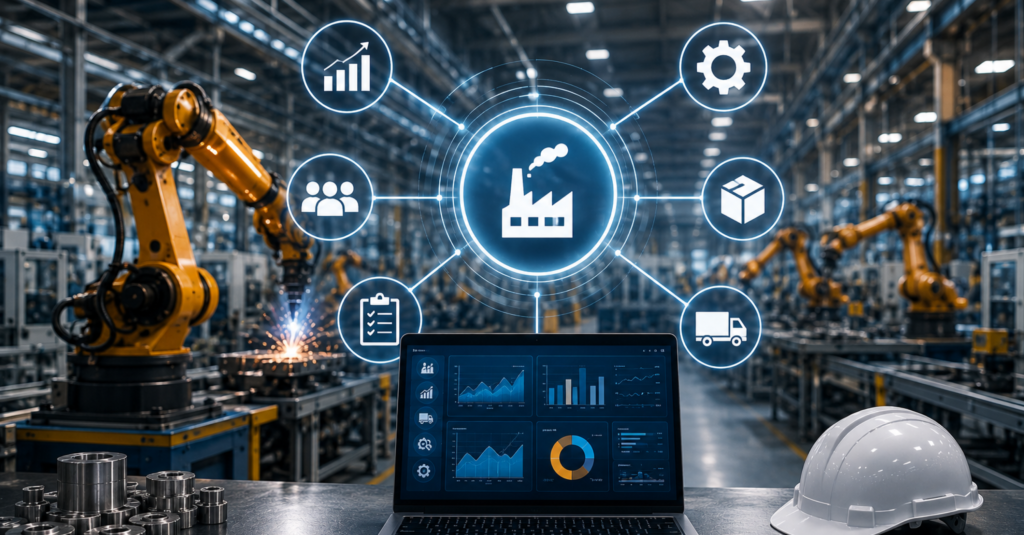
Why ERP for Manufacturing Industry Is Essential
Without a unified system, manufacturers typically deal with disconnected data, delayed decisions, and processes that don’t scale. These aren’t small inconveniences; they directly affect margins, delivery times, and customer trust, as we’ve seen across the manufacturing sector and other industries we support.
Common pain points ERP for the manufacturing industry addresses include:
Inaccurate inventory counts
When stock data is tracked manually or across disconnected spreadsheets, it rarely reflects what’s actually on the shelf, stalling production or tying up cash in excess inventory.
Disconnected production schedules
When the shop floor, sales, and planning teams work from different versions of the schedule, orders get promised on timelines production can’t meet.
Fragmented financial data
When production costs live in one system and accounting in another, finance teams end up reconciling numbers manually, delaying visibility into true profitability.
Manual, error-prone processes
Re-entering data across spreadsheets and standalone tools multiplies the chance of errors that ripple through purchasing, production, and invoicing.
Limited visibility across departments
When teams operate from separate systems, no one has the full picture. Sales might promise a delivery date without knowing procurement is already facing a shortage.
Compliance and traceability gaps
Being unable to quickly trace a batch or component turns audits and recalls into slow manual investigations instead of a quick system lookup.
Slow, reactive decision-making
Without real-time visibility, leadership often finds out about a problem only after it has already affected a customer.

How to Choose the Right Manufacturing ERP Solution
Finding the best ERP for the manufacturing industry isn’t about choosing the most popular platform,it’s about selecting software that aligns with your production processes, business size, and long-term growth plans.
Define Your Manufacturing Type
Discrete, process, and mixed-mode manufacturing all have different ERP requirements. A system built for batch/process manufacturing won’t necessarily handle discrete BOM structures well, and vice versa.
Assess Scalability and Growth Needs
Platforms such as Odoo are designed with modular scalability in mind, making them a strong ERP solution for manufacturing industry businesses that want to expand without replacing their entire system.
Evaluate Integration With Existing Tools
Your ERP needs to connect cleanly with tools you already rely on CRM, accounting software, e-commerce platforms, or specialized shop floor equipment. This is often where AI and automation can bridge gaps that standard integrations don’t cover.
Consider Total Cost of Ownership
Sticker prices rarely reflect the real cost. Factor in implementation, training, customization, and ongoing support fees before comparing vendors.
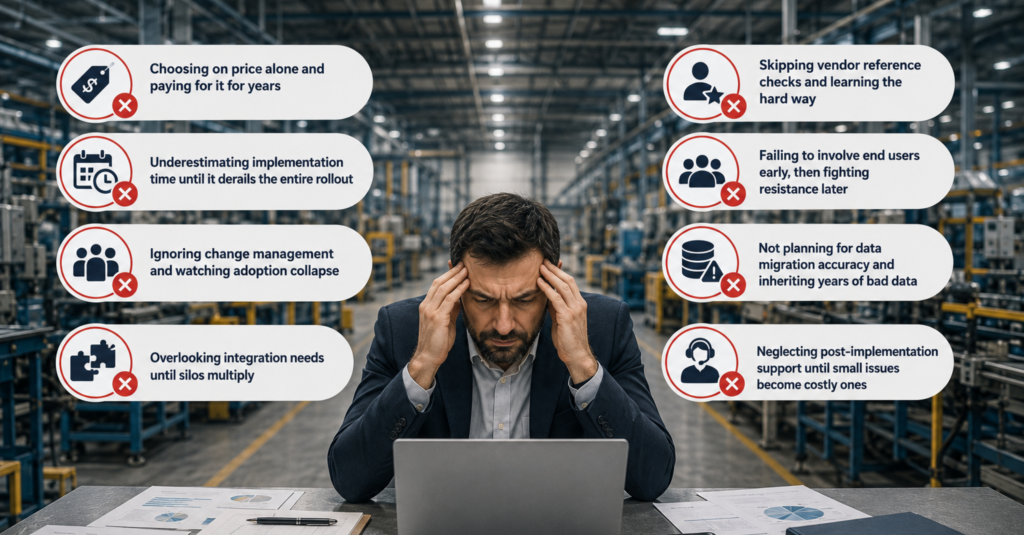
Common Mistakes to Avoid When Selecting ERP for Manufacturing Industry
- Choosing on price alone and paying for it for years
- Underestimating implementation time until it derails the entire rollout
- Ignoring change management and watching adoption collapse
- Overlooking integration needs until silos multiply
- Skipping vendor reference checks and learning the hard way
- Failing to involve end users early, then fighting resistance later
- Not planning for data migration accuracy and inheriting years of bad data
- Neglecting post-implementation support until small issues become costly ones
Avoiding these pitfalls is easier with the right implementation partner — our ERP Implementation & Support team builds in safeguards against each of these from day one.

How AI IoT Geeks Can Help Manufacturing Industry
Choosing the right ERP for the manufacturing industry is only half the battle: implementation, configuration, and ongoing support are what actually determine whether the system delivers value.
Choosing the right fit
Our team can assess your current workflows and recommend a system that matches how your business actually operates, whether that’s Odoo, SAP, or another platform.
Odoo implementation for manufacturers
Our Odoo ERP Implementation service covers end-to-end setup BOM configuration, production scheduling, inventory rules, and custom module development.
SAP implementation and migration
For manufacturers running or moving to SAP, our SAP Implementation team handles configuration and rollout with minimal disruption to production.
Integration with existing systems
We handle integrations with CRM, accounting tools, e-commerce platforms, and shop floor equipment so data flows cleanly, without creating new silos.
Extending ERP with AI and automation
Our AI & Machine Learning Development and RPA Development & Process Automation teams build custom solutions on top of your ERP foundation.
Ongoing support, not just deployment
Through a retainer, fixed-cost project, or on-demand support, we stay involved past go-live to optimize performance and catch issues early.
Conclusion
At AI IoT Geeks, we help manufacturers select, implement, and optimize the right ERP for the manufacturing industry based on their operational needs and long-term business goals. Whether you’re evaluating Odoo, SAP, or another platform, our experts ensure your ERP integrates seamlessly with existing systems, supports production efficiency, and scales as your business grows. Investing in the right ERP for the manufacturing industry today creates a stronger foundation for better planning, improved visibility, and sustainable growth tomorrow.
Ready to Choose the Right ERP for Your Manufacturing Business?
Have any questions in mind
Frequently Asked Questions?
1.What is the difference between ERP and MRP?
MRP (Material Requirements Planning) focuses specifically on production materials and scheduling, while ERP is broader, integrating MRP alongside finance, HR, CRM, and other business functions into one platform.
2.How much does manufacturing ERP cost?
Costs vary widely based on deployment model, company size, and customization needs — small manufacturers can expect anywhere from a few thousand to well over a hundred thousand dollars across licensing, implementation, and training.
3.How long does implementation take?
Cloud ERP implementations for small-to-mid-sized manufacturers typically take a few weeks to a few months; large enterprise rollouts can take six months to a year or more
4.Can small manufacturers benefit from ERP?
Yes , many modern cloud ERP platforms are specifically designed for small manufacturers, offering core functionality without enterprise-level complexity or cost.