


Custom Website Development Cost: What You Are Actually Paying For
Understand the key factors that influence custom website development pricing and project value.
If you have searched “custom website development cost” and landed on pages that hand you a table with dollar ranges, you already know how unsatisfying that experience is. The numbers feel arbitrary. Ten thousand dollars? Two hundred thousand dollars? Neither tells you anything useful about your situation.
This guide takes a different approach. Instead of anchoring you to a price tag, it helps you understand what drives custom website development cost, what you can control, and how to make a smarter decision whether you are a founder building your first product or a growing business replacing a legacy system.
Custom Website Development Cost Shouldn’t Be Your First Question
The most experienced development teams will tell you something counterintuitive: clients who open conversations with “how much will this website development cost?” tend to get worse outcomes than clients who open with “here is the problem we are trying to solve.”
Cost is an output, not an input. It flows from decisions you make about scope, team structure, technology choices, and timelines. When you treat the number as the starting point, you end up reverse-engineering requirements to fit a budget rather than building something that actually works.
That said, you need a number to plan. So here is how to think about custom website development cost correctly.
The Three Custom Website Development Cost Models You Will Encounter
Most agencies and freelancers structure custom website development cost around one of three pricing models, and each approach affects your budget, flexibility, and overall project risk differently.
Fixed Custom Website Development Cost
You agree on a scope document upfront and the vendor delivers it for an agreed total. With the fixed-price model, your custom website development cost is agreed upon upfront based on a predefined scope document.
This feels safe because the number is locked. The tradeoff is that vendors build a buffer into fixed price quotes to cover scope ambiguity, which means you often pay more than you would under other models even when everything goes smoothly. It also incentivizes vendors to interpret scope narrowly when questions arise, because anything outside the original document becomes a change order.
Fixed website development price works well when requirements are genuinely stable and well defined before development begins, which is rarer than most clients assume.
Time and Materials
You pay for actual hours worked at an agreed rate. This custom website development cost model is more transparent and more flexible. If priorities shift mid-project (and they almost always do), the team adapts without renegotiation drama. The risk here falls more on the client because the final cost is not known in advance.
Time and materials work well when you are working with a team you trust and when you expect the product to evolve as you learn more about your users.
Retainer or Dedicated Development Team
You essentially hire a website development team on an ongoing basis, typically monthly. This is common for businesses that treat their website or platform as a living product rather than a one-time delivery. A dedicated web development team builds deep context about your business over time, which translates to faster execution and fewer mistakes.
This model is often the most cost-efficient for companies spending more than a certain threshold annually, because you eliminate the constant cost of onboarding new vendors and re-explaining your business.

What Actually Drives Custom Website Development Cost Up
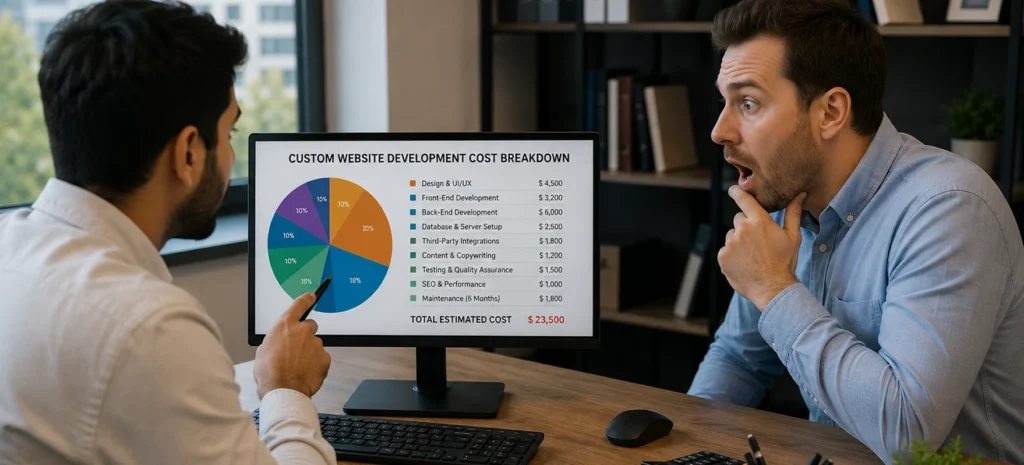
Rather than giving you a generic pricing table, it is more useful to understand what actually increases custom website development cost and why certain projects become significantly more expensive than others.
Complexity of functionality
A brochure website with five pages and a contact form is fundamentally different from a platform where users create accounts, upload files, interact with each other, and receive personalized content. The latter requires backend infrastructure, databases, authentication systems, permission logic, and ongoing maintenance.
Every additional layer of functionality increases custom website development cost because it multiplies development hours, testing requirements, and long-term support needs.
Design ambition
A well-designed website is not just visually attractive. It is the result of research into your audience, competitive analysis, information architecture work, prototyping, user testing, and iteration.
Teams that invest in strategic UX and design typically charge more, which directly impacts custom website development cost, but they also tend to deliver stronger business outcomes.
Integrations
Most modern websites connect to other systems: CRMs, payment processors, inventory systems, analytics platforms, marketing automation tools, and enterprise software. Each integration requires custom work, and the complexity compounds when those systems were not designed to talk to each other.
Performance and security requirements
A website serving a few hundred visitors a month has different infrastructure needs than one handling thousands of concurrent users or processing sensitive financial or health data.
These investments in cyber security and scalable cloud infrastructure raise custom website development cost upfront, but failing to address them early often leads to much higher expenses later.
Geography of the Web development team
Rates vary significantly across regions. Senior developers in the United States or Western Europe typically charge between 100 and 200 dollars per hour. Teams in Eastern Europe or Latin America charge roughly 40 to 90 dollars per hour for comparable seniority. Teams in South and Southeast Asia typically range from 20 to 50 dollars per hour. The cost difference is real but so is the communication overhead, time zone challenge, and quality variance that comes with offshore teams.

Rough Investment Ranges by Project Type
Rather than treating these as fixed quotes, think of them as broad benchmarks for understanding custom website development cost. Every project differs based on functionality, design expectations, integrations, scalability, and team structure.
Simple Informational Websites
A simple informational website with no custom functionality, off-the-shelf design, and basic CMS integration might cost between $3,000 and $15,000.
The final custom website development cost depends on the number of pages, content requirements, design quality, and whether the work is handled by a freelancer or a specialized agency.
Marketing and Lead Generation Websites
A marketing website with custom design, animations, conversion-focused copy, and integrations to marketing tools typically falls between 15,000 and 60,000 dollars. This is where most growing businesses land when they are treating their website as a serious growth asset.
Advanced Custom Website Development Projects
A custom website with advanced functionality such as user authentication, dashboards, workflows, databases, and complex business logic usually starts around $50,000 and can scale to $200,000–$500,000 or more depending on technical complexity.
In this category, custom website development cost is heavily influenced by backend architecture, scalability requirements, and platform functionality. These projects often include SaaS platforms, internal business systems, booking engines, membership platforms, and marketplace-style websites.
Enterprise-Scale Digital Platforms
Enterprise-level platforms operate on an entirely different scale. Systems with deep third-party integrations, compliance requirements, complex user permissions, security controls, and large-scale infrastructure are rarely treated as one-time projects. Instead, they are structured as long-term, multi-phase engagements with dedicated development teams and continuous iteration over several years rather than a few months.

The Hidden Web Development Costs That Surprise Clients
Custom website development cost and total cost of ownership are not the same thing.Many clients budget for the former and forget the latter.
Hosting and Infrastructure Costs
Ongoing hosting and infrastructure costs are often underestimated. A simple website might cost 20 to 100 dollars per month to host. A high-traffic web application with robust infrastructure could cost thousands per month.
Website Maintenance and Technical Support
Maintenance is not optional. Security patches, dependency updates, browser compatibility fixes, and performance monitoring are ongoing requirements for any serious website. Ignoring maintenance to reduce custom website development cost usually leads to technical debt, security vulnerabilities, and larger repair costs later.
Businesses dealing with outdated platforms often require legacy system modernization to maintain performance and long-term scalability.
Content Creation and Media Production
Content creation is frequently forgotten entirely. A beautiful website with placeholder content serves no one. Professional copywriting, photography, and video production are real costs that often rival the development budget itself on marketing-focused projects.
SEO and Performance Optimization
SEO and performance optimization are ongoing investments, not one-time line items. A website that cannot be found or that loads slowly is not an asset regardless of how much was spent building it.
Search engine visibility, technical SEO improvements, Core Web Vitals optimization, schema implementation, content updates, and page-speed enhancements require consistent work over time. A website that loads slowly or cannot be discovered through search engines will struggle to generate business value regardless of the initial custom website development cost.
Questions That Help You Scope More Accurately
Before you contact a web development partner, being able to answer these questions will improve the accuracy of your custom website development cost estimates and reduce misunderstandings during the project.
- What does success look like in twelve months? Not technically, but in terms of business outcomes. More leads? Faster customer onboarding? Reduced support tickets? Internal process efficiency? The answer shapes what actually needs to be built.
- What does your current solution not do that this one needs to do? The gap between current state and desired state is where most of the real requirements live.
- Who are the people using this and what do they need to accomplish? User clarity leads to better decisions about features, navigation, and design.
- What systems does this need to connect to? A complete list of integrations upfront prevents expensive surprises during development.
- What is your timeline and why? Timeline pressure drives cost. Rushed projects require more people working in parallel, which is expensive and introduces coordination risk.
How to Evaluate Proposals Without Getting Burned
When proposals come in, resist the instinct to choose the lowest number. Instead, look for these signals.
Strong Development Partners Ask Better Questions
A good development partner asks more questions than they answer in early conversations. They want to understand your business before they tell you what to build. Vendors who produce detailed proposals very quickly after an initial conversation are either templating their responses or making assumptions that will surface later as scope disagreements.
References Matter More Than Portfolios
A portfolio shows what a team has built. References tell you what it was like to work with them: whether they communicated well, whether they hit timelines, whether they raised problems early or hid them until they became crises. Understanding how a partner manages collaboration is just as important as understanding custom website development cost itself.
Ask How Scope Changes Are Managed
Ask how they handle scope change. Every project encounters unexpected complexity. A vendor who has no clear process for managing change orders is a vendor who will either absorb the cost silently (and cut corners elsewhere) or surprise you with unexpected invoices.
A Note on Building Versus Buying
Custom development is not always the best solution. In many situations, a well-configured off-the-shelf platform, CMS, or no-code tool can solve business problems faster and at a much lower custom website development cost than a fully bespoke build.
The right question is not whether to build custom but which parts of your product are genuinely differentiated. The parts that are unique to your business model, your users, or your competitive advantage are worth building. The parts that are commoditized and available in existing tools are generally not.
Many of the best-built digital products are hybrids: custom-built where it matters and integrated with best-in-class tools everywhere else.
For startups and early-stage products, MVP development is often a smarter first step before investing in a large-scale custom platform.
Why Businesses Trust AI-IoT Geeks With Their Custom Website Investment
Most website development agencies will give you a quote before they understand your business. AI-IoT Geeks does the opposite.
We are a custom web development company that starts every project with the right questions and builds from there. Here is what that looks like in practice:
- We begin with your problem, not a proposal. Before scoping anything we ask what is broken, what your users need, and what success actually looks like for your business.
- We scope honestly. If a simpler solution serves your goals, we will tell you. If a full custom build is the right call, we will show you exactly where the investment goes, whether that involves a scalable platform or custom CMS development tailored to your workflows.
- We keep you in the loop at every stage. No radio silence, no surprises mid-project, no renegotiating scope after you have already committed.
- We price around your actual goals. Whether that is a fixed price engagement, time and materials, or an ongoing retainer, we recommend the model that makes sense for your situation.
- We build for the long term. What we deliver is yours to own, scale, and grow without being locked into a vendor or a platform you cannot control.
Conclusion
Custom website development cost is not just about the final price it is about understanding what you are building and why it matters to your business.
When businesses focus only on cost, they often miss the bigger picture. The real value of custom development comes from solving the right problems, building features that support growth, and creating systems that continue to perform long after launch.
Every decision whether related to functionality, integrations, design, or performance directly impacts the total investment. By understanding these factors early, you gain control over your budget and avoid unexpected surprises during development.
The most successful projects start with clarity. Clear goals, clear requirements, and clear expectations lead to better planning, better collaboration, and better results.
Ready to talk about your project? Reach out to AI-IoT Geeks and let us start with the right questions.
Book a Free Strategy Call at aiiotgeeks.com
Have any questions in mind
Frequently Asked Questions?
What factors influence the cost of custom website development the most?
The biggest cost drivers include project complexity, number of features, design requirements, integrations with third-party tools, performance needs, and the development team’s experience level. More advanced functionality and customization typically require more time and technical resources, increasing overall cost.
How can I estimate the budget for my custom website project?
Start by defining your core features, target users, required integrations, and expected timeline. Sharing clear requirements with a development team allows them to provide more accurate estimates and recommend cost-efficient solutions based on your goals.
Is custom website development worth the investment compared to templates?
Custom development is usually worth the investment when your business requires unique functionality, scalability, or advanced integrations that templates cannot provide. It offers greater flexibility, better performance, and long-term growth potential compared to off-the-shelf solutions.
How long does it typically take to build a custom website?
Most custom website projects take between 6 to 16 weeks depending on complexity, number of features, and design requirements. Larger web applications or platforms with integrations may take several months to complete.
What information should I provide to get an accurate website development quote?
To receive an accurate quote, you should provide project goals, required features, number of pages, integrations, preferred technologies (if any), timeline expectations, and examples of websites you like. The more detailed your brief, the more precise the estimate will be.
How do I choose the right custom website development partner?
Look for a team with relevant industry experience, transparent pricing models, clear communication processes, and strong client references. A reliable partner will ask detailed questions about your business before recommending solutions or providing final pricing.