


Introduction To Legacy System Modernization Approaches
Modernizing Legacy Systems For Scalability, Efficiency, And Innovation.
Many organizations today still rely on legacy systems that once powered growth but now limit innovation, scalability, and efficiency. As business and technology demands evolve, these outdated systems increasingly become barriers to adopting modern solutions like cloud, AI, and real-time data processing.
Legacy system modernization approaches have emerged as a critical strategy for businesses aiming to stay competitive, reduce technical debt, and improve operational performance and drive successful legacy modernization initiatives. At AI-IoT Geeks, we bring hands-on experience in delivering scalable IT solutions across industries including SaaS, healthcare, finance, and enterprise platforms, helping organizations modernize complex legacy environments into secure, cloud-ready architectures.
In this blog, we combine practical insights, real-world implementation experience, and proven frameworks to explore the most effective legacy system modernization approaches, provide a detailed legacy system modernization approaches comparison, and highlight key challenges and best practices to help enterprises make informed decisions in 2026.
What Is Legacy System Modernization?
Understanding Legacy System Modernization.
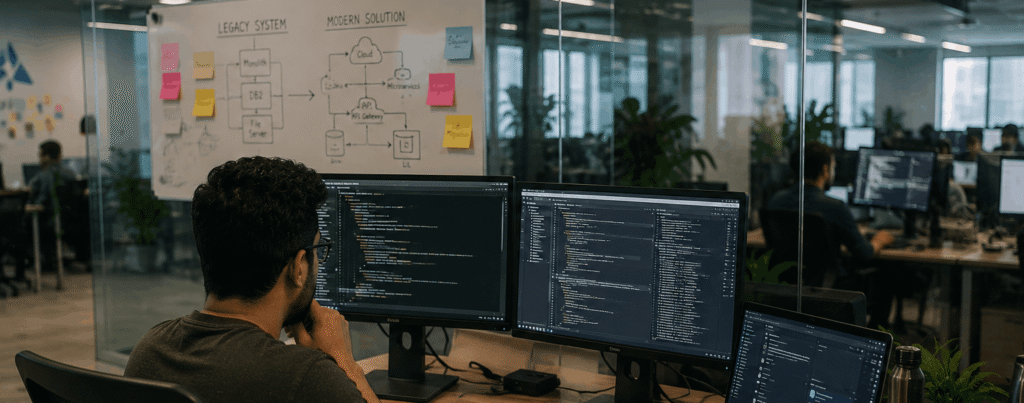
Legacy system modernization refers to the process of transforming outdated business technology including applications, infrastructure, databases, and processes into modern, agile, and scalable systems that meet today’s digital requirements. Rather than a simple system replacement, modernization focuses on aligning IT infrastructure with current and future business goals while preserving critical business logic built up over years or even decades.
From our experience at AI-IoT Geeks, legacy systems often remain deeply embedded in core business operations, especially in industries like finance and healthcare, where reliability and continuity are critical. These systems were typically built using older programming languages and architectures, which may not integrate well with modern platforms and technologies.
Modern organizations adopt different legacy system modernization approaches based on business priorities, system complexity, compliance requirements, and long-term scalability goals. These approaches can range from API modernization and cloud migration to code refactoring, replatforming, and complete architectural transformation.
The scope of modernization can vary significantly, from updating API layers to full-scale cloud migration and microservices transformation. Our engineering teams apply a structured, outcome-driven approach to ensure organizations move faster, reduce maintenance overhead, and deliver better user experiences without disrupting business continuity.
Why Modernize In 2026?
The Critical Need For Legacy System Modernization In 2026.
The urgency around legacy modernization has never been higher. The application modernization services market is growing at a remarkable pace, reflecting a fundamental shift in how organizations view modernization: not as a discretionary IT project, but as a business-critical imperative. This growing demand is driving enterprises to adopt modern legacy system modernization approaches, legacy modernization trends and strategies that improve scalability, security, and long-term operational efficiency.
A substantial majority of CIOs (Chief Information Officer) now identify legacy systems as the top roadblock to business growth. Nearly all IT decision-makers agree that modernization is essential for long-term success. Enterprise IT budgets are increasingly consumed by technical debt rather than innovation and organizations using AI-assisted modernization are completing projects significantly faster than those relying on traditional methods alone.
At AI-IoT Geeks, we actively integrate AI/ML engineering, cloud modernization, and predictive system optimization into modernization workflows to help businesses reduce technical debt and accelerate digital transformation.
Several forces are converging to make legacy systems increasingly untenable in 2026:
1.Talent Scarcity
As technology evolves, the workforce gravitates toward acquiring skills in newer areas. Legacy systems written in COBOL, FORTRAN, or Pascal face a critical shortage of developers who can maintain or modify them. This leads to prolonged system downtimes and increased vulnerability to errors.
2.Security And Compliance Gaps
Legacy systems frequently lack essential security measures and do not align with contemporary compliance standards like GDPR, HIPAA, or SOC 2. Patching vulnerabilities in systems that are no longer actively supported by vendors has become a constant and expensive battle. Our cybersecurity services help close these gaps throughout the modernization journey.
3.The AI Revolution
Generative AI tools can now analyze complex codebases, suggest improvements, and even automate significant portions of the modernization process , reducing development time considerably while minimizing manual errors. Organizations still running legacy infrastructure are increasingly unable to integrate with these capabilities. We actively integrate AI/ML capabilities into modernization workflows to improve accuracy, speed, and scalability.
4.Customer Expectations
Modern users expect real-time, personalized experiences. Our expertise in predictive UX, AI-driven personalization, and scalable architectures enables businesses to meet these expectations effectively.
What Are The Warning Signs That You Need To Act?
Common Warning Signs Your Legacy System Needs Modernization.
Recognizing when a system has become a liability rather than an asset is the critical first step. If your organization is experiencing several of the following symptoms, legacy modernization should move from a backlog item to a strategic priority. Identifying legacy modernisation challenges early allows businesses to implement the right legacy system modernization approaches before operational risks become more severe.
In our experience working with global clients, these warning signs often appear together and compound over time if not addressed early. For a deeper understanding of legacy system types, risks, and modernization signs, read our detailed guide on legacy risks,types and modernization signs.
1.Frequent Downtime & Outages
Crashes damage brand reputation and productivity, with no clear remediation path.
2.Integration Failures
Data silos form because systems can’t communicate with modern APIs or cloud services.
3.Security Vulnerabilities
No active vendor support means unpatched CVEs (Common Vulnerabilities and Exposures) accumulate over time.
4.Soaring Maintenance Costs
A growing share of the IT budget goes to keeping the lights on rather than innovation.
5.Slow Delivery Cycles
New features take months, not days, to deploy due to rigid monolithic architecture.
6.Talent Exodus
Skilled developers refuse to work on outdated stacks, accelerating knowledge loss.
What Are The 8 Core Modernization Approaches ?
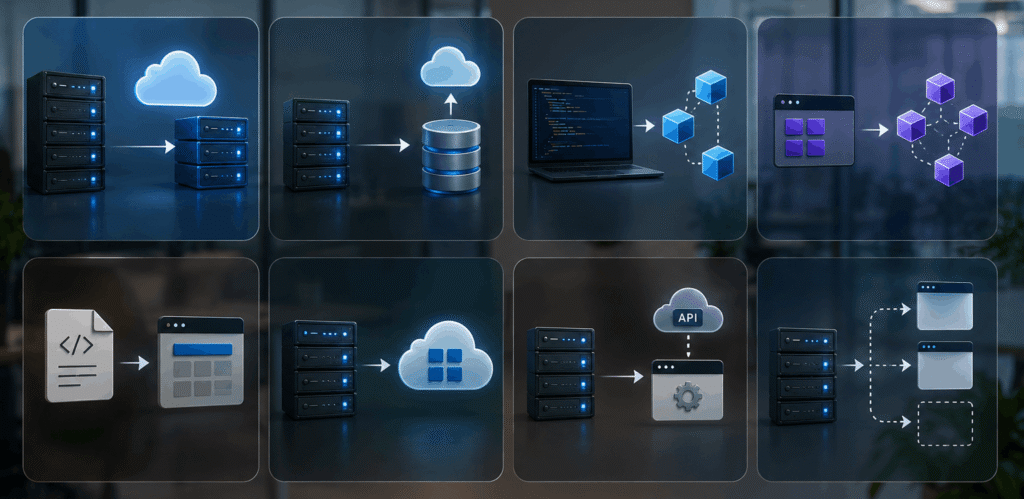
Exploring The 8 Core Legacy System Modernization Approaches.
Let’s go deeper on each of the primary modernization approaches, including when to use them, what they involve, and what trade-offs decision-makers should be aware of.
1. Rehosting (Lift & Shift)
Rehosting involves moving legacy applications to a new host, typically a cloud environment like AWS, Azure, or GCP with minimal or no changes to the application code, architecture, or features. Only the underlying hardware platform is replaced with modern infrastructure. This strategy is often the fastest route to cloud migration and an effective starting point for legacy platform modernization.
While rehosting delivers immediate benefits like reduced infrastructure costs and improved scalability, it doesn’t address underlying technical debt. Organizations often use it as a first step before more extensive modernization efforts.
2. Replatforming
Replatforming introduces targeted changes to optimize applications for modern environments without redesigning the core architecture. This might include upgrading databases, switching middleware, or updating the runtime to support cloud-native features. It strikes a balance between speed and capability improvement, making it a practical legacy modernization approach.
At AI-IoT Geeks, replatforming strategies are designed to optimize application performance using modern databases, middleware, and cloud-native services without disrupting core business functionality.
A key advantage of replatforming is that it preserves existing business logic while unlocking cloud benefits like managed services and auto-scaling. It’s particularly valuable when the core functionality is sound but the surrounding infrastructure is holding the system back.
3. Refactoring (Code Restructuring)
Refactoring restructures existing code to improve efficiency, scalability, and maintainability without changing its external behavior. This approach allows organizations to gradually adopt microservices, APIs, and cloud-native capabilities without a high-risk full-scale rewrite. Some changes are small (renaming variables, simplifying logic), while others are large (decomposing monolithic modules into services).
Refactoring enhances system flexibility and is particularly recommended for organizations transitioning from monolithic architectures toward containers and microservices. Our custom software product development teams use AI-assisted tools to significantly accelerate this process by analyzing code patterns and suggesting optimized alternatives.
4. Rearchitecting
Rearchitecting is the most comprehensive modernization approach short of a full rebuild. It redesigns existing applications using modern architectural patterns supporting legacy architecture modernization for long-term scalability such as microservices, event-driven systems, serverless computing, or domain-driven design. While more complex and time-intensive than refactoring, it delivers the highest long-term value in terms of scalability, resilience, and developer velocity.
Organizations that have already rehosted or replatformed often pursue rearchitecting as the next phase of their modernization journey, once they’ve established a stable cloud foundation and built the necessary team capabilities.
5. Rebuilding From Scratch
Rebuilding involves developing a brand-new version of the application from scratch using modern technologies and frameworks, making it a complete legacy system transformation strategy. The business logic and requirements from the legacy system are preserved and reimplemented, but nothing from the old codebase is carried forward. This approach is warranted when the legacy system is so degraded, undocumented, or architecturally compromised that incremental improvement is not cost-effective.
This is the most expensive and highest-risk strategy, but it can result in a clean, future-proof system that’s fully optimized for modern development practices, cloud environments, and AI integration.
6. Replacing With SaaS/Off-The-Shelf
In many cases, particularly for non-core business functions, it makes more sense to replace legacy systems entirely with a modern off-the-shelf or SaaS solution rather than modernizing it. Modern ERP, CRM, HRM, and finance platforms including options like our Odoo ERP implementation can deliver enterprise-grade functionality at a fraction of the cost of maintaining a custom-built legacy system.
The key challenge with replacement is data migration and user adoption. Organizations must carefully plan for business continuity during the transition and invest in training programs to prevent productivity drops.
7. Encapsulation (Wrapping)
Encapsulation also called wrapping involves building a modern API or service layer around an existing legacy system without touching the underlying code. New applications and integrations communicate with the legacy system through these modern interfaces, effectively hiding its complexity from the rest of the architecture. This allows organizations to incrementally modernize their technology landscape without high-risk disruptions.
This approach is particularly useful when a complete modernization isn’t feasible in the near term, but integrations with modern systems or cloud services are urgently needed. It’s often used as a transitional measure.
8. Incremental / Strangler Fig Pattern
The Strangler Fig pattern, named after a tree that gradually grows around and replaces its host , involves slowly replacing legacy functionality with new modern services over time, while keeping the old system running in parallel. New features are always built in the new system, while existing functionality is migrated piece by piece. Over time, the legacy system is “strangled” until it can be fully stopped.
It is important to go in with clear expectations about what this approach delivers. As Martin Fowler the architect who coined the pattern ,writes: “Using a Strangler Fig approach to Legacy Modernization doesn’t make the exercise easy. Replacing a software system that’s deeply embedded with business processes is never going to be an easy task. What this approach does is make both investment and returns occur gradually and visibly, allowing the organization to evolve its software and business process to better support the current environment.” This is precisely why it remains the most recommended strategy for large, complex systems not because it is simple, but because it makes progress safe, measurable, and continuous.
At AI-IoT Geeks, phased modernization strategies are carefully planned to minimize operational disruption while delivering continuous business value throughout the transformation process.
This is one of the safest and most recommended strategies for large, complex systems where a full system replacement at once would be too risky. It minimizes disruption and provides a steady delivery of business value throughout the transformation.Best for: Large complex systems, risk-averse organizations
Side-By-Side Comparison
Approach
Rehosting
Replatforming
Refactoring
Rearchitecting
Rebuilding
SaaS Replacement
Encapsulation
Strangler Fig
Code Changes
None
Minimal
Significant
Extensive
Complete
None
None (core)
Incremental
Timeline
Weeks
1–3 months
3–9 months
6–18 months
12–36 months
3–12 months
1–4 months
Ongoing
Cost
Low
Low–Medium
Medium
High
Very High
Medium–High
Low–Medium
Medium–High
Business Disruption
Minimal
Low
Low
Medium
High
High (change mgmt)
Very Low
Very Low
Long-term Value
Limited
Moderate
High
Very High
Very High
High (for standard functions)
Moderate (transitional)
Very High

How To Choose The Right Approach?
Choosing The Right Legacy System Modernization Approach.
There is no universally correct modernization approach. The right strategy depends on a combination of factors that every organization must evaluate honestly. Here’s a structured decision framework. Our consultants combine technical assessments, cloud expertise, AI-driven analysis, and business strategy to help organizations select modernization approaches aligned with operational goals and risk tolerance.
A structured legacy system modernization approaches comparison helps organizations evaluate cost, scalability, risk, implementation timelines, and long-term business value before selecting a modernization strategy.
1.Assess Your Current State First
Before selecting an approach, conduct a comprehensive assessment of each system: its business value, technical condition, integration dependencies, security posture, and ongoing maintenance cost. This baseline is essential for making data-driven decisions rather than defaulting to the most familiar strategy.
2.Match Strategy To Objectives
If your primary concern is minimizing costs and achieving a quick transition, rehosting or replatforming are viable starting points. If the goal is to optimize performance, scalability, and long-term flexibility, refactoring, rearchitecting, or the strangler fig pattern will deliver superior results. If a system handles a non-differentiated business function, replacing it with a SaaS alternative often beats any form of modernization.
3.Consider Your Organizational Risk Tolerance
Organizations with low risk tolerance regulated industries like finance, healthcare, or utilities should favor incremental approaches like the strangler fig pattern or phased refactoring over big-bang replacements. The cost of a failed modernization in these environments can far exceed the cost of a longer, more measured approach. Our IT risk protection and cybersecurity services ensure security is maintained throughout every phase of the transition.
4.Evaluate Team Capabilities Honestly
The most technically ambitious modernization approach is worthless if your team lacks the skills to execute it. Assess whether you need to upskill existing staff, hire new talent, or partner with experienced modernization specialists. Partnering with external experts is particularly valuable for organizations attempting architectural transformations for the first time.
Conclusion
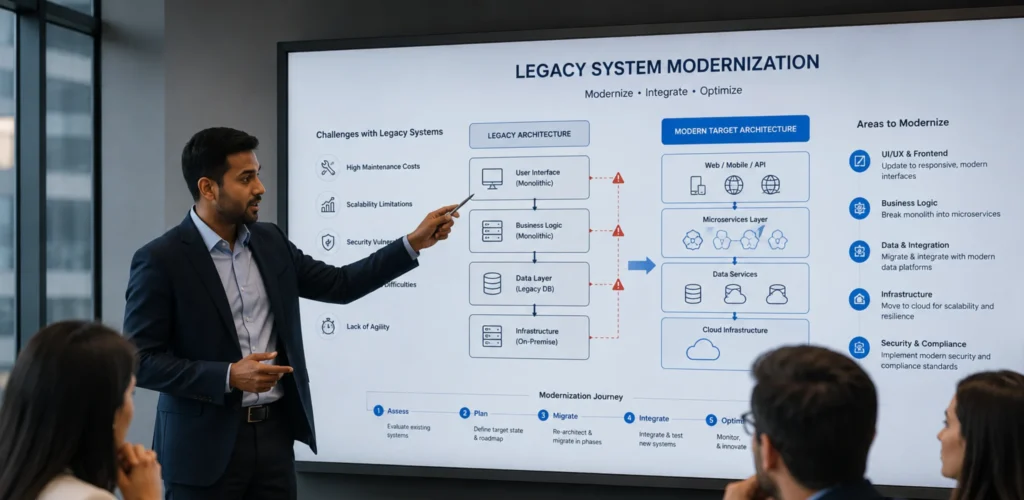
Legacy system modernization is essential for businesses to stay competitive in 2026, as outdated systems increasingly limit scalability, security, and innovation. With multiple legacy modernization solutions and legacy system modernization approaches available, the right choice depends on your goals, system complexity, and risk tolerance.
At AI-IoT Geeks, our experience across enterprise modernization projects shows that a phased, strategic approach consistently reduces risk, controls costs, and ensures smoother transitions. Ultimately, modernization enables faster innovation, lower maintenance, and scalable systems that support long-term business growth.
Transform legacy systems efficiently with AI-IoT Geeks for faster innovation, performance, and long-term business growth.
Book a Free Strategy Call at aiiotgeeks.com
Have any questions in mind
Frequently Asked Questions?
1.Why are legacy systems still used by enterprises?
Many organizations continue using legacy systems because they support critical operations, store valuable data, and replacing them can be complex and costly.
2.What are the risks of not modernizing legacy systems?
Outdated systems can lead to security vulnerabilities, high maintenance costs, poor scalability, and difficulty integrating with modern technologies.
3.What are the main legacy system modernization approaches?
The key approaches include rehosting, replatforming, refactoring, rearchitecting, rebuilding, SaaS replacement, encapsulation, and the Strangler Fig pattern. A proper legacy system modernization approaches comparison helps enterprises determine which strategy best aligns with their goals, budget, and technical requirements.
4.Which legacy system modernization approach is best for my business?
The best approach depends on your system’s complexity, business goals, budget, and risk tolerance. For quick results, rehosting works well, while long-term transformation may require rearchitecting or refactoring
5.How can enterprises choose the right modernization strategy?
Organizations should assess system value, technical condition, and business goals, then align them with the most suitable modernization approach using a phased strategy.
6.Why choose AI-IoT Geeks for legacy system modernization?
AI-IoT Geeks brings enterprise-level expertise, proven modernization strategies, and a phased execution approach to help businesses reduce risk, control costs, and achieve scalable, future-ready systems.