


Introduction To Legacy System
A practical guide to Legacy Systems.
If your organization is still running the same software it deployed a decade ago, you are not alone, but you may already be falling behind. Many businesses continue to depend on legacy system simply because they have been reliable for years and are deeply embedded into daily operations. However, what once worked efficiently can gradually become a barrier to growth, innovation, and competitiveness.
The conversation is no longer about whether legacy systems pose a challenge. It’s about how long your business can afford to delay addressing them before the risks outweigh the comfort of familiarity.
At AI-IoT Geeks, our experience working with global enterprises and startups gives us firsthand insight into how legacy systems impact scalability, security, and long-term innovation,insights that shape the practical guidance shared in this blog.
This blog explains what is a legacy system, why organizations still rely on it, the risks involved, available legacy system support strategies, and how to identify the right time to modernize.
What Is A Legacy System?
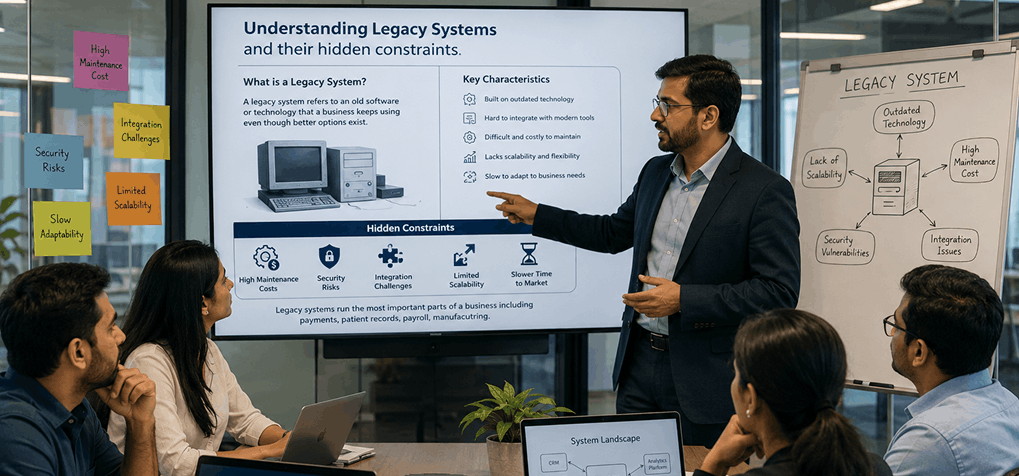
Understanding Legacy Systems and their hidden constraints.
A legacy system refers to an old software or technology that a business keeps using even though better options exist. These systems run on outdated hardware, use programming languages that few developers know today, and lack features that modern businesses need.
So, what is a key characteristic of a legacy system?
One defining trait is its inability to adapt easily, whether that’s integrating with modern tools, scaling operations, or supporting new features. The tricky part is that legacy systems usually run the most important parts of a business including payments, patient records, payroll, manufacturing. That’s exactly why they’re so hard to replace, and so risky to leave as-is.
At AI-IoT Geeks, we’ve seen this consistently across real client projects: these limitations become clear when businesses attempt to scale, integrate new systems, or accelerate operations beyond what their existing technology can support.
What Is Legacy Technology?
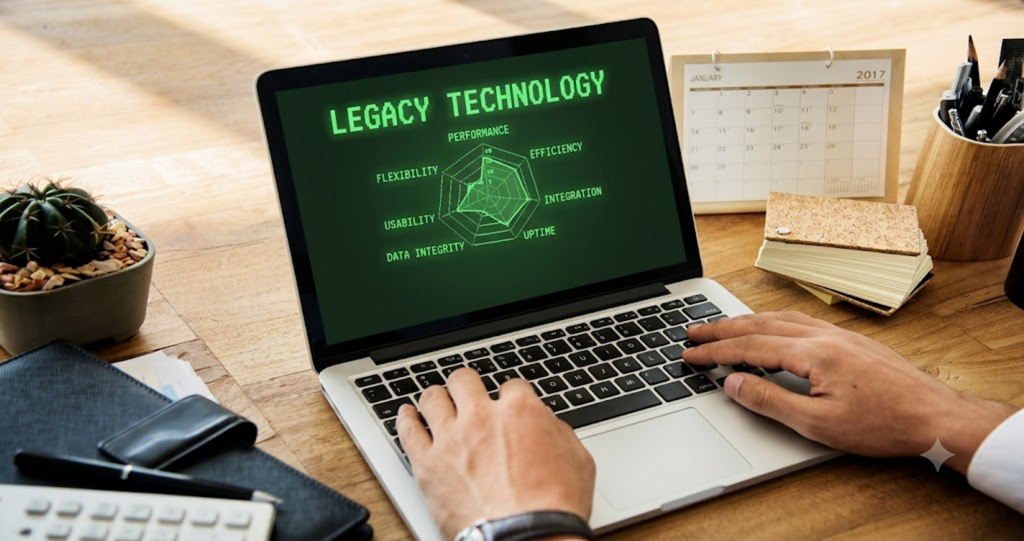
Understanding Legacy Technology and Its Core Components.
Legacy technology refers to the broader umbrella term that covers legacy hardware, legacy software systems, legacy data systems, and even legacy embedded and control systems used in machinery. In short, if a piece of technology is outdated, unsupported, or difficult to integrate with modern tools , yet still critical to operations it falls under the legacy technology definition.
It’s worth drawing a distinction here: “legacy system” usually refers to a specific application or platform, while “legacy technology” is broader and includes the underlying components that support it old operating systems, deprecated programming languages, outdated communication protocols, aging network hardware, and even physical devices like legacy sensors, PLCs (programmable logic controllers), and point-of-sale terminals. A single legacy system can be built on several layers of legacy technology stacked on top of each other, which is part of why modernization is rarely a one-and-done project.
A few common categories worth knowing:
1.Legacy Hardware
Servers, workstations, or industrial equipment running on discontinued or unsupported components, often with no replacement parts available.
2.Legacy Operating Systems
Unsupported platforms (older Windows Server versions, outdated Unix variants) that no longer receive security patches.
3.Legacy Programming Languages And Frameworks
COBOL, Fortran, older Visual Basic, or unsupported framework versions that few current developers are trained in.
4.Legacy Protocols
Outdated communication standards (older serial protocols, deprecated networking standards) still used to connect machinery, medical devices, or point-of-sale systems.
5.Legacy IoT And Embedded Devices
Sensors, controllers, and firmware-based hardware deployed years ago that can’t be remotely updated or integrated with modern cloud platforms.
The common thread across all of these is risk that compounds quietly. Legacy technology rarely fails all at once , it becomes gradually more expensive to maintain, harder to secure, and more isolated from the rest of the technology stack, until a single vendor decision (like end-of-support) forces the issue.
What Are The Types Of Legacy Systems?
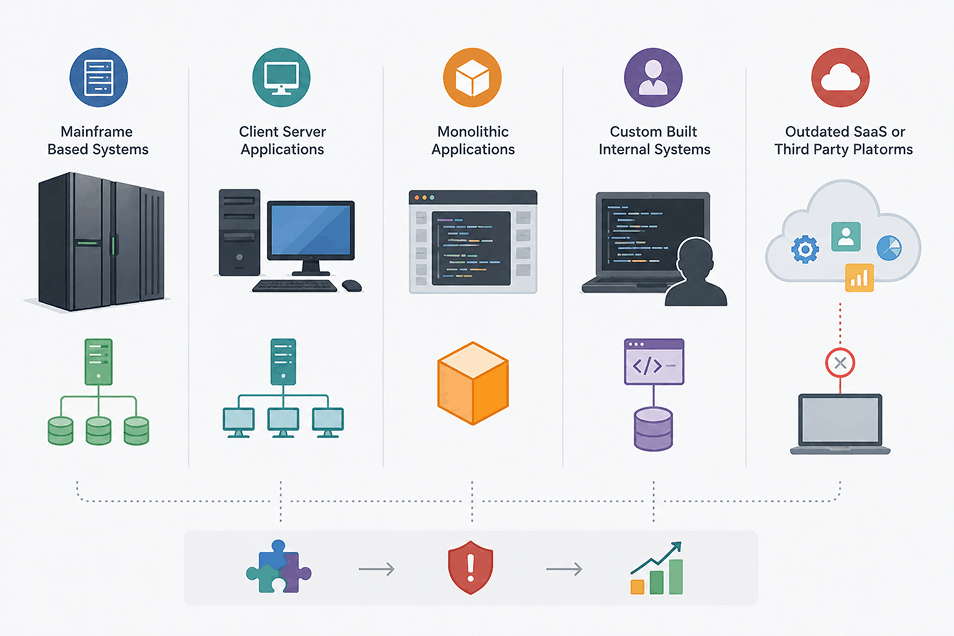
Common types of Legacy Systems in modern businesses.
Not all legacy systems are the same. Identifying the type is essential for choosing the right modernization and legacy system support approach.
At AI-IoT Geeks, identifying the exact type of legacy system is a key part of our assessment process, as each type presents different risks, constraints, and modernization paths.
1.Mainframe Based Systems
These are large, centralized computing systems that were dominant from the 1960s through the 1990s. Many banks, insurance companies, and government agencies still run critical workloads on systems programmed in COBOL or Assembly Language, programming languages with a rapidly shrinking talent pool.
2.Client Server Applications
Built in the 1990s and early 2000s, these systems rely on a local server and desktop client model. They were never designed for cloud deployment, mobile access, or modern API based integrations. Many enterprise resource planning ERP and customer relationship management CRM systems from this era fall into this category.
3.Monolithic Applications
All the functionality of a monolithic application lives in a single, tightly coupled codebase. Changing one part risks breaking another. These systems are extremely difficult to update incrementally and cannot scale efficiently in response to fluctuating demand.
4.Custom Built Internal Systems
Many organizations built bespoke software in house 10 to 30 years ago to solve specific operational problems. These systems often have no documentation, no formal support, and are maintained by a single developer or a shrinking team with irreplaceable institutional knowledge.
5.Outdated SaaS or Third Party Platforms
Sometimes the “legacy” problem is not a custom system at all. It is a vendor-supplied platform that has not kept pace with modern requirements, or whose vendor has stopped providing security updates and feature development.
At AI-IoT Geeks, we often see organizations managing a mix of these legacy system types at once, which is why modernization strategies need to be phased, carefully planned, and aligned with real business priorities rather than treated as a single step replacement.
Legacy System vs. Modern System
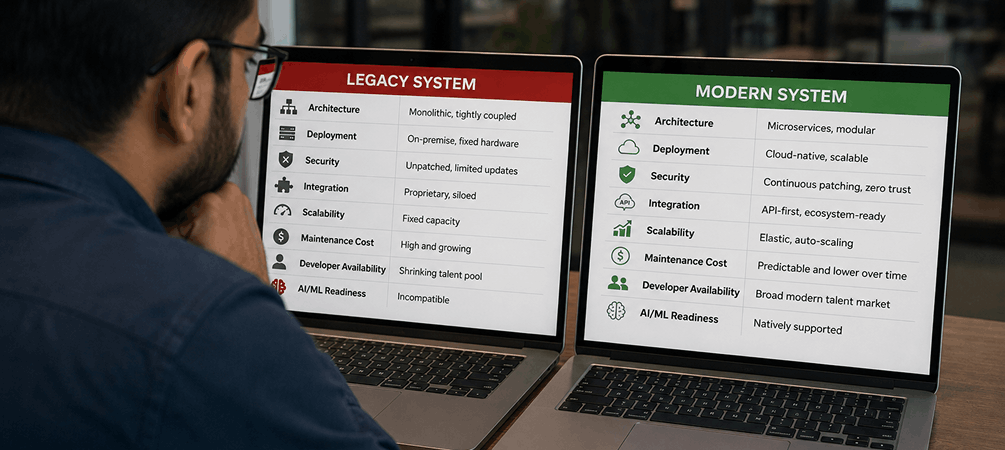
Comparing Legacy Systems and Modern technology architectures.
Dimension
Architecture
Deployment
Security
Integration
Scalability
Maintenance Cost
Developer Availability
AI/ML Readiness
Legacy System
Monolithic, tightly coupled
On-premise, fixed hardware
Unpatched, limited updates
Proprietary, siloed
Fixed capacity
High and growing
Shrinking talent pool
Incompatible
Modern System
Microservices, modular
Cloud-native, scalable
Continuous patching, zero trust
API-first, ecosystem-ready
Elastic, auto-scaling
Predictable and lower over time
Broad modern talent market
Natively supported
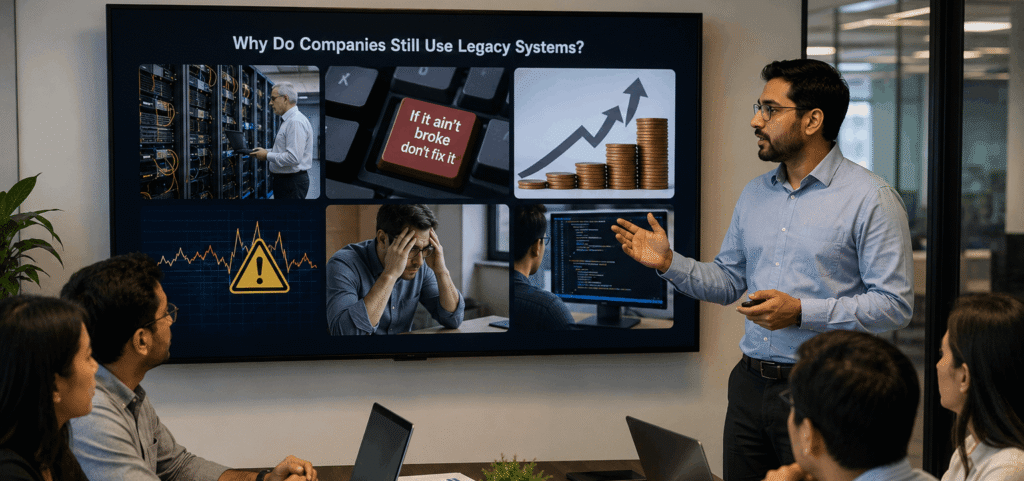
Why Do Companies Still Use Legacy Systems?
Key reasons companies still rely on legacy IT systems.
Despite known legacy system risks, many organizations continue using them due to:
1.High Replacement Cost And Complexity
Legacy systems are frequently deeply embedded in core business operations. Replacing them requires migrating data, retraining staff, rebuilding integrations, and often rewriting custom business logic accumulated over decades. The cost and disruption can seem prohibitive, especially for large enterprises.
2.The “If It Ain’t Broke” Mentality
Many legacy systems are remarkably stable. They have been running, sometimes for 20 to 50 years, without major failure. This creates a false sense of security. Teams rationalize delay with logic like: “It still works, so why change it now?”
3.Fear Of Operational Disruption
Migrating from an old system to a new one can interrupt business processes, affect customer experiences, and introduce new bugs during the transition period. This fear of downtime is a valid concern, but one that compounds risk the longer modernization is deferred.
At AI-IoT Geeks, we approach this phase with carefully planned, phased modernization strategies that maintain business continuity while enabling a smooth and controlled transition to modern systems.
4.Lack Of Internal Skills
As legacy systems get older, fewer people know how to work on them. Many companies continue using them because the original team still maintains them, and replacing that knowledge feels very difficult.
5.Sunk Cost Bias
Companies that have spent a lot of money on a system often find it hard to replace it. They keep using it because of the investment they’ve already made, even if the system is no longer useful.

What Are The Real Risks Of Running A Legacy System?
Key risks of running Legacy Systems in modern business.
Legacy systems are not simply inconvenient. They represent a growing business risk that becomes more serious over time.
1. Security Vulnerabilities
Older software frequently no longer receives security updates. As cyber threats evolve, these unpatched systems become easy targets, leading to data breaches, operational disruptions, and financial losses. The security risk is not theoretical , CISA warns directly that “legacy infrastructure further complicates adoption, as many systems rely on outdated protocols, lack built-in security, and cannot be easily patched or tested without risking downtime.”
At AI-IoT Geeks, we help organizations strengthen their security posture by identifying vulnerabilities early and modernizing systems in a controlled and secure manner.
2.Rising Maintenance Costs
Legacy systems do not get cheaper with age, they become more expensive to maintain. Skilled professionals become harder to find, and ongoing fixes require more time and effort. What seems like a cost saving decision often turns into a long term financial burden.
3.Integration Challenges
Modern businesses rely on multiple connected tools such as CRM systems, ecommerce platforms, analytics tools, and cloud services. Legacy systems were not designed for this level of connectivity. Integrating them often requires complex workarounds or may not be possible at all, slowing down business growth.
4.Limited Scalability
Legacy systems are built for fixed workloads. When demand increases or data grows, they struggle to keep up. This can lead to performance issues, delays, or system failures that impact overall operations.
5.Compliance And Regulatory Risk
Modern data regulations require strict standards for storing and handling information. Legacy systems were not built with these requirements in mind. This makes compliance difficult and increases the risk of penalties or legal issues.
6.Talent And Innovation Challenges
Fewer developers today are trained to work with outdated legacy software systems. This makes hiring and retaining talent difficult. As a result, teams spend more time maintaining old systems instead of building new solutions, slowing down innovation. At AI-IoT Geeks, we help organizations overcome this by transitioning to modern technologies that are easier to manage, scale, and build upon.

Outdated Systems Slowing You Down? Modernize legacy technology with minimal disruption.
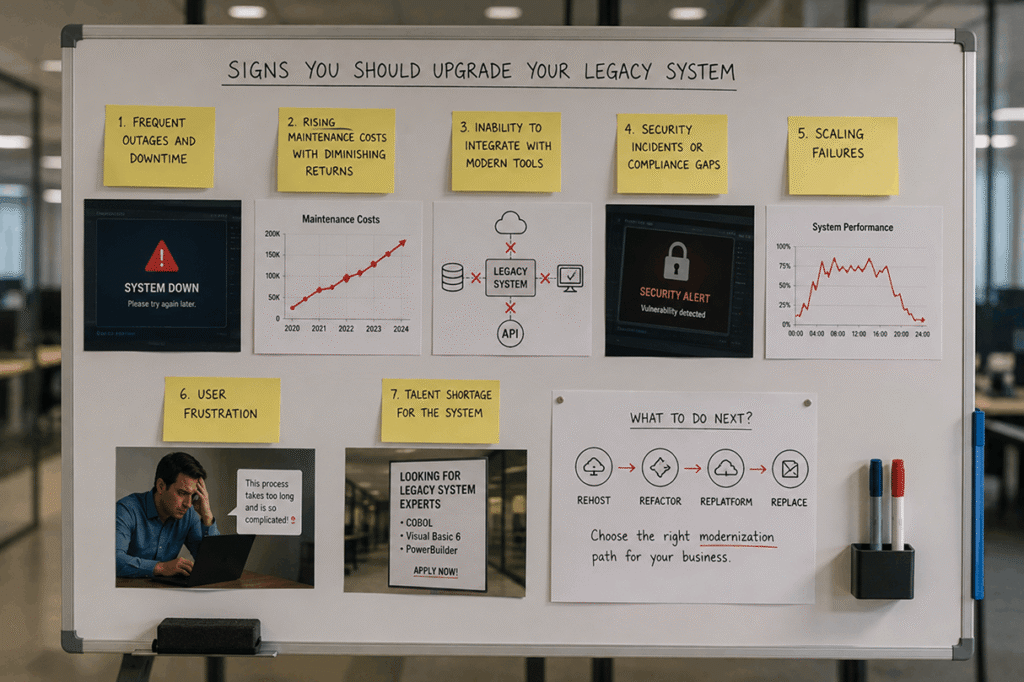
What Are The Key Signs You Should Upgrade Your Legacy System?
Key signs it’s time to upgrade your Legacy System.
How do you know when a legacy system has reached the point where action is unavoidable? Watch for these signals:
1.Frequent Outages And Downtime
Your team spends more time patching fires than building features. The system crashes regularly or requires constant manual intervention to stay operational.
2.Rising Maintenance Costs With Diminishing Returns
You are paying more each year to keep the system running, and what you get back is the same functionality you had five years ago , nothing new.
3.Inability To Integrate With Modern Tools
New platforms, APIs, and cloud services cannot connect with your existing system without expensive, fragile workarounds.
4.Security Incidents Or Compliance Gaps
The system cannot be patched against known vulnerabilities, or it fails to meet current regulatory requirements.
5.Scaling Failures
Traffic spikes or growing data volumes cause performance bottlenecks that cannot be resolved with the existing architecture.
6.User Frustration
Employees and customers struggle with slow, unintuitive interfaces, exactly the kind of usability gap our enterprise application UX work addresses. Requests for improvements cannot be implemented because the underlying technology will not support them. A quick UX audit can usually tell you within days whether the problem is user training or the interface itself.
7.Talent Shortage For The System
The number of people who can work on the system is shrinking, and finding new hires with the required skills is becoming impossible or prohibitively expensive.
Once these signs begin to appear, delaying action only increases risk and cost. The next step is not immediate replacement, but selecting the right path forward. Exploring different legacy system modernization strategies can help you determine whether to rehost, refactor, replatform, or gradually replace your system based on its complexity and business impact.
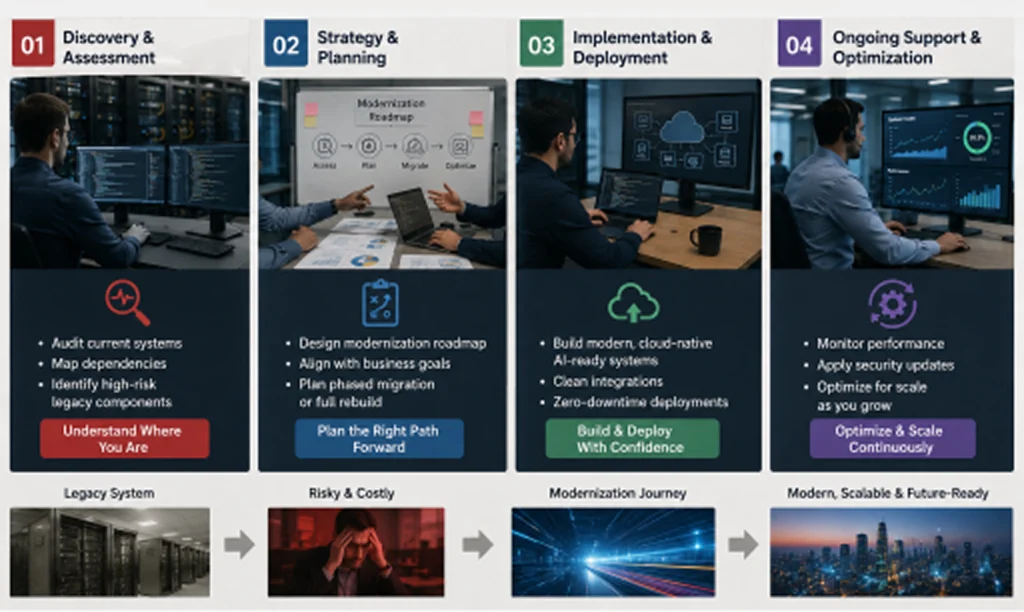
How AI-IoT Geeks Enables Organizations To Move Beyond Legacy Systems?
AI-IoT Geeks approach to Legacy System transformation.
At AI-IoT Geeks, we have helped startups and global enterprises across healthcare, financial services, retail, government , manufacturing and SaaS industries build scalable, modern technology foundations that replace or integrate legacy systems without disrupting ongoing operations. Our legacy system modernization services follow the same structured process outlined below.
Our approach is built on real outcomes ,not just code delivery:
1.Discovery & Assessment
We audit your current systems, map dependencies, and identify the highest-risk legacy components before a single line of code is written.
2.Strategy & Planning
We design a modernization roadmap aligned with your business goals, risk tolerance, and budget , whether that means a phased migration or a full rebuild.
3.Implementation & Deployment
Our engineering teams build modern, cloud-native, AI-ready systems using the latest frameworks and infrastructure patterns, with a focus on clean integrations and zero-downtime deployments.
4.Ongoing Support & Optimization
After go-live, we continue monitoring performance, applying security updates, and optimizing for scale as your business grows.
Conclusion
Legacy systems may have supported your business for years, but they are no longer built for the speed, scale, and complexity of modern operations. What once provided stability can now limit growth, slow innovation, and increase risk across security, compliance, and performance.
The key is not to rush into replacement, but to approach modernization strategically. By understanding your current systems, identifying the highest impact risks, and choosing the right path forward, whether gradual upgrades or a complete transformation, organizations can evolve without disrupting operations.
At AI-IoT Geeks, we have seen that successful modernization is not just about technology, it is about aligning systems with business goals, ensuring scalability, and enabling long term innovation. With the right approach, legacy systems can be transformed from a limitation into a foundation for future growth.
Related Reading
Your legacy system doesn't have to slow you down. AI-IoT Geeks makes modernization simple and affordable.
Book a Free Strategy Call at aiiotgeeks.com
Have any questions in mind
Frequently Asked Questions?
1.Why do companies still use legacy systems?
Companies continue using them because they are reliable, deeply integrated into operations, and replacing them can be costly and complex.
2.Are legacy systems always bad for businesses?
Not always. They can still perform critical tasks reliably, but over time they may limit growth, integration, and innovation.
3.What are the biggest risks of using legacy systems?
The main legacy system risks include security vulnerabilities, rising maintenance costs, poor integration with modern tools, limited scalability, and compliance challenges.
4.How do I know if my legacy system needs modernization?
Common signs include frequent downtime, rising maintenance costs, inability to integrate with new tools, performance issues, and user dissatisfaction.
5.Can legacy systems be upgraded instead of replaced?
Yes. Many organizations modernize systems through phased upgrades, integration layers, or partial refactoring instead of complete replacement.
6.What are the common types of legacy systems?
They include mainframe systems, client server applications, monolithic applications, custom built internal systems, and outdated SaaS platforms.
7.How can AI-IoT Geeks help modernize legacy systems?
AI-IoT Geeks helps businesses assess their current systems, create a clear modernization roadmap, and implement scalable solutions with minimal disruption.